
AI-driven traffic management is already having a big impact
Alexander Spatari via Getty Images



COMMENTARY | Amid growing congestion, the technology holds promise for cities and their transportation planners, although the benefits and risks must be carefully weighed.
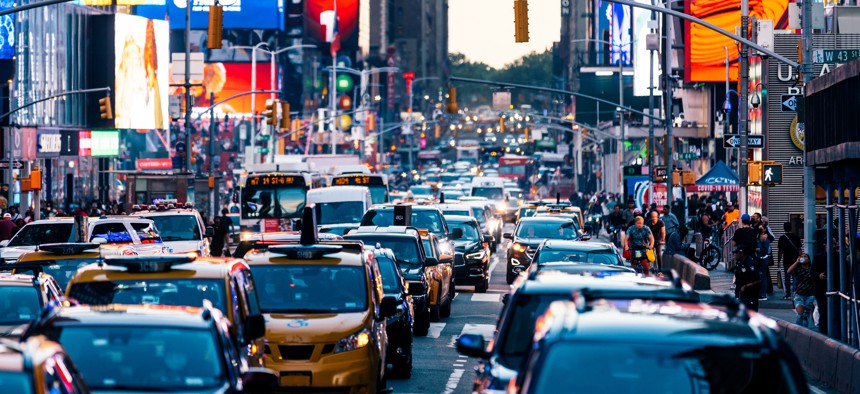
Washington, D.C. recently surpassed Los Angeles for the dubious honor of having the worst traffic of any major metropolitan area in the United States.
According to traffic data compiled by ConsumerAffairs, drivers around the nation’s capital spend more time stuck in traffic than any other U.S. city, with average daily commute times exceeding 33 minutes. Washington's average length of weekday congestion — morning and evening rush hours — is six hours and 35 minutes, which adds up to 71 days annually sitting in traffic.
No doubt about it: traffic congestion continues to be one of the biggest transportation problems facing commuters. According to a 2024 report by StreetLight Data, traffic congestion in the vast majority of the nation’s largest metropolitan areas is actually worse today than it was before the COVID-19 pandemic despite predictions that the increase in work-from-home opportunities it caused would change daily routines and greatly decrease congestion.
On average, traffic congestion costs U.S. drivers 97 hours and $1,350 annually. Beyond wasted time and fuel, traffic congestion is responsible for lost productivity, reduced economic growth, increased air pollution, more instances of road rage and stress and an overall reduced quality of life.
Fortunately, some forward-thinking transportation planners and engineers, many of whom have been grappling with traffic problems for decades, have recognized that artificial intelligence may hold the key to reducing traffic congestion and making highways run more smoothly and safely. By harnessing AI to optimize traffic flow and reduce congestion, cities could actually be in a more advantageous position than ever before to create and maintain efficient and sustainable urban environments.
While still in its infancy, AI is already having an impact on traffic management in numerous ways. To predict traffic patterns and congestion hotspots and optimize traffic flow, for example, AI algorithms are being used in some cities to compare historical trends to current conditions, analyze vast amounts of real-time traffic data, adjust traffic signal timings, and reroute traffic to minimize congestion. As even more data is collected, AI systems will be able to reduce gridlock and improve traffic flow by providing new guidelines for roadway design and traffic signal timing over ever-widening geographies.
Similar technology is being employed to optimize the efficiency of public transportation systems. By analyzing data and demand in real-time, AI is able to predict peak travel times and adjust train, subway, and bus routes as needed, reducing overcrowding and, in the case of buses, traffic congestion.
Predictive traffic modeling, however, is only the tip of the iceberg. AI vision algorithms are beginning to be used to identify, collect, process and report data on pothole damage and other road defects. AI experts predict this technology, known as automated pavement distress detection, will eventually be able to undertake targeted repair and preventative maintenance without human intervention.
Early detection and maintenance is also at the heart of predictive maintenance technology. Already being used by New York’s Metropolitan Transportation Authority, this AI-based system analyzes data from bus sensors and identifies potential issues, enabling repairs to be made before problem areas become worse. Doing so is helping to lower costs on labor and parts, while providing better service by keeping more buses up and running.
Traffic signal optimization represents yet another AI application already being deployed successfully in cities like Los Angeles and Pittsburgh. Unlike the traditional way of operating traffic signals on fixed schedules, AI-powered traffic lights are able to adapt to traffic volume in real-time, reducing signal wait times and improving traffic flow.
AI signal technology is also being used to synchronize traffic signals to pedestrian walk signals, giving pedestrians a head start to minimize their chances of being hit by oncoming traffic. AI can also help planners to reduce traffic signal retiming from 3-5 years to as low as once a month.
Finally, AI-driven incident management systems are gradually replacing human monitoring of traffic cameras and sensors. Unlike human video surveillance, which is dependent on how well humans monitoring multiple video screens do their job, AI-driven systems can scan and analyze data from multiple cameras simultaneously. This speeds up incident response times while minimizing traffic congestion by providing real-time traffic alerts and suggesting alternate routes.
While more cities are turning to AI to handle traffic issues that inevitably lead to congestion and decreased safety, AI applications are not a cure-all and bring their own set of issues, the biggest of which is the high initial cost to purchase the AI software. Cash-strapped local governments also are likely to encounter increased expenses to integrate AI with their existing transportation systems and then train staff in how to use AI effectively and troubleshoot problem areas.
Beyond routine software problems, AI-driven systems are a magnet for cyberattacks which could compromise safety and security. While these can largely be offset by enhanced security measures, such measures and regular updates to counter new threats also translate into another significant cost jurisdictions must underwrite when opting to adopt AI software. A high level of software security is also required simply because AI systems rely on such large amounts of data, much of which may be sensitive and all of which must be protected in order to comply with data privacy regulations.
Clearly, the adoption of AI solutions by local governments is already having an impact on traffic management and the entire transportation industry. By harnessing AI-driven transportation solutions, municipalities can take a huge step toward optimizing traffic flow, improving roadway safety, and ultimately creating more livable urban environments. Like all software, though, AI has its limitations which local governments must factor into their considerations before making such a significant investment.
Wes Guckert, PTP, is chairman & CEO of The Traffic Group, a Service-Disabled Veteran-Owned Small Business (SDVOSB), Maryland-based traffic engineering and transportation planning firm. For more information: www.trafficgroup.com or follow them on LinkedIn.