
FCC chair floats preempting state AI laws
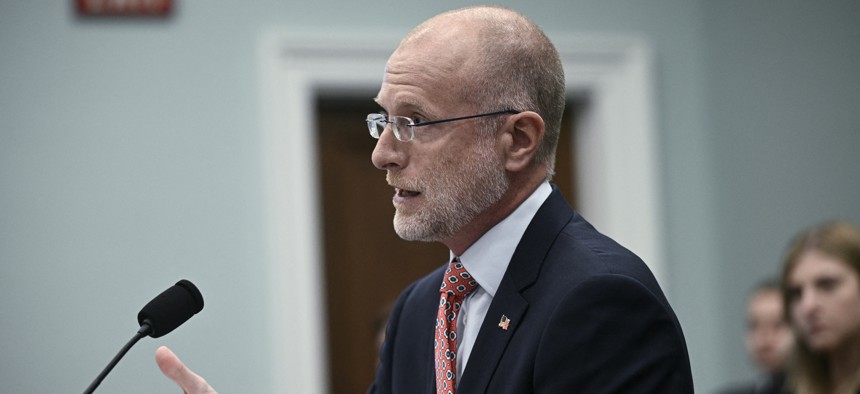
Federal Communications Commission Chair Brendan Carr testifies before Congress earlier this year. BRENDAN SMIALOWSKI via Getty Images





 By
Chris Teale
By
Chris Teale
Brendan Carr said the agency will explore whether it can block “heavy handed” regulations of the technology. Experts aren’t sure it has the authority to do so.
Federal Communications Commission Chair Brendan Carr said the agency is exploring whether it can preempt “heavy handed” state laws and regulations on artificial intelligence, although experts said they doubt it has the authority to do so.
Speaking on stage at the SCTE TechExpo in Washington, D.C., Carr said the FCC may have the authority to block laws under various sections of the Communications Act, which first established the agency. That law, Carr said, “lets us preempt various state or local regulations that effectively prohibit the provision of telecom services.”
“There may be a portion of AI services that may be too heavily regulated at the state and local level that the FCC may be able to play a role in helping to streamline, and so we're taking a look there,” he continued.
President Donald Trump’s AI Action Plan also floated the idea that the FCC could preempt state laws on the technology, and called on the Office of Management and Budget to work with federal agencies that provide funding programs to “consider a state’s AI regulatory climate,” and limit any funding awards if a state’s AI regulations “may hinder the effectiveness of that funding or award.”
Carr said the FCC could carry out this preemptive role under Section 253 of the Communications Act. That part of the legislation mandates that state law cannot “prohibit or have the effect of prohibiting the ability of any entity to provide any interstate or intrastate telecommunications service.” He also argued that Section 332 of that same law, which relates to mobile services, could also give the FCC the ability to preempt state AI laws.
The proposal comes after some federal lawmakers tried unsuccessfully to prevent states regulating AI via a 10-year enforcement moratorium that was eventually struck from Republicans’ budget reconciliation bill. However, experts warned the moratorium could return in some form, while legislators have suggested that AI regulation needs federal leadership.
Meanwhile, numerous states have moved ahead with regulations on various aspects of AI, although few have passed comprehensive legislation. Colorado did so, but is likely to amend their law further, while California Gov. Gavin Newsom yesterday signed a new version of expansive legislation he vetoed last year.
But despite Carr’s pronouncements, experts inside and outside of Congress said the FCC’s preemption authority on AI is murky at best. A May report from the Congressional Research Service said the FCC’s authority is “not boundless” on communications services and can only be exercised “if the FCC has regulatory jurisdiction over that service.” It is a similar story when it comes to preempting state broadband laws, the CRS found, something that has been a flashpoint during the debates over net neutrality.
Outside groups have been even more critical of the FCC’s proposed preemption of state AI laws. In a blog post for Public Knowledge, a nonprofit that promotes an open internet, Senior Vice President Harold Feld said that based on past precedent, it “isn’t even a close call” that the FCC cannot preempt state AI regulations.
“AI does not offer telecommunications services, nor does the broadband network on which it rides,” Feld wrote. “Broadband is an information service, which is why Chairman Carr’s effort to preempt states to promote broadband needs to find a telecommunications service in there somewhere. And AI is one step further removed since it doesn’t touch a telecommunications service anywhere.”
Some of Carr’s colleagues kept their cards close to their chest on his proposal. Commissioner Olivia Trusty said on stage at the SCTE TechExpo she is “also open to looking at other ways to see whether state AI regulations are interfering with our ability to carry out our obligations and authorities under the Communications Act.” Feld said he remains “highly skeptical” that any preemption will be allowed.
“Try as I might, I simply do not see how the FCC can assert jurisdiction over AI that would give it the authority to preempt state regulation of AI,” he wrote. “Heck, at this point, I don’t see how any application could be an information service, since applications delivered over the internet are no longer delivered by ‘telecommunications’ but by information services.”