
New federal bill would mandate agencies study data centers’ rural impact
Westend61 via Getty Images




 By
Chris Teale
By
Chris Teale
The legislation would require several federal agencies to study their effects on energy supply, reliability and costs to consumers amid what is expected to be accelerating demand.
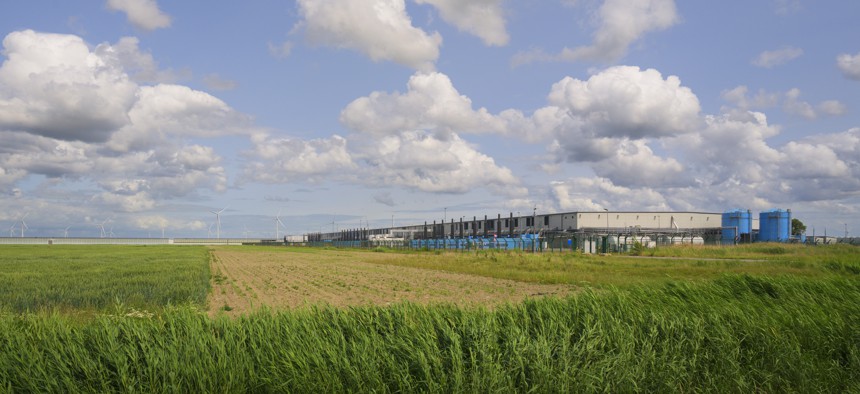
A new bill in Congress would require the federal government to study the impact of artificial intelligence and data centers on rural America’s energy supply and cost to consumers.
Reps. Blake Moore, a Republican from Utah, and Jim Costa, a California Democrat, introduced the Unleashing Low-Cost Rural AI Act last week. The legislation would mandate that the Departments of Agriculture, Interior and Energy conduct a joint study on how AI data center expansion impacts rural areas in energy supply, reliability and consumer costs.
The joint study also would explore ways to upgrade existing energy infrastructure so data centers could be built alongside existing power generation facilities. The bill would review options for nuclear and geothermal energy, hydroelectric dams, solar, wind, battery storage, and carbon capture.
"AI Data Centers are expanding rapidly and using more energy and water than entire cities. That energy demand is driving up utility costs for consumers,” Costa said in a statement. “My legislation ensures we take a hard look at how this growth impacts rural communities that are powering the AI industry, and make sure families aren’t left paying the price."
Data centers are set to become an enormous drain on energy supplies in the coming years, especially as AI use grows worldwide. The Boston Consulting Group estimated in a study earlier this year that global demand for data center power will grow at about 16% on a compound annual basis from 2023 until 2028, which is 33% faster than between 2020 and 2023. BCG estimated that data centers will require 130 gigawatts in power by that time.
And the majority of data center growth is estimated to happen in the United States, although BCG noted that access to power could be a “critical bottleneck” as technology companies invest heavily in the data center infrastructure needed to support AI computing.
Meanwhile, it looks likely that ratepayers will bear increased costs to pay for that extra demand. PJM, the world’s largest energy market that covers 13 U.S. states from Illinois to Washington, D.C., estimates that data centers are responsible for an additional $9.3 billion in costs for ratepayers. That strain could be very hard on rural customers, who already typically have lower incomes than those in urban areas.
States across the country have looked to stake their claim to be a hub for data center development, even as traditional powerhouses like Virginia look set to remain key players in the sector. And that interest in data center development comes from several rural states, including North Dakota, Montana, Utah and New Mexico.
Data center providers have looked to manage the concerns of those who say the facilities will be an enormous strain on power, water and other resources. A February report from the Data Center Coalition, the industry’s membership association, said the industry has advanced “green energy integration” as part of the “evolving role of data centers as both technological hubs and drivers of economic transformation.”
The coalition also pointed to findings that data centers now account for half the nation’s corporate spending on wind and solar, and that its members include four of the top five purchasers of clean energy in the United States, according to a 2021 report by the Clean Energy Buyers Association. Dan Diorio, senior director of state policy for the Data Center Coalition, said in a previous interview that its members are “fully committed” to paying for the energy they use and finding ways to lessen strain on power grids and water systems.
But it’s clear that worries persist even amid those assurances, hence this legislation. Moore said while states may be excited to take advantage of the new infrastructure and reap the economic benefits, they must be sure that the power grid can cope with the extra demand, and ratepayers are not the ones footing the bill.
“As a leader in both tech and energy innovation, Utah is a prime location for data centers and AI infrastructure,” Moore said in a statement. “Cementing our role as an innovation hub will require identifying rural areas ready for data expansion, streamlining permitting for new energy projects, and promoting the co-location of data centers with energy facilities. These efforts will power our growing digital demands without passing costs on to families.”