
The future workforce can’t wait: Why states must redefine student success now
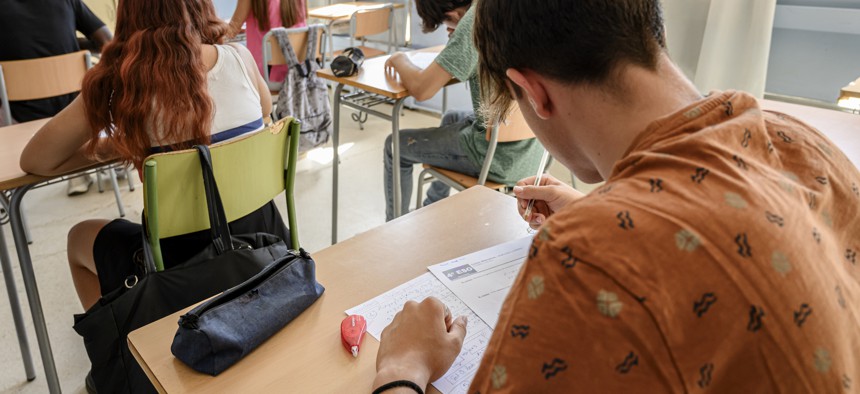
Rafa Fernandez Torres via Getty Images



COMMENTARY | Recent test results showed that our definition of success is not in sync with today’s economy. Schools must act to measure achievement in broader, different ways.
With another school year underway, educators, families and policymakers are rightly focused on student success.
But the recent National Assessment of Educational Progress results — which showed the lowest 12th-grade scores in math and reading in two decades — sent a clear signal: the traditional definition of “success” is out of sync with the demands of today’s economy. The acceleration of artificial intelligence in classrooms and workplaces makes that disconnect even more urgent.
AI and automation are transforming every industry, reducing demand for routine tasks and raising the bar for human skills. Employers across sectors — from software firms to construction sites — report they can’t find talent with the right mix of skills, commitment and adaptability to meet evolving workforce needs.
Put simply, our available workforce is not prepared because schools have reduced rigor and rewarded test-taking over higher order thinking. Employers are increasingly seeking candidates who can think critically, tackle complex challenges and adapt to change across knowledge jobs and trade paths alike.
As AI infiltrates every aspect of our lives and our economy, the value of uniquely human capabilities like creativity, collaboration, and adaptability will grow. Routine tasks can be automated, but humans are needed to design, implement, assess and monitor its outputs. Failing to close this gap will cost America its edge in the increasingly technology-enabled economy.
It was surprising to me that the National Governors Association’s Let’s Get Ready Roadmap, driven by Colorado Gov. Jared Polis, did not garner more attention when it was released in July, as the report put the paradox bluntly: "Graduation rates and college entrance exam scores are not sufficient for students to ‘get ready’ for success and power our economy.”
While math and reading remain foundational, current assessments almost completely overlook durable skills like communication, creativity, and resilience. These aren’t “soft skills.” They are the bedrock of employability in an age of rapid technological change.
Right now, schools teach to the test. Students learn what’s tested. Employers hire graduates who have the credentials, yet those new workers stumble when faced with the complex, ambiguous problems that define modern work. That measurement mismatch leaves students underprepared, teachers undervalued, and employers under-resourced.
Some states and school districts are already acting. Kentucky, New York and North Carolina have adopted durable-skills frameworks, “Portrait of a Graduate,” which define student success in broader, more meaningful ways. These community-driven visions emphasize competencies like critical thinking, collaboration, and adaptability alongside academic foundations.
But having a vision isn’t enough. Real change requires three things: a curriculum that sparks learners’ curiosity and embeds problem-solving into every subject; standards and assessment that define and measure what matters; and professional learning that helps teachers develop students’ durable skills in authentic contexts.
Forward-thinking curriculum providers reject the false choice between academic rigor and real-world readiness. Curriculum is not just what we teach — it’s how we scale a vision of readiness across classrooms. By weaving career-connected learning and purposeful AI into core subjects, students can master standards while building the competencies essential to America’s competitiveness in a changing global economy.
This approach also helps states and districts move from vision to implementation by providing the curriculum, tools and teacher support needed to make “Portrait” priorities real in every classroom. As the NGA roadmap noted, states deserve the discretion to determine what’s best for their residents. But that discretion must be paired with solutions that ensure all students, regardless of zip code, graduate with both the knowledge and the skills needed to thrive.
Business leaders aren’t waiting — companies like Bank of America, Google and Walmart are adopting skills-based hiring, opening doors to talent long shut out by degree requirements.To align K–12 education with the demands of a rapidly evolving economy, state and school leaders must act boldly. The U.S. Department of Education recently reaffirmed its support for innovation by encouraging waivers for new accountability models and high school transformation, signaling that the opportunity to redefine success has never been greater.
This redefinition must include making durable skills like communication, critical thinking, and collaboration visible, teachable, and assessable within state learning standards. It also requires treating AI fluency as a foundational literacy — integrated across subjects, not siloed — so that students graduate ready to engage with emerging technologies critically and ethically.
Doing so calls for systemic support: AI literacy for all educators, clear expectations for student competencies, and guardrails to ensure privacy, equity, and responsible use. California, Ohio and Utah are paving the way with forward-looking policies that offer roadmaps for others to follow.
The freedom to innovate and pursue new definitions of success has never been greater — and the stakes couldn't be higher. Every unprepared graduate represents lost potential for the communities that need their talent. Every student who leaves school empowered with both knowledge and competencies strengthens our economic future.
This is not a mysterious future threat. It’s real and it’s here now.
Sari Factor is vice chairperson and chief strategy officer at Imagine Learning, the nation’s largest provider of digital K-12 solutions for more than 17 million students.