
AI as a thought processor: Implications for learning and understanding
Jonathan Kitchen via Getty Images




 By
Alan R. Shark
By
Alan R. Shark
COMMENTARY | The tech is helping us form ideas and test arguments, and so could change how we think. We must be intentional about how we integrate it into our lives.
For decades, we’ve relied on technology to extend our minds. When the word processor first appeared, it revolutionized how we wrote — not by teaching us new words, but by removing the friction from the act of writing itself. It freed our thoughts to flow, made revision painless and forever changed our relationship with the written word.
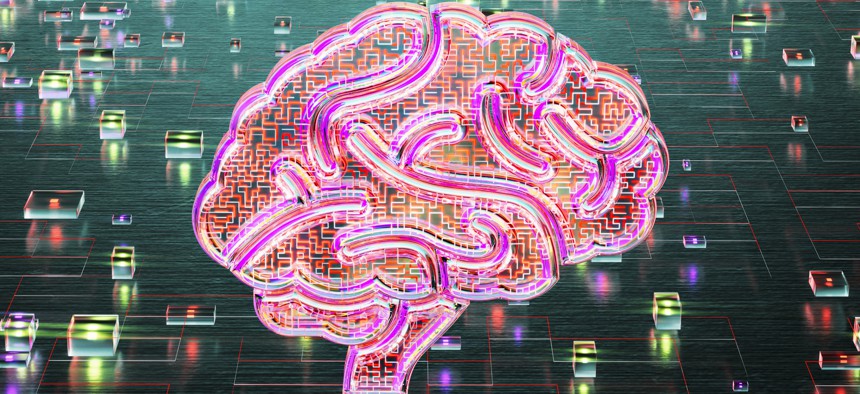
Today, artificial intelligence represents the next great leap — not as a word processor, but as a thought processor. It’s no longer just helping us write sentences; it’s helping us formulate ideas, test arguments and even challenge our assumptions. The implications of this transformation reach deep into how we learn, understand and ultimately know.
From Tools of Writing to Tools of Thinking
History shows that every primary intellectual tool has changed the way we think. The abacus helped us calculate, the printing press democratized knowledge, and the search engine gave us near-instant access to the world’s information. But AI goes further — it doesn’t simply retrieve information; it collaborates.
An AI system engages in an iterative loop of reasoning, brainstorming and refinement. We prompt it, it responds, and through this back-and-forth exchange, new insights emerge. In this way, AI doesn’t just automate tasks — it participates in cognition. It’s emerging as a partner in thought. This idea of “thinking with AI” is both exhilarating and unsettling. Exhilarating, because it expands human capacity; unsettling, because it blurs the boundaries between our own understanding and what’s being generated for us.
What It Means to “Think with AI”
Thinking with AI means externalizing part of the mental process. Instead of solitary reflection, we are now co-constructing thought through dialogue with a non-human interlocutor.
When we ask an AI system to explain a policy concept, generate an outline, or summarize a complex article, we are not merely receiving answers — we are engaging in a new kind of meta-thinking. The AI reflects our thinking back to us, often reorganizing it or offering perspectives we hadn’t considered.
This can be profoundly productive. A student using AI to draft a policy memo learns by comparing their reasoning to the model’s suggestions. A city manager testing alternative budget scenarios with an AI assistant may see patterns they’d otherwise overlook. But in each case, the understanding remains human — AI can simulate comprehension, but it cannot possess it.
Implications for Learning
1. From Knowledge Acquisition to Knowledge Orchestration
In traditional education, success often depended on how much information one could retain. With AI, knowledge is abundant and instantly retrievable — the learner’s role shifts from memorization to interpretation — from what to think to how to think. The challenge now lies in orchestrating knowledge: knowing which questions to ask, which sources to trust, and how to synthesize information meaningfully.
2. From Knowing What to Knowing Why
Since AI can recall and recombine facts far faster than any human, the educational focus must move toward conceptual understanding and application. Students who rely on AI for rote tasks may complete assignments efficiently but miss the deeper “why” behind the answers. Educators must therefore guide learners toward reflection and critical inquiry — asking not just what AI produced, but why it created it.
3. AI as a Tool for Augmented Cognition
AI can serve as a dynamic tutor, explaining complex concepts in ways tailored to each learner’s level and style. It can adapt in real time, offering analogies, examples, or simulations that enhance comprehension. Used well, AI becomes a scaffold for deeper understanding, enabling individualized learning that traditional classrooms could only dream of.
4. The Risk of Cognitive Dependency
Yet there is danger in overreliance. When learners allow AI to think for them, they risk losing the ability to think through problems. Authentic learning requires productive struggle — the moment of uncertainty that leads to insight. AI can make that struggle too easy to avoid.
Implications for Understanding
Understanding, in the human sense, involves empathy, judgment, and moral context — areas where AI still falls short. It can model patterns, generate insights, and simulate expertise, but it lacks awareness.
Still, AI shapes how we understand by structuring the information we see. It filters, prioritizes, and frames ideas in ways that subtly influence perception. The risk is that when AI feels authoritative, we may mistake coherence for truth.
Just as the printing press required a new literacy — the ability to read and interpret — AI demands interpretive literacy: the ability to question, validate, and contextualize what machines produce. In education, this becomes essential. Students must learn with AI but also about AI — understanding its limits, biases, and epistemological blind spots.
The New Roles of Educators and Learners
Educators now face a dual responsibility. They must teach subject matter, but also teach students how to think alongside AI. This means emphasizing:
- Verification: Checking AI outputs against trusted sources.
- Reflection: Analyzing how AI shapes one’s reasoning.
- Ethical use: Understanding when assistance becomes substitution.
Learners, in turn, must cultivate meta-cognition — awareness of their own thought processes. When used intentionally, AI can become a mirror that reveals our cognitive habits, assumptions, and biases. In doing so, it can actually deepen human understanding — if we remain alert to its influence.
Ethical and Philosophical Dimensions
The emergence of AI as a thought processor raises questions that go beyond pedagogy:
- Authorship: Who “owns” ideas co-created with AI?
- Authenticity: Can insights generated through collaboration with AI be called ours?
- Agency: Are we shaping AI, or is AI beginning to shape us?
These are not just philosophical musings; they cut to the heart of what it means to be an autonomous learner and thinker in the digital age.
Rethinking the Nature of Thought
Just as the word processor changed writing by freeing expression from mechanics, the thought processor is changing thinking by freeing it from constraint. Yet freedom without reflection can lead to superficiality. AI can help us think more broadly, but not necessarily more deeply.
As we integrate these tools into classrooms, workplaces and everyday life, we must do so intentionally — cultivating a balance between augmentation and authenticity. The future of learning may belong to those who can co-think: humans who harness AI not to replace curiosity, but to extend it; not to short-circuit understanding, but to deepen it.
In the end, the measure of our progress will not be how much AI can think, but how wisely we think with it.
Alan R. Shark is an associate professor at the Schar School for Policy and Government at George Mason University, where he also serves as a faculty member in the Center for Human AI Innovation in Society. He is also a senior fellow and former executive director of the Public Technology Institute, a fellow of the National Academy of Public Administration, and founder and co-chair of its Standing Panel on Technology Leadership. He is the host of the podcast series Sharkbytes.net.