
Southeastern Virginia turns to AI to sort waste, recycling
Davin G Photography via Getty Images



 By
Chris Teale
By
Chris Teale
The area’s sortation facilities will use the technology to extract recyclables and organic waste, an effort it said will extend the life of its landfills and double its recycling rate.
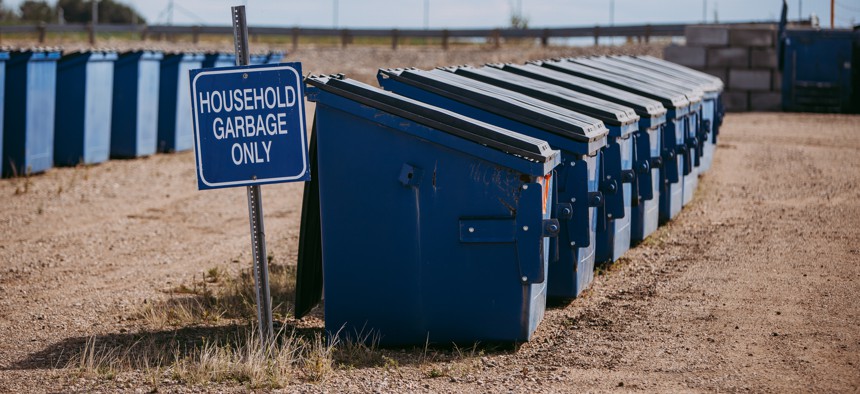
Several communities in southeastern Virginia are turning to artificial intelligence to help sort solid and organic waste, in a bid to boost recycling and extend the life of local landfill sites.
The Southeastern Public Service Authority of Virginia, which provides regional waste services for the cities of Chesapeake, Franklin, Norfolk, Portsmouth, Suffolk and Virginia Beach, as well as the counties of Isle of Wight and Southampton, announced late last month it will partner with a subsidiary of AMP Robotics to use its technology to detect and remove recyclables and organic waste from bagged trash.
AMP, which provides AI-powered waste sorting solutions using cameras, robots and pneumatic jets to detect and separate waste, signed a 20-year agreement with SPSA. The agreement builds on a two-year pilot that the company completed in Portsmouth using a system capable of processing 150 tons of local municipal waste.
Dennis Bagley, SPSA’s executive director, estimated that introducing AI to help sort waste will double the life of its landfill, guarantee the region will recycle 20% of its waste, and turn the authority’s 1.2 million residents into “active recyclers.”
“This technology is demonstrating that there are effective ways to recover valuable resources from the trash, and we're proud to be on the cutting edge of providing high-quality and transparent waste management services,” Bagley continued in a statement.
The partnership comes at a crucial time for the waste industry. The Recycling Partnership, a nonprofit that advocates for the recycling industry, estimated in a report last year that only 21% of recyclable materials are captured in the United States, with the rest going to landfill, as residents are not educated about what can be recycled or that they can participate, and not every household can access recycling services. The group found Virginia was one of 11 states to lose over 1 million tons of recyclables each year.
Having the ability to sort recyclable waste using technology could be enormously helpful, and AMP officials said AI is ideally placed.
“It's a smart system where the cameras recognize individual items and components, and the AI tells it what to do and tells the system what to do with it,” said Tim Stuart, AMP’s CEO, in an interview earlier this year. “We use little air jets to push it to the right place. Think of packed up garbage on a tip floor. We're putting it through a shredder and then laying it out on a conveyor belt so it gives it appropriate spacing and time for the system to do what it needs to do.”
The 18-month pilot in Portsmouth saw between 50% and 60% of material diverted out of landfill, Stuart said, and it came as the city “really wanted to change the way they were recycling and diverting material outside of the landfill.”
This more technology-driven method is a far cry from the manual waste sorting methods employed at processing plants and transfer stations across the country and world. Manual sorting can be dangerous, as workers may encounter chemicals, sharp objects or other hazardous materials, meaning they need layers of personal protective equipment and strict safety protocols.
“What is revolutionary about it is that technology has not been there before,” Stuart said. “It's always been a manual sort system, which is very cost prohibitive and dangerous for people putting their hands into trash, so to speak. Communities didn't spend the time or resources to do that, so now AI is doing all the work, and lowering the cost, which is opening the door to lots of different opportunities.”
It means that workers’ roles will change, with a greater reliance on systems engineers who can make real-time adjustments to machines depending on how they are operating. Stuart said it will take people “out of harm’s way” by reducing the need for manual sorting and instead focusing on the systems’ quality assurance as it uses tech to sort.
It’s early days still for the technology, Stuart said. But AMP is hopeful they can revolutionize how waste is sorted. The company just broke ground on a new facility in Denver, near its headquarters, that will process over 60,000 tons of single stream recycling a year, in partnership with waste management company Waste Connections.
“This is new technology, and this is revolutionary to the waste industry,” he said. “We're in the early innings on getting this technology out and really reshaping how people use landfills. Let's say the vast majority of material makes its way to a landfill in North America. We're going to try to change that municipality by municipality. It's an exciting new thing for the waste industry, and we're excited about what's going forward.”
NEXT STORY: Pennsylvania businesses are all in on AI