
AI preemption ‘top of mind’ for state, local tech leaders
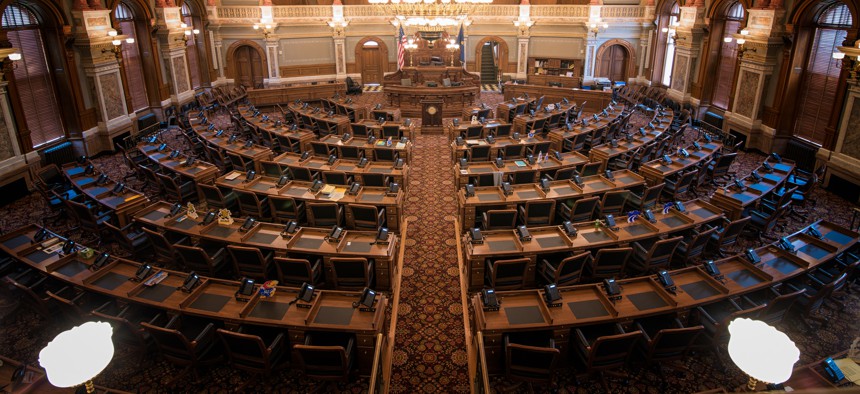
MATTHEW PALMER via Getty Images





 By
Chris Teale
By
Chris Teale
Observers called for an intergovernmental working group as well as better collaboration, one month on from President Donald Trump’s executive order targeting “cumbersome” state AI regulations.
States are bracing for federal preemption of their artificial intelligence regulations, as a top tech leader called for more collaboration on AI between the levels of government.
Doug Robinson, executive director of the National Association of State Chief Information Officers, said during a webinar last week that mitigating preemption — or any other restrictions on state regulations — remains “top of mind” for the organization going into 2026.
It comes just over a month after President Donald Trump signed an executive order targeting states deemed to have “cumbersome” AI regulations and threatening to cut off grant funding in an effort experts said would face legal challenges. Congress had already attempted a 10-year moratorium on state-level AI regulations but failed to pass the measure as part of a larger reconciliation bill.
Trump’s order brought a stinging reaction from state and local government leaders. Late last year, NASCIO issued a joint statement alongside the National League of Cities, National Conference of State Legislatures, U.S. Conference of Mayors and Council of State Governments saying the order “moves away from repeated calls for partnership” and “risks weakening protections for Americans.”
The letter also called for an intergovernmental AI working group, and Robinson reiterated that collaboration, not preemption, must be the best path forward.
“The bottom line here is that we would all agree that a preferable model would be a collaborative model between the federal government and state governments around AI regulations, perhaps with a federal floor, with the states be able to build on that,” Robinson said during a webinar hosted jointly with the Public Technology Institute. “Absent that, in discussions which just took place last week in multiple congressional committees, there's a major divide about that approach and that philosophy.”
In the absence of a federal framework, many states have stepped up either with comprehensive AI legislation or with laws targeting specific areas where it can be used. And with such activity likely to continue in this legislative session, according to experts’ projections, Robinson said preemption is “injurious to the states that have made a lot of progress in protecting their consumers from some of the harms that we've seen from AI being deployed in an inappropriate manner.”
All the while, states are pressing ahead with AI use cases and seeing some intriguing results. Robinson noted Indiana’s success with its Ask Indiana generative AI chatbot, which was a finalist for a NASCIO award last year. The chatbot pulls information from the state’s entire website in a bid to reduce the time it takes for residents and customers to interact with the site, and it appears to be the first state generative AI chatbot with that breadth of knowledge. Similarly, California has been piloting its Poppy generative AI tool for its state employees, with that pilot set to end in June.
Robinson said those initiatives and more will accelerate this year as they move from being in production to a pilot phase. But other, familiar, obstacles remain, including the need for more workforce training, better data and improved governance. A long road remains ahead, he said.
“I think we're going to see continuing growth and interest in AI adoption,” Robinson said. “We're seeing many more of those [programs] already into production. That's going to grow. I think we're going to have some missteps along the way, and states are going to have to step back and reevaluate that, because there seems to be unmanaged expectations about what AI can do in state government, and the technical capacity and workforce skills are very thin. States are going to have to be cautious.”
Looming over everything, meanwhile, is any potential federal preemption. Robinson predicted a “long, drawn-out court battle” on Trump’s executive order that would take years to resolve.