
The data center rush in Appalachia
Posnov via Getty Images




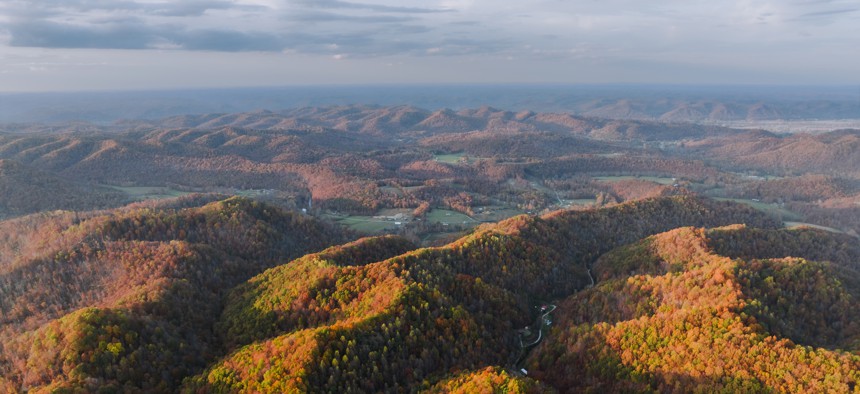
Big tech eyes coal country as AI demand soars, but rural communities push back.
This article was originally published by Daily Yonder.
The demise of the coal industry left much of Appalachia in economic tatters, with lost jobs, spoiled water, and depopulated communities across the coalfields of Kentucky, West Virginia, and Virginia. Now, in an ironic twist of the region’s energy history, tech companies and data center developers are eyeing these same rural landscapes with ambitious plans to power the artificial intelligence revolution.
From the hollows of Tucker County, West Virginia, to the former strip mines of Wise County, Virginia, proposals for massive data center complexes are sparking both hope and fierce resistance. Proponents promise economic revitalization and tax revenues for struggling communities. Critics warn of environmental degradation, soaring utility bills for residents, limited job creation, and the stripping away of local control over development decisions.
The stakes are enormous. According to a September 2025 report from the Energy & Manufacturing in Appalachia initiative, approximately 92 gigawatts of data center capacity are currently in the pipeline across the United States, with seven gigawatts being added monthly by the end of 2024. Traditional data center hubs like Northern Virginia’s “Data Center Alley” are becoming saturated, pushing growth toward rural regions in Pennsylvania, West Virginia, and Kentucky.
Where Data Centers Stand Today
Northern Virginia remains the undisputed capital of the data center world, with roughly 300 operational facilities across Fairfax, Loudoun, and Prince William counties. Northern Virginia is one of the world’s largest internet interconnection hubs. But capacity constraints and community opposition are forcing the industry to look elsewhere. West Virginia has thrown out the largest welcome mat in the region.
In Appalachia proper, data center development remains nascent but is accelerating rapidly. Southwest Virginia’s Wise County hosts the Mineral Gap Data Center, which came online in 2023 and is powered by a 3.4-megawatt solar array built on former strip-mined land—widely promoted as the first abandoned mine land converted to solar in Virginia. OnePartner ATAC runs a facility in Duffield, Virginia.
In January 2025, developers announced plans for Kentucky’s first hyperscale data center in Louisville, a 400-megawatt campus to be developed by PowerHouse Data Centers and Poe Companies, with utility service from Louisville Gas and Electric. The Lane Report noted the project is expected to begin operations by late 2026. It will likely represent a demonstration of what can be exported to Eastern Kentucky.
Southwest Virginia’s Growing Pipeline
Beyond the Wise County proposals, data center interest is spreading across Southwest Virginia, often into communities with minimal regulatory frameworks to evaluate such projects.
In early December 2025, Wythe County announced its first data center: a 99-acre AI computing campus at Progress Park to be developed by Solis Arx, a newly formed digital infrastructure company led by CEO Rob Noll. Cardinal News reported that county officials project the facility will represent more than $1 billion in total investment. County Administrator Stephen Bear told the Wythe County Board of Supervisors that the project would generate more than $10 million in annual tax revenue by 2028, making Solis Arx the county’s single largest taxpayer.
The company claims its facility will consume only about 2,000 gallons of water daily—roughly equivalent to a restaurant—by using closed-loop and air-based cooling systems rather than the evaporative cooling that can require hundreds of thousands of gallons per day at older facilities. Appalachian Power will provide electricity, with water supplied by the town of Wytheville.
At a December 9, 2025 board meeting covered by Cardinal News, nearly all of the dozen residents who spoke during public comment opposed the project or raised concerns about electricity rates, water supplies, environmental impacts, and the loss of rural character. Resident Hannah Ainsworth questioned the trajectory of such development: “It’s 99 acres proposed today, but what about next year, in three years? At what point is our region unrecognizable?”
Board of Supervisors Chairman Brian Vaught acknowledged a significant vulnerability in how such projects arrive. Wythe County is one of approximately seven Virginia counties that lack zoning ordinances governing where data centers can be built. “So until that’s addressed, if you don’t live in the town of Wytheville or the town of Rural Retreat, one of these could pop up as your neighbor,” Vaught said, according to Cardinal News.
Pulaski County may not be far behind. The 2025 Virginia General Assembly allocated $15 million for site readiness improvements—including road extensions, grading, and natural gas pipeline work—to support what budget documents describe as “up to $3.0 billion in capital investment” through construction of a data center and power plant. The project remains under nondisclosure agreements, with no developer publicly identified, according to Inside Climate News and Cardinal News.
Montgomery County supervisors are also weighing the issue. Cardinal News reported in mid-December 2025 that local officials are considering commissioning a study on data center zoning—a sign that even communities without active proposals recognize the need to prepare for an industry expanding rapidly across the region.
The Wise County Vision: Mine Water Cooling
One of the most ambitious proposals involves transforming 65,000 acres of former coal mining land in Wise County, Virginia, into an energy hub including data centers. A nonprofit venture called Energy DELTA Lab, managed by Will Clear and Will Payne, envisions building a massive 450-acre “Data Center Ridge” on top of old mining lands that could be powered and cooled using billions of gallons of water that naturally replenish in abandoned underground mines.
In a December 2025 report, the Thomson Reuters Foundation detailed how the entrepreneurs hope to prove the feasibility of their idea to Texas-based Energy Transfer, which owns the land managed by Penn Virginia Operating Co. Unlike neighboring areas plagued by acid mine drainage, the Wise County coalfields lack the mineral pyrite that contaminates water. The underground mine water maintains a temperature of 55 degrees or below, roughly 10 to 15 degrees cooler than river water typically used for data center cooling elsewhere in Virginia.
Payne told the Thomson Reuters Foundation that the water quality makes the site attractive for data center cooling. He acknowledged, however, that the region faces deep skepticism about outside development. “Anyone looking at expanding in the region, there is skepticism because there have been so many stories of promises made but not kept,” Payne said, according to the Reuters report.
Canary Media reported in September 2024 that tax revenues from data centers could help address the region’s fiscal crisis. Will Clear told Canary Media that local government finances face an existential threat without new development. The Virginia Mercury reported in July 2024 that a 36-megawatt data center could provide about $464 million in capital investment and create approximately 40 high-income jobs.
West Virginia’s Controversial Push
West Virginia has become the most aggressive state in pursuing data center development, passing sweeping legislation in April 2025 that strips local governments of regulatory authority over such projects. House Bill 2014, championed by Governor Patrick Morrisey as the centerpiece of his economic development agenda, prohibits counties and municipalities from enforcing zoning ordinances, permitting requirements, noise regulations, or code enforcement on certified microgrid districts or “high-impact” data center projects.
The law also diverts most property tax revenue from data centers away from local taxing bodies to state coffers. Under the final version, only 30% of property tax proceeds go to the host county, with five percent divided among the state’s other 54 counties. The West Virginia Gazette-Mail reported that this formula is estimated to cost counties and school districts millions of dollars.
Upon the bill’s passage, Morrisey declared it “the economic development bill of the session,” according to the Gazette-Mail. “West Virginia is America’s energy state, and this law is going to demonstrate it to the whole country that we are ready for action,” Morrisey said in a statement reported by Mountain State Spotlight.
At least four major data center projects are now publicly known in West Virginia. The most controversial involves Fundamental Data LLC, a Virginia-based company seeking to build a 1,656-megawatt natural gas power plant and data center complex on 500 acres between the towns of Thomas and Davis in Tucker County. The Wall Street Journal reported that the proposed facility could eventually span 10,000 acres across Tucker and Grant counties if fully realized.
Kentucky: Multiple Proposals, Growing Debate
Kentucky’s data center conversation has moved quickly from possibility to reality. Beyond the Louisville hyperscale campus, the Kentucky Lantern reported in August 2025 on a proposed multi-billion-dollar “technology campus” with data centers in Mason County, though key details remain thin, and local reaction has included both hope and skepticism.
In Oldham County, Louisville Public Media reported that residents organized against a proposed hyperscale data center, and the controversy has become a statewide case study in zoning disputes, noise concerns, and rural quality-of-life politics. The fight illustrates how quickly economic development proposals can become community flashpoints when a hyperscale project lands on rural ground.
The Economic Equation
The Promise of Tax Revenue
Proponents argue that data centers represent one of the few realistic options for diversifying Appalachian economies devastated by coal’s decline. The numbers from Virginia’s experience are eye-catching. According to Loudoun County officials quoted by the Citizens Voice in December 2025, data centers generate 35 to 40% of the county’s General Fund revenue, with fiscal contributions jumping from $1 million in fiscal year 2018 to $875 million in 2024. That figure is projected to reach $1.1 billion by fiscal year 2026.
A PricewaterhouseCoopers study cited by Virginia Business found that between 2017 and 2021, data centers contributed $54.2 billion to Virginia’s gross domestic product. Southwest Virginia localities have positioned themselves to capture some of this wealth by implementing the state’s lowest regional property tax rate on data center equipment at 24 cents per $100 of assessed value, compared to $3.70 in Prince William County, according to Virginia Business.
The Jobs Question
Critics contend that data centers deliver far fewer permanent jobs than their industrial footprint suggests. According to an October 2025 report from ReImagine Appalachia, most data center employment is in construction, and those jobs are often contracted from outside the communities where facilities are built.
A typical data center adds up to 1,500 workers during construction but employs only about 50 full-time workers when operational, according to a 2024 Virginia state report cited by the Thomson Reuters Foundation. Those permanent positions are primarily security or janitorial staff.
At an April 2025 town hall meeting in Davis, West Virginia, covered by 100 Days in Appalachia, electrical engineer Brian Reed—whose family has been in Tucker County since 1896—challenged the jobs pitch. “$12 an hour isn’t a job, you can’t survive,” Reed said. “The operators in the plant where I work make $43 an hour. That’s a job that makes a difference. So don’t offer jobs that are for security people that are going to starve to death.”
Nationwide, data center employment grew from 306,000 to 501,000 workers between 2016 and 2023, according to the Bureau of Labor Statistics. But more than 40% of those jobs are concentrated in just three states, far from Appalachia’s coalfields, as reported by West Virginia Watch.
Environmental Concerns
The Water Challenge
Data centers rank among the top ten water-consuming commercial industries in the United States. A medium-sized facility can consume around 110 million gallons of water annually for cooling, with some consuming up to 5 million gallons daily, according to a report from the University of Tulsa. The Environmental and Energy Study Institute reported that data centers in Northern Virginia collectively consumed nearly 2 billion gallons of water in 2023, a 63% increase from 2019.
Water consumption varies significantly based on cooling technology. Evaporative or wet cooling requires substantial water withdrawals and raises concerns in drought-prone areas like Maricopa County, Arizona, which has been inundated by data center developments. Air cooling reduces water needs but increases electricity consumption. The Wise County proposal’s closed-loop mine-water cooling approach attempts to change the equation by using cool underground mine water as a heat sink, potentially eliminating dependence on surface water or municipal systems.
Water concerns are particularly acute in some Appalachian locations. Tucker County, West Virginia, suffered through a severe drought in 2024 that forced emergency water pumping from the Blackwater River. 100 Days in Appalachia reported that in neighboring Thomas, the reservoir reached its lowest level in 60 years, rendering water unusable due to high iron concentrations.
In a December 2025 Brookings Institution podcast, Davis Mayor Al Tomson expressed concern about cumulative water impacts. “We’ve suffered a drought for the last two summers,” Tomson said. “We’ve had to go to our secondary water source, which is the Blackwater River. But if the data centers start drawing water out of the aquifer... I’m concerned that it’s gonna affect the source water for the creek that we’re using right now.”
Noise Pollution
The constant hum of cooling systems and backup generators has emerged as one of the most contentious issues for communities living near data centers. According to TechTarget, facilities produce noise levels between 55 and 85 decibels from cooling fans, mechanical chillers, and ventilation systems—sounds that are particularly intrusive in rural areas where residents moved seeking quiet.
In Northern Virginia, Amazon Web Services data centers near the Great Oak subdivision in Manassas have drawn persistent complaints. WUSA9 reported that residents describe the sound as a low roar combined with a high-pitched whir. “These data centers are loud, noisy beasts, and they are being built too close to residential areas,” community activist Roger Yackel told WUSA9. “That’s not something that we should have to live with.”
The Prince William Times reported in December 2022 that noise remediation can cost millions of dollars, and unless regulators apply pressure, companies may be slow to implement solutions. In Tucker County, the prospect of constant industrial noise near the tourist towns of Davis and Thomas—known for stargazing, hiking, and natural beauty—has fueled fierce opposition.
Air Quality and Diesel Risk
Large data centers typically rely on diesel backup generators that produce air pollution during testing and emergencies. The Parsons Advocate of Tucker County reported that the Fundamental Data project there would include 30 million gallons of diesel fuel storage to back up its natural gas power plant.
The West Virginia Department of Environmental Protection approved an air quality permit for the Tucker County facility in August 2025 over strenuous community objections. The Intermountain newspaper in Elkins, West Virginia, reported that more than 1,600 written comments were submitted during the public comment period.
“We are extremely disappointed that the West Virginia DEP really isn’t upholding their mission to protect our air, land, and water,” Nikki Forrester of Tucker United told The Intermountain. “They discussed at the public meeting that they’ve never rejected an air quality permit before.”
Community Backlash: Three Overlapping Camps
Across Appalachia, community reactions to data center proposals tend to fall into three overlapping camps. The first is the development coalition: county officials, industrial development authorities, some trades, landowners, and utilities who argue that data centers represent a once-in-a-generation chance to replace the coal-era tax base and keep young people local.
The second is the quality-of-life coalition: nearby residents, tourism businesses, and preservation groups focused on noise, light pollution, traffic, and land conversion. The third is the accountability coalition: people who might tolerate a project if rules are strict, demanding transparency about corporate identity, enforceable limits, and binding community benefits.
In Pittsylvania County, Virginia, grassroots organizing successfully blocked Balico LLC’s proposal to build what would have been Virginia’s largest natural gas power plant at 3,500 megawatts alongside a hyperscale data center campus.
In Tucker County, residents formed Tucker United within weeks of learning about the Fundamental Data proposal. West Virginia Watch reported that the group now counts hundreds of members. “No Data Center in Tucker County” signs have proliferated in windows, storefronts, and on vehicles throughout Davis and Thomas.
One recurring complaint involves the lack of transparency from developers. Fundamental Data’s air permit application was heavily redacted, with the company claiming confidential business information. The firm’s public website consists only of a logo and a copyright notice, as noted by 100 Days in Appalachia.
“The company hasn’t come down and spoken with us at all,” Forrester told Corporate Crime Reporter in August 2025. “From a local leadership standpoint, none of us were aware that this was even a possibility. It feels like it’s a power grab where they want to get rid of any local control, take the money, and leave West Virginians to suffer.”
WVVA reported in April 2025 that more than 1,000 West Virginians signed a petition asking Governor Morrisey to veto HB 2014. He signed it anyway.
Utility Companies in the Mix
This is not just a technology story—it’s a utility planning story. Several major utilities are positioning themselves to serve the anticipated data center boom in Appalachia.
American Electric Power, the parent company of Appalachian Power in West Virginia and Kentucky Power in eastern Kentucky, has emerged as a key player. Data Center Dynamics reported in February 2025 that AEP expects to bring 4.7 gigawatts of new data center capacity online in 2025 alone and has customer commitments for 20 gigawatts of incremental load by 2030.
Louisville Gas and Electric will serve Kentucky’s first hyperscale data center campus. Dominion Energy, Virginia’s largest utility and the company most directly tied to Northern Virginia’s data center concentration, is expanding infrastructure across the Commonwealth. In Southwest Virginia, Appalachian Power and Dominion Energy provide electricity to the region where the Energy DELTA Lab project is proposed.
FirstEnergy has announced $15 billion for power infrastructure investments to support data center growth, according to the Energy & Manufacturing in Appalachia report. The company serves customers across Ohio, Pennsylvania, West Virginia, Maryland, and New Jersey.
PJM Interconnection, the regional grid operator covering much of coal-country Appalachia, has become central to debates about supply, demand, and rate impacts. West Virginia Public Broadcasting reported that projected data center load growth far exceeds new supply coming online in the near term.
Will Electric Bills Rise?
The short answer appears to be yes, and in some cases dramatically. Data center demand has already contributed to soaring wholesale electricity prices across the PJM Interconnection, the regional grid that serves West Virginia, Pennsylvania, Ohio, and other mid-Atlantic states. Stories of ratepayer protests about rising electricity prices are appearing all across the mountains.
Mountain State Spotlight reported in October 2025 that the cost to secure an adequate power supply in PJM’s annual capacity auction jumped from $2.2 billion for 2024-2025 to $14.7 billion for 2025-2026, an increase of more than 500%. CNBC reported that an independent monitor found data center demand, both actual and forecast, accounted for $9.3 billion, or 63%, of that total. In the December 2025 auction, prices hit $16.4 billion, with PJM falling short of its reliability target for the first time. Nearly all of the 5,250-megawatt increase in projected demand was attributable to data centers.
Monitoring Analytics, a specialized firm that acts as an independent monitor for the PJM Interconnection, said in its June report: “Data center load growth is the primary reason for recent and expected capacity market conditions, including total forecast load growth, the tight supply and demand balance, and high prices.”
These costs are spread across the entire grid, affecting ratepayers throughout the region. CNBC reported in November 2025 that residential electricity prices surged 13% in Virginia, 16% in Illinois, and 12% in Ohio during a recent 12-month period, well above the six percent national average.
A Harvard Law School study released in September 2025 warned that utilities may be subsidizing data center growth by shifting infrastructure costs to residential and other ratepayers. The Union of Concerned Scientists reached a similar conclusion in an October 2025 analysis: “The wealthiest companies are building extraordinarily expensive data centers that you and I are subsidizing.”
Cathy Kunkel, an energy consultant at the Institute for Energy Economics and Financial Analysis, told Mountain State Spotlight: “One of the principles of electric rate regulation is that the entity that’s imposing cost on the system bears those costs to the extent possible. The historical way transmission cost allocation has been done is just not keeping up with that principle when it comes to data centers.”
Corporate Players in Appalachia
Two overlapping groups of corporations are driving the data center push into Appalachia. The first consists of hyperscalers—the companies whose cloud and AI services create the underlying demand: Amazon (AWS), Microsoft, Google, and Meta. Even when they aren’t named publicly, they often sit behind developer NDAs or vague references to “Fortune 100” clients, as the Kentucky Lantern has noted in its coverage.
Amazon Web Services has the largest data center footprint nationally, with hundreds of facilities in Northern Virginia alone. Google has committed $25 billion for data centers and infrastructure, including a $3 billion deal with Brookfield Asset Management for hydropower electricity, according to the Energy & Manufacturing in Appalachia report.
The second group consists of developers, landholders, and power partners—the visible local actors. PowerHouse Data Centers and Poe Companies are developing Kentucky’s first hyperscale campus in Louisville. Compass Datacenters and QTS Data Centers are building the Prince William Digital Gateway in Virginia, billed as the world’s largest future data center complex at 23 million square feet, according to Virginia Business.
In West Virginia, Fundamental Data LLC of Purcellville, Virginia, is pursuing the massive Tucker County project. TransGas Development Systems of New York is proposing two off-grid power plants in Mingo County for what the applications call the “Adams Fork Data Center Energy Campus,” according to Mountain State Spotlight. Texas-based Fidelis New Energy has proposed a data center complex in Mason County.
In early December, ten Mingo County residents filed a federal lawsuit seeking to halt the Adams Fork project, alleging violations of the Endangered Species Act, Clean Water Act, and National Environmental Policy Act.
Questions Communities Should Ask
What Advocacy Groups Recommend
Several organizations have developed frameworks to help communities evaluate data center proposals and advocate for responsible development. Their recommendations share common themes: transparency, local control, binding commitments, and protection for existing residents and ratepayers.
Virginia Data Center Reform Coalition
The Piedmont Environmental Council and nearly 30 environmental, preservation, and climate advocacy groups formed the Virginia Data Center Reform Coalition in late 2023. Julie Bolthouse, the Council’s director of land use, told Inside Climate News in December 2023 that an “ever-increasing data center footprint” has resulted in “higher utility rates, new transmission lines, declining air quality, reduced water supply,” and a loss in Virginia’s “hard-fought climate goals.”
The coalition has articulated four pillars of reform. The first is enhanced transparency, requiring disclosure and statewide reporting on data center energy use, water consumption, and emissions. The second is state oversight, establishing state-level regulatory review to evaluate regional impacts. The third is ratepayer protection, safeguarding residents and businesses from subsidizing billions of dollars in infrastructure that data centers require. The fourth is incentivizing sustainability by connecting tax exemptions to clean energy and efficiency standards.
“There needs to be more transparency around this industry; we need to know how much energy, how much water, and their emissions,” Bolthouse told Data Center Dynamics in November 2024. “Our localities are ill-equipped to handle the regional implications that are coming from these massive projects.”
PennFuture’s Model Ordinance
PennFuture, a Pennsylvania environmental nonprofit, has created a model zoning ordinance and educational video series to help municipalities prepare for data center development. The organization developed its model after reviewing ordinances passed in Pennsylvania and Northern Virginia.
The model ordinance addresses water consumption, power consumption, noise, and aesthetic concerns. According to PennFuture’s website, “Municipalities must take seriously their responsibility to plan for this new land use and avoid being caught unaware, as many were when the distribution center boom struck Pennsylvania in recent years.”
Donna Kohut of PennFuture told the Republican Herald in August 2025 that Pennsylvania faces serious risks from legislation that would fast-track data center approvals. “By allowing developers to side-step critical and constitutionally required environmental protections, our elected officials would be allowing for unfettered destruction of Pennsylvania’s natural resources and risking the health of our local communities,” Kohut said.
ReImagine Appalachia
ReImagine Appalachia, a coalition focused on sustainable economic development in the Ohio River Valley, published a report in October 2025 titled “Is Responsible Data Center Development Possible?” The report argues that data centers can benefit communities if proper safeguards are implemented.
The organization recommends that data centers be located on shuttered industrial facilities rather than greenfields, ideally co-located with factories or greenhouses that can benefit from waste heat recovery. Components should be procured locally to contribute to the region’s manufacturing sector. Strong labor standards should ensure local workers are hired in development and construction, including prevailing wage requirements, project labor agreements, and registered apprenticeship programs.
“Attracting new industries to our communities should not be a race to the bottom,” ReImagine Appalachia wrote. “The new growth of data centers in the region is a call to assess how our policy models have historically favored economic and project development that benefits extractive, exploitative, absentee corporations at the expense of our communities, workers, and lands.”
NAACP Environmental and Climate Justice Principles
In September 2025, the NAACP and environmental justice advocates released guiding principles for data center development following a convening in Memphis, Tennessee, of nearly 70 climate and community advocates. The gathering was prompted in part by concerns about Elon Musk’s xAI data center in South Memphis, which the NAACP has challenged legally over unpermitted gas turbines in a historically Black neighborhood.
The NAACP’s framework demands that companies disclose water and energy consumption, emissions, subsidies, and corporate ownership details as soon as they propose new projects. Energy efficiency standards and environmental commitments must become legally binding through community benefit agreements.
“No community should be forced to sacrifice clean air, clean water, or safe homes so that corporations and billionaires can build energy-hungry facilities,” the NAACP stated in the principles, as reported by The Verge. Abre’ Conner, director of the Center for Environmental and Climate Justice at the NAACP, told The Verge that the principles put tech companies “on alert” that “if they do not meet our demands... we move into other forms of advocacy, including filing litigation.”
An Uncertain Future
The data center rush into Appalachia encapsulates the region’s century-long struggle with extractive industries and outside development. Like coal before it, data centers promise jobs and prosperity while communities worry about bearing the environmental and social costs.
Julie Bolthouse, director of land use at the Piedmont Environmental Council, offered a warning to West Virginia Watch in June 2025: “What you’re going to get if you do it this way is the worst players, the ones that didn’t need to be in Northern Virginia. The players that are wanting that lack of regulations because they didn’t want to abide by rules and didn’t want to or need to protect communities, which is worse for West Virginia and the communities.”
The U.S. Department of Energy projects that data centers could consume between 6.7 and 12% of total U.S. electricity by 2028, up from 4.4% in 2023. That growth will require new power generation somewhere, and Appalachia’s abundant natural gas, available land, and water resources make it attractive despite the challenges.
Whether the region can chart a different path than its coal experience remains to be seen. The battles playing out in Tucker County, Wise County, Wythe County, and communities across the region will help determine whether data centers become genuine engines of renewal or simply the latest chapter in Appalachia’s long history of extraction without lasting benefit.
As one Tucker County resident put it at an April town hall covered by 100 Days in Appalachia: “It’s been so long and such a hard fight, and then all of a sudden it feels like this is gonna kick the legs out from the stool from everything that’s already here.”
EDITOR'S NOTE: Full, unedited version of this article can be found on James Branscome's Substack.
James Branscome is a retired managing director of Standard & Poor’s and a former journalist whose articles have appeared in the Washington Post, York Times, Business Week, and Mountain Eagle of Whitesburg, Kentucky. He was a staff member in 1969-71 at the Appalachian Regional Commission, a lobbyist for Save Our Kentucky in Frankfort, and a staff member of the Appalachian Project at the Highlander Research and Education Center in New Market, Tennessee. He was born in Hillsville, Virginia, and is a graduate of Berea College in Kentucky.