
House hearings highlight AI divides
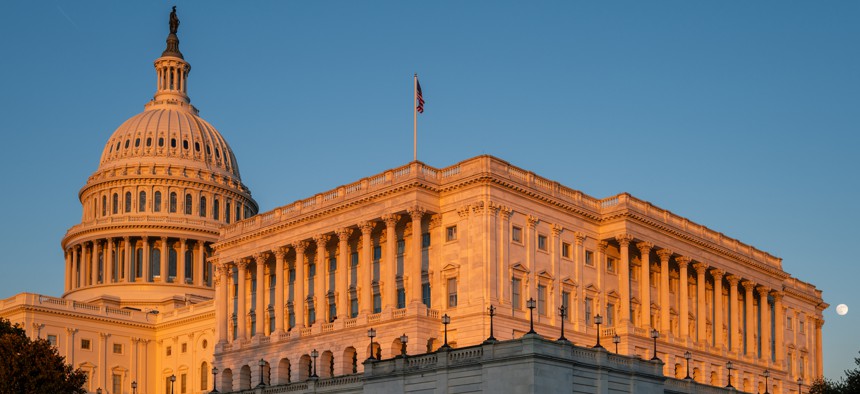
Garen Meguerian via Getty Images




 By
Chris Teale
By
Chris Teale
Two separate hearings last week shone light on lingering issues over preempting state and local AI regulations and the role of Congress in finally forming a national standard.
Two House hearings illustrated the delicate dance federal lawmakers are doing over artificial intelligence and the role of state and local governments in regulating and supporting the technology.
Administration officials came under fire for their efforts to preempt state and local regulation of AI. Those attempts accelerated late last year when President Donald Trump signed an executive order targeting states with “cumbersome” AI regulations and threatening their grant funding. That order, which could be subject to legal challenges, drew criticism from some Democratic lawmakers who called it executive overreach.
Much of the discussion centered in the House Committee on Space, Science and Technology, where its Research and Technology Subcommittee held a hearing on implementation of the federal government’s AI Action Plan, which Trump unveiled last year.
Michael Kratsios, director of the White House Office of Science and Technology Policy, said in his opening statement that the administration is “working with industry and the American people to relieve innovators of undue regulatory burdens and to formulate policy frameworks that safeguard the public interest while enabling further revolutionary developments.”
Democratic lawmakers criticized the Trump administration for trying to overrule Congress and state legislatures in determining which AI laws are too burdensome, and for threatening grant funding while doing so. Those efforts have also been opposed by a bipartisan group of state attorneys general.
“Some of what California has adopted to protect its people is appropriate and other legislation the Governor, with the support of the delegation, vetoed because they were not appropriate,” Rep. Zoe Lofgren, a California Democrat and the committee’s ranking member, said in her opening statement. “But there was a reason Justice [Louis] Brandeis suggested that states are the laboratories of democracy. In the absence of a federal framework, we should be encouraging states to experiment with how best to manage the risks to their citizens. What we should not do is preempt the states from taking necessary actions to protect their citizens while we twiddle our thumbs here in Congress.”
Rep. Jay Obernolte, a California Republican who chairs the subcommittee, said during his questioning of Kratsios that there should be a “federal lane” and a “state lane” when it comes to AI regulations, but that the federal government “needs to go first” and set national standards. In response, Kratsios said Trump’s executive order contained “an explicit acknowledgement in that executive order that congressional action is needed.”
“It's not something that could be done unilaterally,” he added.
Kratsios also argued that having many state laws on AI presents major compliance headaches for companies in the space, which is “not the best for American innovation” and creates a “patchwork” of laws.
“What is sometimes missed in this conversation is if you have this tremendous patchwork of laws across the country, the folks who actually are able to work within that system most successfully are the deep pocketed, large, big tech companies,” he said. “The small innovators, the entrepreneurs, the people who want to start new businesses, forcing them to try to find a way to comply with 50 different sets of AI rules is actually anti-innovation and it's something that I don't think anyone on this committee actually supports.”
Some states have been ahead of the curve on regulating AI, even some that are more ideologically aligned with the administration. Rep. Mike Kennedy, a Utah Republican, pointed to that state’s Office of Artificial Intelligence Policy and its “positive policies to promote artificial intelligence and its use for our society.”
He said the federal government should work “in a collaborative fashion not just with industry but also with states to promulgate positive policy that's going to help us not just use artificial intelligence in the best way but also to beat our economic and artificial intelligence competitors throughout the world.” Kratsios agreed.
“When we think of creating ultimately a sensible national policy framework, states that are creating regulatory sandboxes or encouraging AI innovation are the types of things we would love more states to be doing, not less of,” he said. “We want more of that, and we want to create a framework that encourages that and creates an environment where our innovators can safely test and deploy their technologies.”
Separately, Federal Communications Commission Chair Brendan Carr has argued previously that the agency has a role to play in preempting what they deem to be burdensome state-level AI regulations. Lawmakers rejected that argument too.
“Chairman Carr’s decision to insert the FCC into policy debates where it has no authority to act while walking away from Congressional mandates and existing FCC rules is also very disturbing,” Rep. Frank Pallone, a New Jersey Democrat who is ranking member of the House Energy and Commerce Committee, said in his opening statement during a subcommittee hearing. “While President Trump and Chairman Carr may wish that the FCC could preempt state and local laws on artificial intelligence, Congress has not given the agency that power.”
Obernolte said Congress must lead the way with national regulations for AI, something he has said repeatedly in the past. Rep. Brian Babin, a Texas Republican who chairs the full committee, said in his opening statement that doing so would “bolster our economic competitiveness, protect national security, and promote our values of liberty and freedom.”
“It is critical that Congress does its job in enacting an appropriate federal framework for this burgeoning new technology,” Obernolte said in his opening statement. “It is also imperative that this framework maintains the position of the United States as the leading force in the development and deployment of worldwide AI.”