
While Washington talks AI, 16,000 small towns are on their own
larrybraunphotography.com via Getty Images




COMMENTARY | Federal initiatives and state programs to help local governments navigate artificial intelligence are flourishing. But they're barely reaching the communities that need them most.
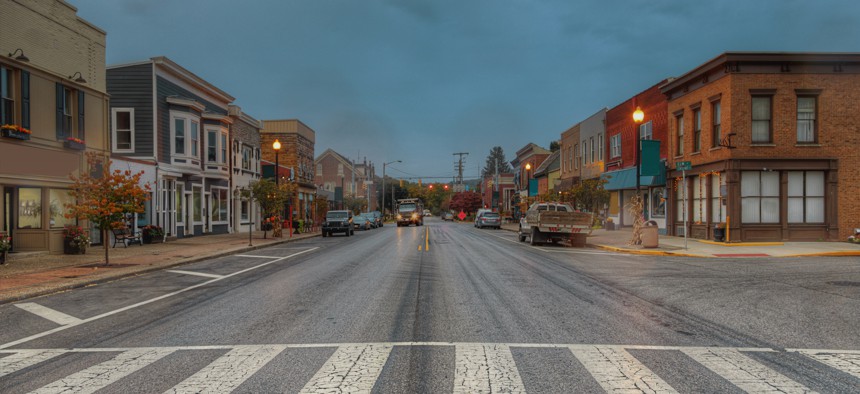
The clerk-treasurer in a rural Indiana town of 1,200 wears a lot of hats. She handles payroll, accounts payable, utility billing and building permits. She takes minutes at council meetings and answers the phone when residents call about potholes or stray dogs.
She's also, whether anyone realizes it or not, her municipality's de facto technology officer. And lately, she's been hearing about artificial intelligence: at conferences she can't afford to attend, in newsletters she doesn't have time to read, from vendors pitching solutions designed for jurisdictions ten times her size.
What she hasn't heard is anyone asking what she needs.
That silence is reflected in the data, or rather, the lack of it. The most comprehensive recent survey on AI adoption in local government received responses from just 12 communities with populations under 5,000. Twelve towns, out of more than 16,000 such municipalities across the country.
We have federal AI executive orders, state-level task forces and innovation offices in major cities. What we don't have is any real understanding of how the smallest local governments (the ones serving most of America's municipalities) are encountering this technology.
The Gap Between Policy and Reality
The federal government has been busy on AI. Executive orders have directed agencies to develop guidelines, assess risks, and consider impacts on the workforce. Former President Joe Biden’s administration launched AI.gov and pushed for responsible AI adoption across government.
States have followed. More than half now have AI task forces, executive orders, or legislation in some form. California, Colorado and Texas have moved on AI governance frameworks. State chief information officers are developing guidance documents and acceptable use policies.
But here's the disconnect: almost none of this reaches a town of 800 people with a part-time mayor and no IT staff.
Federal guidance tends to flow through professional networks that small towns don't belong to. State resources often assume baseline capacity: a city manager who reads policy briefs, an IT director who can translate guidance into practice. In thousands of American communities, those positions don't exist.
Meanwhile, AI doesn't wait for organizational readiness. ChatGPT is free and available in any browser. Small-town employees are already encountering it, using it to draft letters, summarize documents, and answer questions. Often they do so without any guidance, training, or policy.
"Federal guidance flows through professional networks that small towns don't belong to. State resources assume capacity that doesn't exist."
Who Gets Counted, Who Gets Missed
The 2024 International City/County Management Association survey on AI in local government drew 635 responses, a respectable sample that offered real insights about municipal priorities and barriers. But break down the data by community size and the picture gets troubling.
With only 12 respondents from municipalities under a 5,000 population, the margin of error in that category exceeds 27 percentage points. The survey found these small towns were highly enthusiastic about AI, with 83% calling it a priority and 92% reporting current use. But those numbers could plausibly be off by a third.
More importantly, consider who those 12 communities are. They're ICMA members with professional managers engaged enough to complete a survey about emerging technology. They're almost certainly the small towns doing it right, not the ones struggling to keep the water system running.
This isn't a critique of ICMA's methodology. It's a structural problem with how local government research works. Professional associations survey their members, but most small towns aren't members. Surveys go to city managers, but many small towns don't have them. Outreach happens via email, but plenty of small jurisdictions lack dedicated government email systems.
The result is a knowledge base that systematically overrepresents the professionalized minority and ignores the majority. When policymakers at any level of government ask "how are local governments adopting AI," the honest answer is: we only know about some of them.
Three-Quarters of Municipalities, Invisible
The scale of this blind spot is easy to underestimate. Of roughly 19,500 general-purpose municipalities in the United States, more than 10,000 have populations under 1,000. Another 4,000 fall between 1,000 and 5,000. Together, these small towns represent about 75% of all municipal governments.
They're concentrated in rural areas (the Great Plains, Appalachia, the rural Midwest and South) but they exist in every state. Many are the kind of communities that federal rural development programs are explicitly designed to serve.
Yet in the national conversation about AI and government, they're almost entirely absent. When we celebrate municipal AI innovation, we point to California powerhouses like San José and Long Beach. When we worry about AI risks, we imagine big-city police departments and social service agencies. The towns where a single clerk-treasurer is the government barely register.
Their residents, though, face the same questions anyone does: Will AI affect how their local government communicates with them? Will it influence code enforcement or utility billing? Will their data be protected? They deserve answers, too.
What Federal and State Leaders Could Do
Filling this knowledge gap would cost roughly $200,000 and take about nine months. Those are serious resources, but modest compared to most technology initiatives. A rigorous national study would require sampling from the Census of Governments rather than association membership, multi-modal outreach to reach communities without reliable email, and questions designed for organizations that don't look like big-city governments.
Several entities are positioned to lead. Federal agencies with rural mandates, such as the U.S.Department of Agriculture’s Rural Development program and the Economic Development Administration, could fund the research as part of their mission to serve underserved communities. The work aligns naturally with their focus.
State municipal leagues, which collectively cover every community in America, could form a consortium to distribute costs and ensure regional relevance. They're often the only professional organization small towns engage with at all.
Philanthropic and nonprofit organizations like Bloomberg, Pew and Ford have invested heavily in local government innovation. Understanding whether those investments are reaching beyond metros would seem to be a natural part of evaluating impact.
What we'd learn would shape policy at every level. Are small towns aware of AI at all? If awareness is the problem, the response looks different than if they're already experimenting without guidance. Are there regional patterns, with some states where small municipalities are thriving and others where they're struggling? What support would actually help: template policies, regional shared services, tools designed for small-government budgets?
The Cost of Not Knowing
For decades, technology moved slowly enough through local government that small towns could wait. Solutions matured, costs fell, and communities without cutting-edge capacity could eventually catch up.
AI is different. In November 2022, ChatGPT didn't exist as a public product. By early 2024, Pennsylvania was running a statewide pilot with employees reporting time savings of 95 minutes per day. The gap between early adopters and everyone else is widening faster than ever, and there's no reason to think it will slow down.
States and the federal government are making policy right now. They're designing training programs, allocating resources and setting priorities. They're doing so based on evidence that essentially excludes the majority of American municipalities.
The clerk-treasurer in Indiana, along with her counterparts in thousands of towns, will navigate AI with or without help. The question is whether anyone will think to ask what she's encountering before deciding what support to offer.
Right now, the answer is no. Washington is talking about AI governance. State capitals are developing frameworks. And 16,000 small towns are on their own.
Alton Henley is Dean of Business at Montgomery College in Maryland.