
Localities bemoan apparent ‘race to the bottom’ on data centers
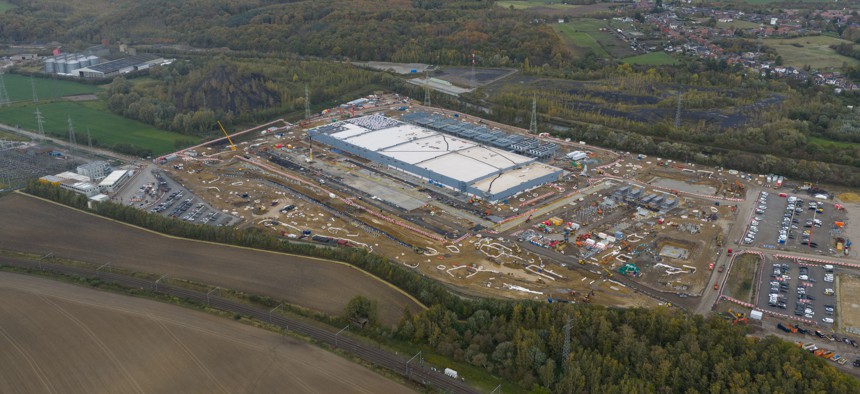
Hugo Kurk via Getty Images



 By
Chris Teale
By
Chris Teale
Attendees at the National Association of Counties said tech companies are not being good partners, but research and recent deals suggest a new way of doing business for local governments.
Denver became the latest city to announce it would pursue a moratorium on new data center development as state and local officials seek to better understand their financial and environmental costs.
The announcement came after a staff report reportedly noted the economic cost of the various tax breaks afforded to those behind data centers, while opponents in the community said the centers strain the electric grid and water system in supporting artificial intelligence. And while local leaders say they are working to extract concessions from tech companies to prevent the worst impacts on their areas, local concerns are rising unabated.
At a panel discussion during the National Association of Counties’ Legislative Conference in Washington, D.C. this week, one attendee during a question-and-answer session bemoaned what he called a “race to the bottom” as communities offer more and more concessions to try to attract data centers without considering the consequences. He also said the technology companies “don’t give a damn” and are fighting any effort to hold them accountable.
“I’m not against any of it,” said another attendee. “I just want to make sure our communities are protected.”
In response, Tony Clark, executive director of the National Association of Regulatory Utility Commissioners, acknowledged there is a lot of “frustration,” including among governments who are subject to the whims of tech companies exploring multiple sites at once and looking at how quickly they can get power and at what cost. And when it comes to land-use policies, Palm Beach County, Florida Commissioner Gregg Weiss said local communities must be more proactive, as they are “probably a little behind the eight-ball right now.”
Federal officials said there are signs that state and local leaders can get help for their communities, especially in a bid to avoid residents’ power bills spiking as data centers become operational.
Earlier this month, a bipartisan group of 13 governors announced alongside the White House that they secured major concessions from a regional electric grid operator to keep prices down and make tech companies pay for new energy generation.
Among the concessions the governors from the East Coast and Midwest won from PJM Interconnection, the largest regional transmission organization in the nation, was an agreement to make data center operators and other large users pay for the cost of new power, rather than pass those costs on to ratepayers. Those on stage at NACo said it shows what is possible when leaders come together for a common goal.
“I think it's very fair if a tech company or data center developer comes to your local territory, you point to that PJM deal that the president laid out and say, ‘We expect you to meet those same standards,’” said Peter Lake, senior director for power at the National Energy Dominance Council, a White House body established last year. “That's very fair.”
Separately, President Donald Trump announced during his State of the Union address an agreement known as the Rate Payer Protection Pledge, where major tech companies will pay for their power needs to try and avoid passing those costs onto existing ratepayers.
Outside experts have suggested that states and localities should rethink how they make deals to bring in data centers, especially when they consider any economic impacts. Earlier this month, researchers at the Brookings Institution noted what report co-author and Brookings senior fellow Mark Muro called “asymmetric negotiations” between communities and tech companies, with the former often lacking the expertise to truly break down a deal’s benefits and drawbacks. Communities also need to be more cognizant of its long-term implications.
“Data center deals are really great for elected officials, who are measured in four-year cycles,” said Daniel Goetzel, a fellow at Harvard University’s Reimagining the Economy Project and a report co-author. “All the benefits are front loaded. The construction jobs are front loaded. The big announcement with the end user, the influx of revenue into these communities without a lot of thought to the long tail on these projects. There is a revenue tail on these projects, which is great, especially for communities that are struggling financially, but the job creation numbers are a cliff.”
Instead, the report urged governments to think longer term, whether that be through thinking about how a data center can fit into a region’s efforts to become a hub for technology or providing power interconnectivity, or even by leveraging them to develop test beds to boost collaboration between the public and private sectors and academia. Communities should not just take the first deal they receive from a data center operator, the report argued, but instead think about how they can fit into a broader ecosystem that may outlast every elected official for years to come.
“I would say running through all this and practicing all of it is elevating aspirations and actually knowing what you want as a region long term, so that these dialogs are within the context of the strategies,” Muro said. “In many cases, that may be asking for more.”
Supporters said those behind data centers need to be better storytellers about the benefits for local communities and try to assuage some of residents’ concerns.
“People understand if BMW comes to Spartanburg, South Carolina, they know what that looks like,” said Kevin Gundersen, head of public affairs at data center company Digital Realty. “It's jobs, it's investment. People don't really know what a data center looks like… It's incumbent upon us to do that education. Right now, people in some places are afraid of data centers. It's on us to go in and explain what's actually happening inside of the data center.”