
Anthropic and nonprofit partner to streamline benefits administration with AI
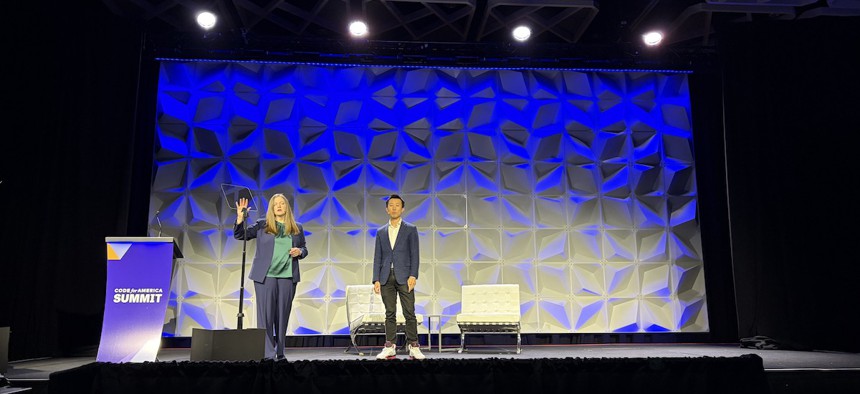
Jana Rhyu (left) and Michael Lai announce Code for America and Anthropic's partnership to develop AI-based tools to streamline benefits administration for caseworkers at the annual Code for America Summit on May 8, 2026, in Chicago. Kaitlyn Levinson for GovExec






Code for America is working with the AI company to build and pilot solutions that leverage Anthropic’s Claude chatbot to help benefit caseworkers improve service delivery.
CHICAGO — The civic tech nonprofit Code for America is partnering with artificial intelligence company Anthropic to develop tools aimed at helping caseworkers enhance public benefits administration across the nation.
The organizations are working together to develop an AI-enabled solution to improve the accuracy and timeliness of benefits service delivery under the Supplemental Nutrition Assistance Program, Jana Rhyu, vice president of product at Code for America, announced Friday at a summit hosted by the organization in Chicago last week.
The SNAP Policy Navigator tool is built on federal regulations, state manual selections, official policy directives and other documents to help caseworkers “quickly and accurately get an answer to [a] very specific policy question” when they are working with clients, said Michael Lai, who leads state and local government AI at Anthropic.
The tool leverages Anthropic’s Claude chatbot and is built on a model context protocol to ensure a secure two-way connection between data sources and AI applications, Rhyu said. A caseworker can input a simple, policy-based question, such as how a client’s change in income or a new federal policy could impact their benefits, and the tool outputs an up-to-date response in plain language with cited sources and suggested next steps.
The user “gets clarity on policy, not a decision on overall eligibility. The decision stays with [them],” she said.
The announcement comes as state and local public benefit agencies scramble to comply with rule changes to the federal food assistance program made last July under President Donald Trump’s “Big, Beautiful Bill.” The law subjects participants to expanded work requirements, shifts administrative costs to states based on their SNAP payment error rates, and requires that the Thrifty Food Plan — the model used to calculate the lowest-cost nutritional meal for a family of four — be cost-neutral to changes in food prices.
Since its passage, SNAP participation has declined by more than 3 million people across 36 states as of January, and further reductions are expected once the new rules are fully implemented, according to the Center on Budget and Policy Priorities.
“Policy is constantly changing, and the complexities of policy implementation are immense, which places an even bigger burden on the caseworkers,” Rhyu said.
That’s why it’s critical for resources like the SNAP Policy Navigator tool to help reduce caseworkers’ administrative burden of sifting through and trying to apply intricate policies to individual cases, she said.
Indeed, the complex rules regarding eligibility and exemptions present common barriers to benefits access and having to explain those to residents who depend on the timely and accurate delivery of public assistance to meet their everyday needs only adds to it, Lai said.
Such challenges are exacerbated by funding uncertainty, workforce shortages and increasing caseloads that many states and localities are grappling with across the U.S.
He pointed to one former caseworker who described their job as “an email inbox that's always full, where each one requires care and attention, but you're constantly getting interrupted as you try to work through the never ending inbox of people to help.”
In addition to the SNAP Policy Navigator, Code for America and Anthropic will develop a suite of Claude-based tools to further assist benefit workers with answering policy questions, reviewing eligibility documents and drafting communications to benefit recipients, Code for America leaders said in an announcement last week.
“We know that caseworkers are really overburdened in general, but especially at this moment with HR 1 as well, and so AI shouldn't be used for AI’s sake,” Lai said. “We want it ultimately to be helping in this human way and trying to make benefits administration more efficient, more accurate and more human centered.”