
How a data center derailed $240,000 for affordable housing in rural Maine
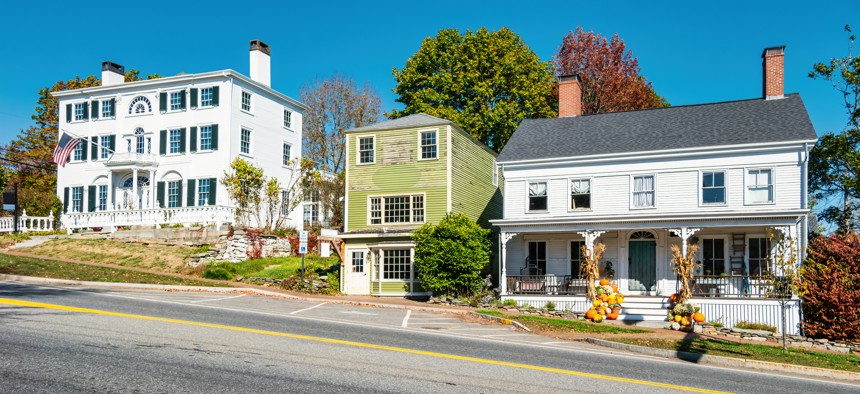
benedek via Getty Images





In rural Midcoast Maine, nearly a quarter of a million dollars in federal money earmarked for housing was rescinded from a small town after local officials sought to use the funds for a data center.
This article was originally published by Daily Yonder.
On a crisp afternoon in early April 2026, Richard Davis walked to the end of a boat launch on the Back River, a tidal channel that cuts through Midcoast Maine’s rocky coastline. As the tide swept in, Davis, co-founder of a local group called Protect Wiscasset and an area resident, fixed his attention on the opposite riverbank.
There, a 300-acre parcel of land, mostly covered by evergreen trees, is the subject of a decades-long debate that’s sparked questions about land use, energy, and local control in the town of Wiscasset, a community in Maine’s rural Lincoln County with a year-round population of 4,000 residents.
A recent idea? To build much-needed affordable housing, with initial federal funding from the American Rescue Plan Act (ARPA), a Covid-19 economic relief package passed in 2021.
Yet the land captured public attention in full force when plans to build a $5 billion data center were made public in September of 2025. Davis, who lives along the Back River about a mile and a half from the site, became concerned as soon as he found out about the data center. Protect Wiscasset came together last fall to organize against a development.
But Davis would soon learn that the data center was just part of the story. As the facilities are planned, often without much public transparency, communities also find themselves dealing with the opportunities lost to the possibility of a sprawling data center.
In Midcoast Maine, Wiscasset’s handling of a prospective data center ended with the community losing nearly a quarter of a million dollars of federal funding earmarked for housing.
All of this happened without a data center ever breaking ground. As the data center rush unfolds in small towns, the story is not only about what gets built, but also about what doesn’t.
Blinded by the Data Center Boom
Across rural America, places like Wiscasset are grappling with the data center boom. The data center market in North America is expected to be valued at $135 billion by the end of 2026, and it’s growing rapidly, driven by the needs of artificial intelligence. According to April 2026 findings from the Pew Research Center, two-thirds of new data centers are going to be built in rural places. Along with planned developments come fears about environmental and energy cost effects on host communities.
On Wiscasset’s Old Ferry Road, development plans are nothing new for the property along the Back River. The fate of the land has been an open question for more than two decades, since the Maine Yankee Atomic Power Company decommissioned its nuclear plant and sold hundreds of surrounding acres in the early 2000s. Wiscasset acquired the parcel in 2013, according to Aaron Chrostowsky, the town’s economic development director.
But the sudden, explosive debate over the data center last fall eclipsed federally-backed plans for affordable housing that had been in the works for months. Revelations about the potential data center caused more than just a community uproar.
Over a year ago, Lincoln County rescinded $240,000 in federal housing funds from Wiscasset after the town proposed using the money to scope out the feasibility of a data center, a Daily Yonder analysis of public records found. All of it happened outside of the public’s view.
As of the publishing of this story, the 300 acres on Old Ferry Road remain undeveloped. On March 3, 2026, Lincoln County reallocated Wiscasset’s federal dollars to the neighboring communities of Waldoboro and Newcastle, for their own affordable housing and infrastructure projects. The towns have until December 31, 2026, to spend the money, per federal law.
“They were so enamored by the idea of a $5 billion data center landing in Wiscasset that they kind of got blinded,” said Peter Arnold, a Lincoln County resident and the founder of RePower Wiscasset, about the town’s actions.
An Affordable Housing Crisis
During the Covid-19 pandemic, the Biden administration and U.S. Congress passed ARPA to promote the country’s economic recovery with $1.9 trillion in funding. Those funds were dispersed to businesses, households, and local governments across the U.S.
Maine counties got $261 million in federal ARPA dollars, and Lincoln County received more than $6.7 million, with the responsibility to allocate the money by the end of 2024 and spend it by the end of 2026.
By the spring of 2023, Lincoln County had approved the spending of $4.1 million of its ARPA dollars for emergency services, infrastructure, and other projects. Then, the county identified a need for nearly 900 additional affordable housing units to support community members.
Molly Feeney, executive director of Homeworthy, an area nonprofit working to prevent homelessness in the state’s Midcoast region, said middle and low-income people are being squeezed out of housing and rental markets.
“Particularly in the Midcoast and Lincoln County, there’s a lack of affordability on the entire scale,” said Feeney. “Whether that is subsidized units that we’re lacking inventory on, or just reasonable market rentals, there’s no affordability in any of this.”
This reality prompted Lincoln County commissioners to vote in June 2023 to allocate $1.5 million of their remaining ARPA funds to build affordable housing. Between the spring of 2023 and 2024, the county used ARPA dollars to fund the construction of 220 housing units in the region. By July of 2024, with six months left before the December 31, 2024, ARPA allocation deadline, the county decided its remaining funds would go toward building first responder and municipal workforce housing, citing a shortage of first responders in the region due to a lack of affordable units.
“Teachers, firefighters, police, they can’t afford to live in a lot of Wiscasset,” said Davis, who is a retired university professor. “Their salaries are not high enough to afford the housing.”
A May 2023 assessment and May 2025 follow-up found that the Old Ferry Road property was among several parcels in the town that could accommodate housing, with approximately 200 units possible on the 300 acres.
“Like pretty much every town village, there’s a real dearth of housing,” said Sam Selby, a Wiscasset resident and a member of the Protect Wiscasset group. “We could use all we can get.”
Funding Goes to Wiscasset
Back in July of 2024, Wiscasset discussed the opportunity at a town board meeting. There, Aaron Chrostowsky, Wiscasset economic development director, laid out his vision for a project, which he’d detailed in a memo to Dennis Simmons, the town manager, a few days before.
Chrostowsky described what he called a “Great American Neighborhood” on the Old Ferry Road property. The development would follow the principles of New Urbanism, a movement centered on sustainable design.
Chrostowsky’s memo detailed affordable and market-rate housing types and renewable energy on the property, as well as future energy and technology developments on adjacent parcels of land. The plan also cited the region’s “housing affordability crisis,” mentioning Lincoln County’s May 2023 housing assessment, which had identified a need for 110 homes in Wiscasset.
On November 5, 2024, Lincoln County awarded $240,000 to Wiscasset for the Old Ferry Road property. The town’s submission included plans for a housing feasibility study, with a proposal to build 110 units on the land. The submission also included plans for public engagement to bring residents into the planning process.
While finalizing the details of its ARPA award in October of 2024, Wiscasset also signed an agreement to receive technical assistance from the Maine Community Energy Redevelopment Program (MECERP), an initiative launched by Maine’s Governor, Janet Mills, to support locally-determined revitalization projects at current and former industrial sites. Wiscasset’s Old Ferry Road property, near the former Maine Yankee nuclear plant, was among those selected for economic development planning.
In an October 24, 2024, letter to Wiscasset about the ARPA funding, Lincoln County administrator Carrie Kipfer “strongly recommended” the town coordinate the MECERP technical assistance award with the ARPA funding, since both dealt with the same property on Old Ferry Road but had different aims.
The technical assistance, an agreement with the state, was intended to survey locals about their ideas for development on the property. The ARPA award, an agreement with the county and federal government, was specifically geared toward conducting a feasibility study to determine whether the land could be turned into affordable housing.
A Data Center Enters the Picture
But by November of 2024, a different plan was taking shape in Wiscasset, without the public’s awareness. Chrostowsky became involved in dialogue about developing a data center on town-owned land as early as November 7, 2024, two days after the ARPA agreement was signed by Wiscasset and Lincoln County, according to public records obtained by the Daily Yonder.
A few months later, on February 4, 2025, Chrostowsky told a Lincoln County Regional Planning Commission staffer that he was going to use the ARPA award to “explore the feasibility of developing a data information center,” per a February 13, 2025, memo from Emily Rabbe, executive director of the Lincoln County Regional Planning Commission (LCRPC), obtained by the Daily Yonder.
Chrostowsky told the staffer he’d been working with a man from an unnamed private company interested in developing approximately 200 of the 300 acres for a data center. The man, Chrostowsky later told the Daily Yonder, is a site evaluator from California who heard about the property through MECERP, the state’s energy redevelopment program.
During the February 4, 2025, meeting with the LCRPC staffer, Chrostowsky also “expressed knowledge that the ARPA funding is supposed to be used for housing,” according to the February 13, 2025, memo. The staffer cautioned Chrostowsky to be “extremely careful about misappropriating government funding that has been directed for a specific use.” Chrostowsky then asked the staffer not to tell anyone, per the memo. The staffer later reported the conversation to Rabbe out of an “ethical obligation.”
“We explained to the county our dilemma, so to say that we weren't communicating with the county, that was not the case,” Chrostowsky told the Daily Yonder. He said the town struggled with the fact that it had received a $240,000 award for housing on the same property where interest from an out-of-state site evaluator presented an opportunity to significantly increase the town’s tax base.
Yet for Wiscasset community members, news about a data center wouldn’t emerge for another seven months.
The Community Finds Out
When lifelong Wiscasset resident John Maclaren first heard about the proposed data center last fall, his first reaction was: “Why our town?” But having grown up during what he described as the “heyday” of the Maine Yankee plant’s operation, Maclaren already knew the answer: the power infrastructure.
While in operation between 1972 and 1996, Maine Yankee was Maine’s largest generator of electricity. Since Wiscasset acquired the Old Ferry Road property, a number of energy industry players have eyed the site for its proximity to the nuclear plant’s legacy electricity infrastructure, but no developments have ever materialized.
“All of those wires and substations are still there,” Peter Arnold said. Arnold's RePower Wiscasset is a local group promoting renewable energy and sustainable development on the old Maine Yankee parcel. “We have the capacity to connect with not only the rest of Maine, but all of New England. Wiscasset is sitting on this amazing, valuable, underutilized legacy electricity infrastructure.”
“It’s a prime spot,” Maclaren said. “I understand that. But then again, my question still stands. What benefit is this place going to give the Wiscasset residents?”
While news of the data center became public in September, 2025, there weren’t a lot of details about what a facility would entail, said Jim Stewart, a Wiscasset resident who’s part of the Protect Wiscasset group. Information about how much electricity and water a campus would use was obscured behind a nondisclosure agreement that the town manager, Dennis Simmons, signed on August 19, 2025, with the developer.
Chrostowsky told the Daily Yonder that the town decided to sign the NDA in order to access the site evaluator’s financial information. After months of regular communication with the site evaluator, Chrostowsky said that the idea of a data center “started to get legs” in the summer of 2025, shortly before the NDA was signed.
The agreement prohibits the town from sharing the name of the site evaluator or any technical details about the project with the public.
“That's what really got under our skin – you’re not giving us any answers, you’re not giving us any information, and yet, this thing seems to have a great deal of momentum,” Stewart said about Protect Wiscasset’s efforts to learn more about the data center during town and county meetings last fall.
Maclaren, too, said the plans were secretive. He described the whole thing as “hush hush.” After working on the decommissioning of Maine Yankee in the late 1990s and early 2000s, Maclaren remembers how the town’s tax revenue dried up when the plant was gone. In his opinion, a data center would have to meet or exceed the benefits Wiscasset received during its Maine Yankee days. “When it comes to our tax revenue, I’d say they have to beat it,” Maclaren said.
Chrostowsky told the Daily Yonder that he saw the NDA as a typical development tool to learn more about a potential project while protecting the project’s interests. Yet, after the public backlash that ensued over the data center last fall, Chrostowsky said the decision to sign the NDA is one he’s revisited.
“The NDA is one part of it that I’ve lamented about, and I struggle with. On occasion, we have conversations about that here, whether we do that again,” Chrostowsky said.
Wishy-Washy Plans
Meanwhile, months before the data center became public, Wiscasset had gone back and forth with Lincoln County about the ARPA funds. On March 3, 2025, Lincoln County administrator Carrie Kipfer wrote to Wiscasset’s town selectboard, which functions like a city council, expressing concerns that Wiscasset’s plans for using the federal money had “significantly changed”.
She wrote that using ARPA funds for a data center was “outside the scope of the project that was approved.” On March 24, 2025, in response to Kipfer, Wiscasset town manager Dennis Simmons defended the town’s actions, describing the potential data center as “game-changing, not only for the Town of Wiscasset’s economic development but also for the County as a whole.” Simmons continued that “the potential is such that it would be a grave disservice to our community not to do our due diligence and explore this possibility.”
Wiscasset residents were still completely unaware of talks of a data center in their community at this time.
“I think the opportunity presented itself to try and develop a data center there, and I think that they had the idea that they could use the funding award that we had awarded them to position themselves better for that project,” Evan Goodkowsky, a lifelong Wiscasset resident and one of Lincoln County’s three commissioners, told the Daily Yonder.
At this point last spring, Goodkowsky said, the commissioners weren’t confident that Wiscasset was going to use the ARPA funds they’d been awarded by the December 31, 2026, spending deadline. Goodkowsky described a “wishy-washiness of the plan” in terms of the type of development that the town wanted to pursue.
By March 27, 2025, the county had withheld Wiscasset’s ARPA funding, according to a memo between Kipfer and Lincoln County commissioners. In that memo, Kipfer wrote, “The Town argues that the scope of the project has not changed since their original application; however, a 200-acre data center is not compatible with their vision of a ‘Great American Neighborhood.’”
Kipfer continued on to express concerns about Wiscasset’s actions, including that “it appears the Town is ‘shopping around’ for alternative development opportunities” not necessarily aligned with the county’s housing priorities. She wrote, “The approval was given for $240,000, a sum that is not mere pocket change. The intent of the project approval was to move the housing priorities forward in Lincoln County.”
“We were only concerned with the housing issue, and we weren’t interested in helping a private developer build a multi-million, if not multi-billion, dollar facility,” Goodkowsky said of the commissioners’ decision.
The County Loses Confidence
At the end of May of 2025, Kipfer sent a letter to Wiscasset’s selectboard telling the board the county was rescinding its offer of ARPA funding. The county came to that decision, Kipfer wrote, because the town was still exploring a data center on the Old Ferry Road property that, at 200 acres, was too large to accommodate any housing development on the same parcel.
“This exploration is not a result of a public engagement process, nor a recommendation of the MECERP analysis, but an economic development opportunity misaligned from the housing priorities required in the grant process,” Kipfer wrote.
The MECERP analysis, which had been completed in January of 2025, surveyed the community to see what kinds of development they’d want on town-owned land. At the top of the list were parks and recreation, retail, shopping, and culture and entertainment venues. Technology and light industry, the categories under which data centers are developed, were not on the list of community-determined priorities.
Kipfer concluded the May 29, 2025, letter by saying that the Lincoln County commissioners “no longer have confidence that the funds will be used for the advancement of the development of affordable workforce housing.”
Simmons, the town manager, responded two days later, writing that Wiscasset hadn’t used any ARPA funds and was “choosing to instead invest its own resources in site assessments, surveys, and planning groundwork.” Wiscasset continued to move forward with data center development plans over the summer.
By the fall, the town was also trying to save its ARPA funding.
At the September 16, 2025, county commissioner meeting, Simmons requested to redirect the town’s ARPA funds from the Old Ferry Road property to a different site for housing development. The commissioners raised concerns about that plan, noting that other projects in the county might be better prepared to use the ARPA funds by the 2026 deadline.
Over the next several weeks, Wiscasset communicated with Lincoln County about reapplying for the rescinded $240,000, per correspondence obtained by the Daily Yonder. On October 20, 2025, Kipfer wrote to the town selectboard informing them that Lincoln County would not be entertaining applications for new projects.
Kipfer expressed concerns about Wiscasset’s development plans in relation to U.S. Treasury rules. Any wrongful obligation or spending of federal funds “could have a negative effect on all Lincoln County municipalities,” Kipfer wrote, adding that the county was taking steps necessary to “mitigate that financial risk.”
Empty Land, Declining Trust
In the six months since Wiscasset’s selectboard paused conversations about developing the Old Ferry Road property, little new information has come to light, according to residents.
Around the state, backlash to data center proposals prompted the Maine legislature to take up the issue this spring, sending a bill to the governor’s desk in April. The bill would have imposed an 18-month moratorium on data centers with power loads above 20 megawatts. Governor Mills vetoed that measure on April 24, 2026. In Wiscasset, Chrostowsky said he has not heard from the site evaluator about a data center since the town paused discussions last November.
And housing, at least funded by federal dollars, is also unlikely to be built on the property anytime soon.
“The ARPA funds were certainly what seems like a one-time thing,” said Seth Parker, the director of real estate development at Bath Housing, the local housing authority in the city of Bath, Maine, just south of Wiscasset. Accessing other federal funding sources is tricky, Parker said: “Other funds get parsed out in various ways. It doesn’t create a simple mechanism to develop in rural communities, that’s for sure, or in places like Lincoln County.”
Goodkowsky, who grew up in Wiscasset during and after the decommissioning of Maine Yankee, said the town has a “boom and bust” dynamic. After the loss of the ARPA funds, he doesn’t see the town moving forward on housing developments anytime soon.
“Realistically, I don't see them being a power player in any new housing project in the next handful of years,” Goodkowsky said.
Peter Arnold is working with Aaron Chrostowsky on other opportunities for the town, including developing a strategic energy plan for Wiscasset with help from a U.S. Department of Energy technical assistance program. Three months into that work, Arnold said the data center still “clouds” the field. The handling of the data center proposal did not build the public’s trust in the town government, he said.
In rural America, the story of data center development is not only about technology or infrastructure. It’s also about local governance and decision-making. When a powerful industry comes in and exercises its financial might, it’s often up to local elected leaders to balance attractive economic prospects with a community’s existing needs for other kinds of developments. In Midcoast Maine, a data center stalled.
So did affordable housing in its wake.
As for the land on Old Ferry Road? “Wiscasset is now vulnerable again to development,” Arnold said. “$5 billion can buy a lot of influence.”