
New Senate bill would reauthorize cyber grant program
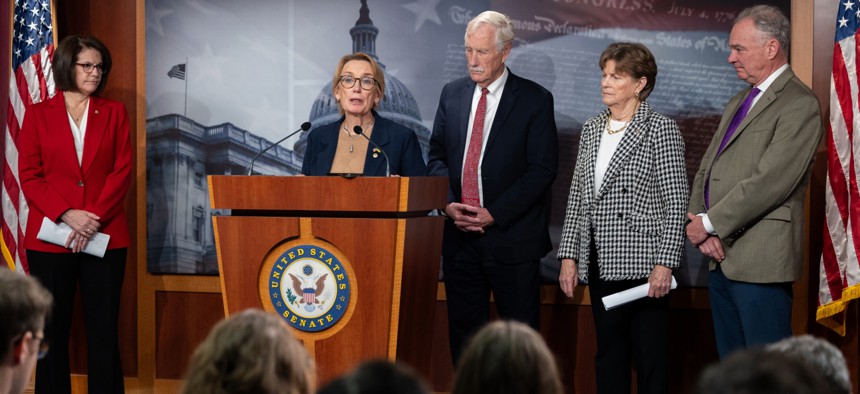
Sen. Maggie Hassan (center) speaks during a Senate press conference. Anadolu via Getty Images





 By
Chris Teale
By
Chris Teale
It comes weeks after the House voted to reup the $1 billion state and local grants, which also received a temporary lifeline during the recent government funding deal.
Just weeks after the House voted to reauthorize a federal grant program for state and local cybersecurity, a new Senate bill aims to do the same.
Democratic Sen. Maggie Hassan of New Hampshire and Republican Sen. John Cornyn of Texas introduced a bill to reup the State and Local Cybersecurity Grant Program, a four-year, $1 billion initiative initially funded by the 2021 infrastructure law. This bill would reauthorize the program for Fiscal Year 2026.
“State and local governments continue to face evolving cyber threats that put essential services like school systems, utilities, and emergency services at risk,” Hassan said in a statement. “The State and Local Cybersecurity Grant Program has given states and localities critical resources to strengthen their cyber defenses, and this bipartisan legislation will ensure that this important work can continue.”
The House has already approved the Protecting Information by Local Leaders for Agency Resilience Act, known as the PILLAR Act, which would reauthorize the cyber grant program for 10 years. That bill would also stabilize cost-sharing agreements for the grants so that the federal government would provide 60% of a grant to a single entity that applies and 70% for a multi-entity group, with states providing the rest.
The program, which expired at the end of September, received a temporary reauthorization as part of the deal to reopen the federal government. It has proven popular among state and local leaders; the Government Accountability Office found in a report earlier this year that the program had helped fund 839 state and local cybersecurity projects as of Aug. 1, 2024.
The bill, like its House counterpart, does not deal with funding levels for the grant program. State leaders have for some time been urging Congress to invest more given the program’s successes, and how it has helped them think more about cybersecurity. Groups have said previously that a funding level of $4.5 billion over two years from a stable funding stream would be an appropriate amount to spend.
Lawmakers said the program plays a crucial role in boosting cybersecurity and must be reauthorized so it can continue that work.
“As the digital threat landscape continues to evolve and grow more perilous, it’s imperative that Texans are able to defend against harmful attacks online,” Cornyn said in a statement. “I am proud to have created this program, which has provided nearly $40 million in resources for Texas, and this legislation will continue to ensure communities across the Lone Star State are equipped with the tools necessary to maintain vigilance and improve cybersecurity.”