New attacks multiply the threats to systems

A new type of denial-of-service attack showing up on the Internet dramatically increases the threat to even well-secured computer systems, security experts said recently.

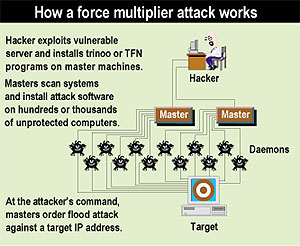
A new type of denial-of-service attack showing up on the Internet dramatically increases the threat to even well-secured computer systems, security experts said recently.The distributed attacks are described as force multipliers, and can leverage the power of thousands of computers against a single site.Two versions have been identified, called trinoo and Tribe Flood Network. Alan Paller, director of research for the SANS Institute in Bethesda, Md., said the new attacks are stealthy, automated and powerful.'It's a bigger problem by several orders of magnitude' compared with other typical hacker methods, Paller said.Hackers until recently were working out bugs in the force multiplier programs.But in August, a trinoo network of more than 200 computers was used to flood a system at the University of Minnesota with User Datagram Protocol (UDP) packets, knocking it out for two days, according to a report by David Dittrich of the University of Washington. About half of the computers used to launch the attack were on Internet2, the high-speed backbone operated by the University Corp. for Advanced Internet Development.'Trinoo networks are probably being set up on hundreds, perhaps thousands of systems on the Internet,' said Dittrich, a software engineer and consultant at the school's computing and communications client services group. 'An attack like this has the advantage of allowing an attacker to give a single IP address and have multiple attacks be launched, increasing the probability of successful attack.'A Tribe Flood Network, or TFN, attack is similar to trinoo but more versatile, Dittrich said.'While trinoo only implements UDP flood attacks, TFN supports Internet Control Message Protocol flood, UDP flood, SYN flood and Smurf-style attacks,' he said.TFN agents also can be harder to detect because they communicate using ICMP packets. Extra bits are inserted in the headers of these packets, which are disguised as echo replies to ICMP Packet Internet Groper requests. These packets pass through most firewalls without being inspected.With both trinoo and TFN, an attacker installs the application on a computer, often a server, that has been exploited using common vulnerabilities. These computers, called masters, then scan other systems to find vulnerable machines, and can automatically install attack software. These machines, called daemons, can number in the thousands in a single trinoo or TFN network. The master maintains a list of IP addresses for daemons under its command.When the attacker orders an attack against a target IP address, the master sends orders to the daemons under its control to launch a coordinated assault.'In many cases, masters have been set up on Internet service providers' primary name server hosts,' where high traffic hides covert communications, Dittrich said.Because of the volume of attack packets that can be focused on a single address, even a well-protected site can be overwhelmed and put out of service, Paller said. This can put sites with good security at the mercy of poorly secured sites that serve as masters and daemons.Since the attack programs were discovered, the SANS Institute and the Computer Emergency Response Team at Carnegie Mellon University have received a growing number of reports of suspicious ICMP echo replies on networks.Both trinoo and TFN have mostly been found installed on machines running SunSoft Solaris 2.x or Linux'probably because of the availability of hacker tools for these systems, Dittrich said.CERT's suggestions for defending against automated denial-of-service attacks focus on stopping them before they can get started. The first step is to secure networks against known exploits so they will not become hosts for trinoo and TFN. Next is preventing the origination of IP packets with spoofed source addresses.If an attack tool is found on a system, 'it is important to determine the role of the tool,' CERT advises. 'The piece you find may provide information that is useful in locating and disabling other parts of a distributed attack network.'Finally, if your agency's systems are the victim of a denial-of-service attack, remember that you might not be able to rely on the Internet for communications.Get more information on trinoo and TFN attacks on the SANS Web site, at , and the Carnegie Mellon CERT's Web site, at .

By William Jackson
GCN Staff


A force multiplier attack can leverage the power of many computers to wear down the defenses of a single system.


Flood support


On the attack


www.sans.orgwww.cert.org

NEXT STORY: OS UPDATE

X
This website uses cookies to enhance user experience and to analyze performance and traffic on our website. We also share information about your use of our site with our social media, advertising and analytics partners. Learn More / Do Not Sell My Personal Information
Accept Cookies
X
Cookie Preferences Cookie List

Do Not Sell My Personal Information

When you visit our website, we store cookies on your browser to collect information. The information collected might relate to you, your preferences or your device, and is mostly used to make the site work as you expect it to and to provide a more personalized web experience. However, you can choose not to allow certain types of cookies, which may impact your experience of the site and the services we are able to offer. Click on the different category headings to find out more and change our default settings according to your preference. You cannot opt-out of our First Party Strictly Necessary Cookies as they are deployed in order to ensure the proper functioning of our website (such as prompting the cookie banner and remembering your settings, to log into your account, to redirect you when you log out, etc.). For more information about the First and Third Party Cookies used please follow this link.

Allow All Cookies

Manage Consent Preferences

Strictly Necessary Cookies - Always Active

We do not allow you to opt-out of our certain cookies, as they are necessary to ensure the proper functioning of our website (such as prompting our cookie banner and remembering your privacy choices) and/or to monitor site performance. These cookies are not used in a way that constitutes a “sale” of your data under the CCPA. You can set your browser to block or alert you about these cookies, but some parts of the site will not work as intended if you do so. You can usually find these settings in the Options or Preferences menu of your browser. Visit www.allaboutcookies.org to learn more.

Sale of Personal Data, Targeting & Social Media Cookies

Under the California Consumer Privacy Act, you have the right to opt-out of the sale of your personal information to third parties. These cookies collect information for analytics and to personalize your experience with targeted ads. You may exercise your right to opt out of the sale of personal information by using this toggle switch. If you opt out we will not be able to offer you personalised ads and will not hand over your personal information to any third parties. Additionally, you may contact our legal department for further clarification about your rights as a California consumer by using this Exercise My Rights link

If you have enabled privacy controls on your browser (such as a plugin), we have to take that as a valid request to opt-out. Therefore we would not be able to track your activity through the web. This may affect our ability to personalize ads according to your preferences.

Targeting cookies may be set through our site by our advertising partners. They may be used by those companies to build a profile of your interests and show you relevant adverts on other sites. They do not store directly personal information, but are based on uniquely identifying your browser and internet device. If you do not allow these cookies, you will experience less targeted advertising.

Social media cookies are set by a range of social media services that we have added to the site to enable you to share our content with your friends and networks. They are capable of tracking your browser across other sites and building up a profile of your interests. This may impact the content and messages you see on other websites you visit. If you do not allow these cookies you may not be able to use or see these sharing tools.

If you want to opt out of all of our lead reports and lists, please submit a privacy request at our Do Not Sell page.

Save Settings
Cookie Preferences Cookie List

Cookie List

A cookie is a small piece of data (text file) that a website – when visited by a user – asks your browser to store on your device in order to remember information about you, such as your language preference or login information. Those cookies are set by us and called first-party cookies. We also use third-party cookies – which are cookies from a domain different than the domain of the website you are visiting – for our advertising and marketing efforts. More specifically, we use cookies and other tracking technologies for the following purposes:

Strictly Necessary Cookies

We do not allow you to opt-out of our certain cookies, as they are necessary to ensure the proper functioning of our website (such as prompting our cookie banner and remembering your privacy choices) and/or to monitor site performance. These cookies are not used in a way that constitutes a “sale” of your data under the CCPA. You can set your browser to block or alert you about these cookies, but some parts of the site will not work as intended if you do so. You can usually find these settings in the Options or Preferences menu of your browser. Visit www.allaboutcookies.org to learn more.

Functional Cookies

We do not allow you to opt-out of our certain cookies, as they are necessary to ensure the proper functioning of our website (such as prompting our cookie banner and remembering your privacy choices) and/or to monitor site performance. These cookies are not used in a way that constitutes a “sale” of your data under the CCPA. You can set your browser to block or alert you about these cookies, but some parts of the site will not work as intended if you do so. You can usually find these settings in the Options or Preferences menu of your browser. Visit www.allaboutcookies.org to learn more.

Performance Cookies

We do not allow you to opt-out of our certain cookies, as they are necessary to ensure the proper functioning of our website (such as prompting our cookie banner and remembering your privacy choices) and/or to monitor site performance. These cookies are not used in a way that constitutes a “sale” of your data under the CCPA. You can set your browser to block or alert you about these cookies, but some parts of the site will not work as intended if you do so. You can usually find these settings in the Options or Preferences menu of your browser. Visit www.allaboutcookies.org to learn more.

Sale of Personal Data

We also use cookies to personalize your experience on our websites, including by determining the most relevant content and advertisements to show you, and to monitor site traffic and performance, so that we may improve our websites and your experience. You may opt out of our use of such cookies (and the associated “sale” of your Personal Information) by using this toggle switch. You will still see some advertising, regardless of your selection. Because we do not track you across different devices, browsers and GEMG properties, your selection will take effect only on this browser, this device and this website.

Social Media Cookies

We also use cookies to personalize your experience on our websites, including by determining the most relevant content and advertisements to show you, and to monitor site traffic and performance, so that we may improve our websites and your experience. You may opt out of our use of such cookies (and the associated “sale” of your Personal Information) by using this toggle switch. You will still see some advertising, regardless of your selection. Because we do not track you across different devices, browsers and GEMG properties, your selection will take effect only on this browser, this device and this website.

Targeting Cookies

We also use cookies to personalize your experience on our websites, including by determining the most relevant content and advertisements to show you, and to monitor site traffic and performance, so that we may improve our websites and your experience. You may opt out of our use of such cookies (and the associated “sale” of your Personal Information) by using this toggle switch. You will still see some advertising, regardless of your selection. Because we do not track you across different devices, browsers and GEMG properties, your selection will take effect only on this browser, this device and this website.