Interview: State IT moves to front office

Fernando Burbano was sworn in as the State Department's chief information officer on May 11, 1998.

BURBANO: Until recently'after Y2K to be honest with you'the focus over the last two years has required the State Department to enforce moratoriums because people didn't want to work on maintenance and legacy systems.But now we are starting to look at another theme. Most agencies had paid attention only to administrative applications, standard personnel, payroll and finance'all back-office stuff. But the core mission of the department is international affairs. So we wanted to start developing applications for our core mission, for the diplomats, public diplomacy and foreign affairs specialists, economic officers, all those people who are in diplomacy and international affairs.We want to make these applications Web-based. We want to do knowledge management, data mining and data warehousing.We will lower the intensity on the administrative applications, but we don't want to neglect them because we aren't going to say that they are in the greatest shape. A lot of them aren't Web-based; many don't use relational databases. So we aren't going to completely forget about them, but we are going to put more resources toward the core mission.There were two reports done on the department about foreign affairs and diplomacy that talk about information technology. They said that State, not having enough funds, ought to look at doing things better to reduce cost, take advantage of fewer personnel and consolidate some of our networks. The reports said that our truly unclassified Internet network, which is separate, could be combined with our sensitive but unclassified network.That way we could reduce costs and would ultimately improve productivity because people wouldn't have two log-ons, two password systems and two e-mail systems. And then there is the problem of maintaining the infrastructure: the servers, the lines and all that other stuff. The unclassified data would remain separate from the classified.Some of the problems we are having at State are applicable to any federal agency. You have the problem of information sharing vs. security. We have to have diplomatic officers and such collecting information overseas, and what's a better place than the Internet? The Internet gives you a presence in every country; it gives you Web sites.And since we acquired the U.S. Information Agency in October, we also have worldwide information dissemination. We picked up the big responsibility for pumping out information.On the security side, since all this stuff we're talking about is Internet, you have all these cyberattacks and viruses. So the technology of the Internet has good things, but it also poses risks. We have to worry about sensitive information. We have done a lot in security. There is a lot of user frustration. People don't like to have to log on to multiple systems. But there is an increasing need for e-diplomacy. We are going to schedule an evaluation by an independent contractor who will look at the vulnerabilities, solutions, costs, etc. If there are vulnerabilities, we will close them, and if our independent assessor says, 'This is too risky,' then we won't do it.

Fernando Burbano

Fernando Burbano was sworn in as the State Department's chief information officer on May 11, 1998.

As head of State's IRM Bureau, he is the equivalent of an assistant secretary and reports directly to the secretary and the undersecretary for management. He oversees an information technology budget of more than $500 million and the activities of more than 2,000 employees.

From 1993 to May 1998 Burbano worked at the National Institutes of Health's National Library of Medicine, as its director of computer and communications and as director of information systems. He directed the office of information resources management for the Peace Corps from 1990 to 1993. He also has spent stints in industry IT jobs.

Burbano recently spoke with GCN about focusing on projects that further the department's day-to-day mission.


Who's In Charge


Fernando Burbano

Chief Information Officer and Assistant Secretary, IRM


Patricia Popovich

Deputy CIO, Management


Robert Surprise

Deputy CIO, Operations


Dan Campbell

Deputy CIO, Customer Service and Chief Knowledge Officer


Roy Standing

Deputy CIO, Architecture


Joe Chaddic

Senior Director, Foreign Affairs Systems Integration

TOP CONTRACTORS


(In millions, fourth quarter fiscal 1998 through third quarter fiscal 1999)


AT&T Corp. . . .$21.8
Orkand Corp. . . . .$11.6
MCI WorldCom Inc. . . .$10.4
BTG Inc. .$9.5
WorldCom Federal Systems .$5.2
IBM Corp. . . . .$5.2
Logicon Inc. . . .$5.0
Computer Sciences Corp. . . .$4.4
Esatel Communications Inc.$4.1
Mantech International Corp. . .$3.8
TOTAL. . . .$81.0


Sources for this GCN Snapshot
include the State Department and Input of Vienna, Va.


One, not two


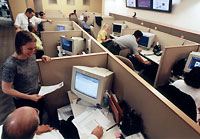
The State Department's InfoCenter Service Desk assists employees worldwide 24 hours a day, seven days a week.


Major programs
Corporate Information Security Officer Program'Designed to improve systems security, the program began last April. Through it, State oversees the security programs at more than 340 department sites. The program staff certifies and accredits sites to ensure that they follow security policies. The program team also approves plans for State voice systems and the privileges for services through the department's main data hubs. Between 15 and 20 State employees work in the program office.


Enterprise Network Management Initiative'In this effort, State supports departmentwide intranet. The initiative team oversees the intranet's design and assures its round-the-clock operation. The team also runs a technical lab to test network changes. With a $12 million budget, the team also tracks State's IT resources, monitoring use of all hardware and software.


OpenNet Plus'State is studying the feasibility of using a single network for unclassified information over the Internet and its intranet. The department is studying a report on the OpenNet Plus project to determine whether the security risk is within acceptable parameters before it implements a pilot. State expects to decide this month whether to proceed with a two-year, $318,000 pilot.


Superserver Initiative'The department has worked for two years on upgrading the performance of its mainframe data centers. The goal is to distribute more services'security, consular systems, financial management, administrative payroll and personnel retirement management'to users via Web interfaces. The department also wants to do more data warehousing, remote backup, configuration management and disaster recovery. State expects to spend $25 million upgrading its core data services.


X
This website uses cookies to enhance user experience and to analyze performance and traffic on our website. We also share information about your use of our site with our social media, advertising and analytics partners. Learn More / Do Not Sell My Personal Information
Accept Cookies
X
Cookie Preferences Cookie List

Do Not Sell My Personal Information

When you visit our website, we store cookies on your browser to collect information. The information collected might relate to you, your preferences or your device, and is mostly used to make the site work as you expect it to and to provide a more personalized web experience. However, you can choose not to allow certain types of cookies, which may impact your experience of the site and the services we are able to offer. Click on the different category headings to find out more and change our default settings according to your preference. You cannot opt-out of our First Party Strictly Necessary Cookies as they are deployed in order to ensure the proper functioning of our website (such as prompting the cookie banner and remembering your settings, to log into your account, to redirect you when you log out, etc.). For more information about the First and Third Party Cookies used please follow this link.

Allow All Cookies

Manage Consent Preferences

Strictly Necessary Cookies - Always Active

We do not allow you to opt-out of our certain cookies, as they are necessary to ensure the proper functioning of our website (such as prompting our cookie banner and remembering your privacy choices) and/or to monitor site performance. These cookies are not used in a way that constitutes a “sale” of your data under the CCPA. You can set your browser to block or alert you about these cookies, but some parts of the site will not work as intended if you do so. You can usually find these settings in the Options or Preferences menu of your browser. Visit www.allaboutcookies.org to learn more.

Sale of Personal Data, Targeting & Social Media Cookies

Under the California Consumer Privacy Act, you have the right to opt-out of the sale of your personal information to third parties. These cookies collect information for analytics and to personalize your experience with targeted ads. You may exercise your right to opt out of the sale of personal information by using this toggle switch. If you opt out we will not be able to offer you personalised ads and will not hand over your personal information to any third parties. Additionally, you may contact our legal department for further clarification about your rights as a California consumer by using this Exercise My Rights link

If you have enabled privacy controls on your browser (such as a plugin), we have to take that as a valid request to opt-out. Therefore we would not be able to track your activity through the web. This may affect our ability to personalize ads according to your preferences.

Targeting cookies may be set through our site by our advertising partners. They may be used by those companies to build a profile of your interests and show you relevant adverts on other sites. They do not store directly personal information, but are based on uniquely identifying your browser and internet device. If you do not allow these cookies, you will experience less targeted advertising.

Social media cookies are set by a range of social media services that we have added to the site to enable you to share our content with your friends and networks. They are capable of tracking your browser across other sites and building up a profile of your interests. This may impact the content and messages you see on other websites you visit. If you do not allow these cookies you may not be able to use or see these sharing tools.

If you want to opt out of all of our lead reports and lists, please submit a privacy request at our Do Not Sell page.

Save Settings
Cookie Preferences Cookie List

Cookie List

A cookie is a small piece of data (text file) that a website – when visited by a user – asks your browser to store on your device in order to remember information about you, such as your language preference or login information. Those cookies are set by us and called first-party cookies. We also use third-party cookies – which are cookies from a domain different than the domain of the website you are visiting – for our advertising and marketing efforts. More specifically, we use cookies and other tracking technologies for the following purposes:

Strictly Necessary Cookies

We do not allow you to opt-out of our certain cookies, as they are necessary to ensure the proper functioning of our website (such as prompting our cookie banner and remembering your privacy choices) and/or to monitor site performance. These cookies are not used in a way that constitutes a “sale” of your data under the CCPA. You can set your browser to block or alert you about these cookies, but some parts of the site will not work as intended if you do so. You can usually find these settings in the Options or Preferences menu of your browser. Visit www.allaboutcookies.org to learn more.

Functional Cookies

We do not allow you to opt-out of our certain cookies, as they are necessary to ensure the proper functioning of our website (such as prompting our cookie banner and remembering your privacy choices) and/or to monitor site performance. These cookies are not used in a way that constitutes a “sale” of your data under the CCPA. You can set your browser to block or alert you about these cookies, but some parts of the site will not work as intended if you do so. You can usually find these settings in the Options or Preferences menu of your browser. Visit www.allaboutcookies.org to learn more.

Performance Cookies

We do not allow you to opt-out of our certain cookies, as they are necessary to ensure the proper functioning of our website (such as prompting our cookie banner and remembering your privacy choices) and/or to monitor site performance. These cookies are not used in a way that constitutes a “sale” of your data under the CCPA. You can set your browser to block or alert you about these cookies, but some parts of the site will not work as intended if you do so. You can usually find these settings in the Options or Preferences menu of your browser. Visit www.allaboutcookies.org to learn more.

Sale of Personal Data

We also use cookies to personalize your experience on our websites, including by determining the most relevant content and advertisements to show you, and to monitor site traffic and performance, so that we may improve our websites and your experience. You may opt out of our use of such cookies (and the associated “sale” of your Personal Information) by using this toggle switch. You will still see some advertising, regardless of your selection. Because we do not track you across different devices, browsers and GEMG properties, your selection will take effect only on this browser, this device and this website.

Social Media Cookies

We also use cookies to personalize your experience on our websites, including by determining the most relevant content and advertisements to show you, and to monitor site traffic and performance, so that we may improve our websites and your experience. You may opt out of our use of such cookies (and the associated “sale” of your Personal Information) by using this toggle switch. You will still see some advertising, regardless of your selection. Because we do not track you across different devices, browsers and GEMG properties, your selection will take effect only on this browser, this device and this website.

Targeting Cookies

We also use cookies to personalize your experience on our websites, including by determining the most relevant content and advertisements to show you, and to monitor site traffic and performance, so that we may improve our websites and your experience. You may opt out of our use of such cookies (and the associated “sale” of your Personal Information) by using this toggle switch. You will still see some advertising, regardless of your selection. Because we do not track you across different devices, browsers and GEMG properties, your selection will take effect only on this browser, this device and this website.