School smartphone bans reflect growing concern over youth mental health and academic performance
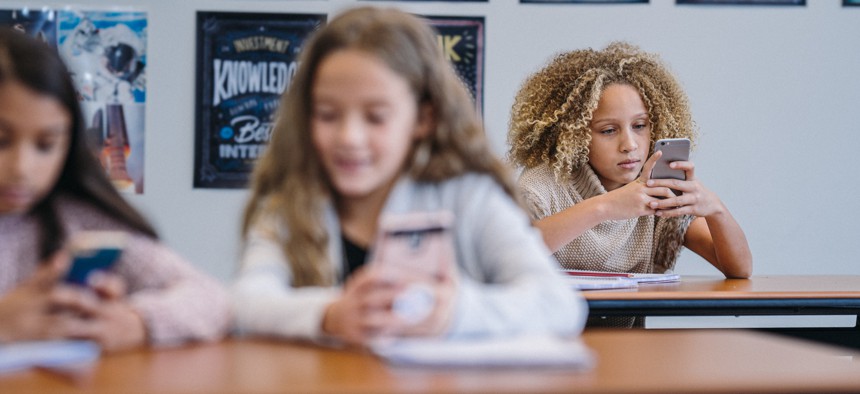
Fly View Productions via Getty Images


COMMENTARY | Across the US, parents are leading the charge to limit cellphone use in schools.

This article was originally published by The Conversation.

The number of states banning smartphones in schools is growing.

New York is now the largest state in the U.S. to ban smartphones in public schools. Starting in fall 2025, students will not be allowed to use their phones during the school day, including during lunch, recess or in between classes. This bell-to-bell policy will impact almost 2.5 million students in grades K-12.

By banning smartphones in schools, New York is joining states across the country. The bans are happening in both traditionally liberal and conservative states.

Alabama, Arkansas, Nebraska, North Dakota, Oklahoma and West Virginia all passed legislation in 2025 that requires schools to have policies that limit access to smartphones. The policies will go into effect in the 2025-2026 school year. This brings the total to 17 states, plus Washington, D.C., that have phone-free school legislation or executive orders.

I’m a professor who studies communication and culture, and while writing a book about parenting culture, I’ve noticed the narrative around smartphones and social media shifting over the past decade.

A Turning Tide

According to the Pew Research Center, 67% of American adults support banning smartphones during class time, although only 36% support banning them for the entire school day. Notably, a majority of Republican, Democratic and independent voters all support bans during class time.

More broadly, parent-led movements to limit children’s use of smartphones, social media and the internet have sprung up around the country. For example, the Phone-Free Schools Movement in Pennsylvania was launched in 2023, and Mothers Against Media Addiction started in New York in March 2024. These organizations, which empower parents to advocate in their local communities, follow in the footsteps of organizations such as Wait Until 8th in Texas and Screen Time Action Network at Fairplay in Massachusetts, which were formed in 2017.

The concerns of these parent-led organizations were reflected in the best-selling book “The Anxious Generation,” which paints a bleak picture of modern childhood as dominated by depression and anxiety brought on by smartphone addiction.

Phone-free schools are one of the four actions the book’s author, Jonathan Haidt, recommended to change course. The other three are no smartphones for children before high school, waiting until 16 for social media access, and allowing more childhood independence in the real world.

Haidt’s research team collaborated with The Harris Poll to survey Gen Z. They found that almost half of those age 18-27 wish social media had never been invented, and 21% wish smartphones had never been invented. About 40% of Gen Z respondents supported phone-free schools.

The Pew Research Center found that almost 40% of kids age 8-12 use social media, and almost 95% of kids age 13-17 use it, with nearly half of teens reporting that they use social media almost constantly.

Phone-free schools are also part of the larger trend of states and nations resisting Big Tech, the large technology companies that play a significant role in global commerce.

In May 2025, two U.S. senators introduced the Stop the Scroll Act, which would require mental health warnings on social media.

New laws that ban smartphones or social media for youth are being introduced across several Western nations. Australia has banned all social media for those under 16.

After a fatal stabbing at a middle school in eastern France on June 10, French President Emmanuel Macron announced the same day that he wants the European Union to set the minimum age for social media at 15. He argued that social media is a factor in teen violence. If the EU doesn’t act within a few months, Macron has pledged to enact a ban in France as soon as possible.

The Impact on Learning

Although this trend of restricting use of phones in school is new, more states may adopt smartphone bans in the future. Bell-to-bell bans are viewed as especially powerful in improving academic performance.

Some research has suggested that when children have access to a smartphone, even if they do not use it, they find it harder to focus in class. Initial research has found that academic performance improves after the bans go into effect.

Test scores fell across the U.S. during the pandemic lockdown and have not returned to prepandemic levels. Some states, such as Maine and Oregon, are almost a full year behind grade level in reading. Not a single state has recovered in both math and reading.

Statewide bans free local school districts from having to create their own technology bans, which can lead to heated debates. Although a majority of adults approve of banning smartphones in class, 24% oppose it for reasons such as wanting to be able to contact their kids throughout the day and wanting parents to set the boundaries.

However, 72% of high school teachers say that phones are a major distraction. Anecdotally, schools report that students like the bans after getting used to the change.

The Conversation

Margaret Murray, Associate Professor of Public Communication and Culture Studies, University of Michigan

X
This website uses cookies to enhance user experience and to analyze performance and traffic on our website. We also share information about your use of our site with our social media, advertising and analytics partners. Learn More / Do Not Sell My Personal Information
Accept Cookies
X
Cookie Preferences Cookie List

Do Not Sell My Personal Information

When you visit our website, we store cookies on your browser to collect information. The information collected might relate to you, your preferences or your device, and is mostly used to make the site work as you expect it to and to provide a more personalized web experience. However, you can choose not to allow certain types of cookies, which may impact your experience of the site and the services we are able to offer. Click on the different category headings to find out more and change our default settings according to your preference. You cannot opt-out of our First Party Strictly Necessary Cookies as they are deployed in order to ensure the proper functioning of our website (such as prompting the cookie banner and remembering your settings, to log into your account, to redirect you when you log out, etc.). For more information about the First and Third Party Cookies used please follow this link.

Allow All Cookies

Manage Consent Preferences

Strictly Necessary Cookies - Always Active

We do not allow you to opt-out of our certain cookies, as they are necessary to ensure the proper functioning of our website (such as prompting our cookie banner and remembering your privacy choices) and/or to monitor site performance. These cookies are not used in a way that constitutes a “sale” of your data under the CCPA. You can set your browser to block or alert you about these cookies, but some parts of the site will not work as intended if you do so. You can usually find these settings in the Options or Preferences menu of your browser. Visit www.allaboutcookies.org to learn more.

Sale of Personal Data, Targeting & Social Media Cookies

Under the California Consumer Privacy Act, you have the right to opt-out of the sale of your personal information to third parties. These cookies collect information for analytics and to personalize your experience with targeted ads. You may exercise your right to opt out of the sale of personal information by using this toggle switch. If you opt out we will not be able to offer you personalised ads and will not hand over your personal information to any third parties. Additionally, you may contact our legal department for further clarification about your rights as a California consumer by using this Exercise My Rights link

If you have enabled privacy controls on your browser (such as a plugin), we have to take that as a valid request to opt-out. Therefore we would not be able to track your activity through the web. This may affect our ability to personalize ads according to your preferences.

Targeting cookies may be set through our site by our advertising partners. They may be used by those companies to build a profile of your interests and show you relevant adverts on other sites. They do not store directly personal information, but are based on uniquely identifying your browser and internet device. If you do not allow these cookies, you will experience less targeted advertising.

Social media cookies are set by a range of social media services that we have added to the site to enable you to share our content with your friends and networks. They are capable of tracking your browser across other sites and building up a profile of your interests. This may impact the content and messages you see on other websites you visit. If you do not allow these cookies you may not be able to use or see these sharing tools.

If you want to opt out of all of our lead reports and lists, please submit a privacy request at our Do Not Sell page.

Save Settings
Cookie Preferences Cookie List

Cookie List

A cookie is a small piece of data (text file) that a website – when visited by a user – asks your browser to store on your device in order to remember information about you, such as your language preference or login information. Those cookies are set by us and called first-party cookies. We also use third-party cookies – which are cookies from a domain different than the domain of the website you are visiting – for our advertising and marketing efforts. More specifically, we use cookies and other tracking technologies for the following purposes:

Strictly Necessary Cookies

We do not allow you to opt-out of our certain cookies, as they are necessary to ensure the proper functioning of our website (such as prompting our cookie banner and remembering your privacy choices) and/or to monitor site performance. These cookies are not used in a way that constitutes a “sale” of your data under the CCPA. You can set your browser to block or alert you about these cookies, but some parts of the site will not work as intended if you do so. You can usually find these settings in the Options or Preferences menu of your browser. Visit www.allaboutcookies.org to learn more.

Functional Cookies

We do not allow you to opt-out of our certain cookies, as they are necessary to ensure the proper functioning of our website (such as prompting our cookie banner and remembering your privacy choices) and/or to monitor site performance. These cookies are not used in a way that constitutes a “sale” of your data under the CCPA. You can set your browser to block or alert you about these cookies, but some parts of the site will not work as intended if you do so. You can usually find these settings in the Options or Preferences menu of your browser. Visit www.allaboutcookies.org to learn more.

Performance Cookies

We do not allow you to opt-out of our certain cookies, as they are necessary to ensure the proper functioning of our website (such as prompting our cookie banner and remembering your privacy choices) and/or to monitor site performance. These cookies are not used in a way that constitutes a “sale” of your data under the CCPA. You can set your browser to block or alert you about these cookies, but some parts of the site will not work as intended if you do so. You can usually find these settings in the Options or Preferences menu of your browser. Visit www.allaboutcookies.org to learn more.

Sale of Personal Data

We also use cookies to personalize your experience on our websites, including by determining the most relevant content and advertisements to show you, and to monitor site traffic and performance, so that we may improve our websites and your experience. You may opt out of our use of such cookies (and the associated “sale” of your Personal Information) by using this toggle switch. You will still see some advertising, regardless of your selection. Because we do not track you across different devices, browsers and GEMG properties, your selection will take effect only on this browser, this device and this website.

Social Media Cookies

We also use cookies to personalize your experience on our websites, including by determining the most relevant content and advertisements to show you, and to monitor site traffic and performance, so that we may improve our websites and your experience. You may opt out of our use of such cookies (and the associated “sale” of your Personal Information) by using this toggle switch. You will still see some advertising, regardless of your selection. Because we do not track you across different devices, browsers and GEMG properties, your selection will take effect only on this browser, this device and this website.

Targeting Cookies

We also use cookies to personalize your experience on our websites, including by determining the most relevant content and advertisements to show you, and to monitor site traffic and performance, so that we may improve our websites and your experience. You may opt out of our use of such cookies (and the associated “sale” of your Personal Information) by using this toggle switch. You will still see some advertising, regardless of your selection. Because we do not track you across different devices, browsers and GEMG properties, your selection will take effect only on this browser, this device and this website.