
Trump wants states to feed voter info into powerful citizenship data program
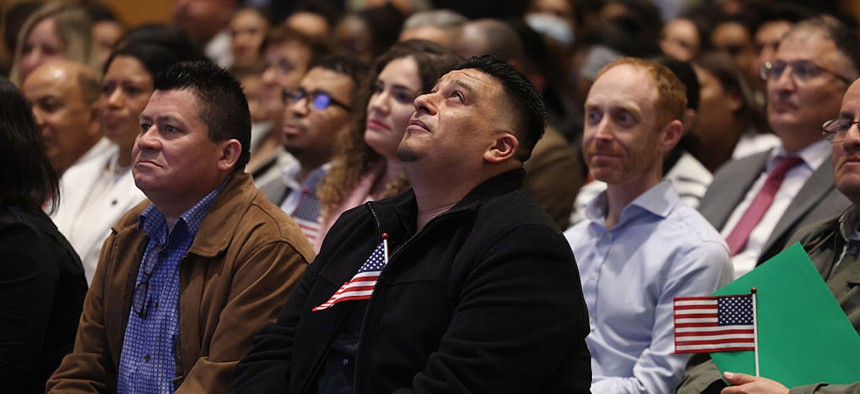
People react after getting their certificate of naturalization during a naturalization ceremony at the JFK Library in Boston on May 22, 2025. Jessica Rinaldi/The Boston Globe via Getty Images





Republicans are laser-focused on purging noncitizens from voter rolls.
This story was originally published by Stateline.
BILOXI, Miss. — The Trump administration is developing a powerful data tool it claims will let states identify noncitizens registered to vote. But Democratic critics and data experts warn it could allow the federal government to vacuum up vast quantities of information on Americans for unclear purposes.
Some Democratic election officials and opponents of the effort fear President Donald Trump wants to build a federal database of voters to target political opponents or cherry-pick rare examples of noncitizen voters to fuel a sense of crisis. Republican election officials allied with the president counter that he’s helping states to maintain accurate voter rolls.
The Trump administration has rolled out changes to the Systematic Alien Verification for Entitlements, or SAVE, tool at the same time the U.S. Department of Justice is asking states for copies of their voter rolls. The timing, combined with questions about what happens to voter data uploaded to the program, has alarmed critics.
Trump wants Congress to pass a national proof of citizenship voter registration requirement and in March tried to unilaterally impose one for federal elections through executive order. But with the legislation stalled and the order halted by the courts, the citizenship data tool may offer a backdoor way to accomplish the same goal.
SAVE was originally intended to help state and local officials verify the immigration status of individual noncitizens seeking government benefits. But U.S. Citizenship and Immigration Services, which is part of the Department of Homeland Security, this spring refashioned it into a platform that can scan states’ voter rolls if election officials upload the data.
The changes to SAVE, rolled out over just a few months and with little public debate, are “tinkering with sort of the bones of democracy,” said John Davisson, senior counsel and director of litigation at the Electronic Privacy Information Center, a Washington, D.C.-based research and advocacy group that argues privacy is a fundamental right.
“You’re talking about the voting process and who will be eligible to vote,” Davisson said. “And to take a system that is not designed for use in that process and repurpose it, really on the fly, without a formal comment process, without formal rulemaking, without congressional intervention — that’s pretty anomalous and pretty alarming.”
Previously, SAVE could only search one name at a time. Now it can conduct bulk searches, allowing state officials to potentially feed into it information on millions of registered voters. SAVE checks that information against a series of federal databases and reports back whether it can verify someone’s immigration status.
Since May, it also can draw upon Social Security data, transforming the program into a tool that can confirm citizenship because Social Security records for many, but not all, Americans include the information. NPR reported earlier on changes to SAVE.
“It is incredible what has been done, really since March,” Wyoming Secretary of State Chuck Gray, a Republican who supports proof of citizenship requirements and the SAVE tool, told a gathering of state secretaries of state in Biloxi, Mississippi, last week.
Individuals registering to vote in federal elections must already sign a statement affirming they are citizens under penalty of perjury, and those who cast a ballot face criminal penalties and deportation. One study of the 2016 election placed the prevalence of noncitizen voting at 0.0001% of votes cast.
But as Trump has spread falsehoods about elections, Republicans have made purging noncitizens from voter rolls a central focus.
Democratic concerns were on display last week at the National Association of Secretaries of State conference, held at the Beau Rivage casino-resort in Biloxi. In interviews on the sidelines of the conference, Democratic secretaries of state voiced deep reservations — or outright opposition — about plugging their voter data into SAVE.
Maine Democratic Secretary of State Shenna Bellows said Aug. 6 that the federal government appeared to be trying to take over election administration. She formally rejected the Justice Department’s voter roll request two days later.
Bellows said the Department of Homeland Security told her in a recent phone call that it planned to retain SAVE data for 10 years for “audit purposes only.”
“Just like the [Justice Department] is asking us to hand over an electronic file of all the voters in our state, it seems like the Department of Homeland Security is through this backdoor system also asking us to share voter information about every voter in our state,” Bellows said.
At least one state appears to have granted the federal government sweeping authority over any voter data it provides to SAVE.
Indiana Secretary of State Diego Morales announced in July he had reached an agreement with U.S. Citizenship and Immigration Services to access the newly expanded system for voter list maintenance. Indiana’s agreement allows the federal agency to use information the state provides for any purpose permitted by law, including criminal prosecutions.
Morales, a Republican, said in a news release that SAVE represented “another step in safeguarding the rights” of eligible voters. His office didn’t respond to Stateline’s questions.
The Trump administration has ramped up efforts to encourage state election officials to use the expanded program. The White House hosted a bipartisan “fly in” event for state secretaries of state on July 29. Multiple secretaries of state told Stateline that USCIS Director Joseph Edlow, who was confirmed on July 15, spoke at the event.
“The president is very much keyed in on voter list maintenance,” Missouri Secretary of State Denny Hoskins, a Republican, said in an interview — echoing other GOP secretaries of state who released statements praising the Trump administration after the meeting.
When we disclose information, particularly personal identifying information, we need to have a handle on how it’s going to be used, by whom and under what circumstances.– Minnesota Democratic Secretary of State Steve Simon
Minnesota Secretary of State Steve Simon, a Democrat who attended the meeting, said he questioned how the federal government would handle voter information provided to SAVE. He added that the Justice Department’s request for his state’s voter rolls raised his level of concern about how data would be used.
“When we disclose information, particularly personal identifying information, we need to have a handle on how it’s going to be used, by whom and under what circumstances,” Simon told Stateline.
The White House referred questions about SAVE and the event to the Department of Homeland Security and USCIS.
In response to questions from Stateline, USCIS didn’t directly answer whether the agency would share voter roll data with other parts of the federal government but confirmed it disposes of records after 10 years.
“The SAVE application is a critical tool for state and local governments to access information to safeguard the integrity of elections across the country. It’s no wonder many states have quickly adopted it, and we continue to promote the tool to other states and counties not using SAVE,” USCIS spokesperson Matthew Tragesser said in a statement.
“We look forward to continued optimization efforts and implementing more updates to SAVE.”
GOP Pressure
Some Republican election officials and Trump allies have long wanted the federal government to take an expanded role in searching state voter rolls for noncitizens.
Last summer the Trump-aligned litigation group America First Legal, co-founded by Trump adviser Stephen Miller, encouraged states to submit to the Department of Homeland Security the names of individuals for citizenship or immigration status verification.
Some states did just that. Texas, for example, asked USCIS to verify the citizenship of some voters in September, and Indiana asked the agency to verify 585,774 voters in October. The same month, 16 Republican state attorneys general signed a letter criticizing Homeland Security, then under the Biden administration, for failing to work with states on verification.
After Trump took office, GOP state officials kept up the pressure. Twenty-one Republican secretaries of state urged Homeland Security Secretary Kristi Noem in February to prioritize SAVE improvements.
On April 16, Indiana sued the department in federal court for not responding to its verification request last fall. USCIS announced an overhaul of SAVE less than a week later.
As the agency continues to remake SAVE, the tool will soon allow searches using the last four digits of a Social Security number, multiple state secretaries of state told Stateline. The agency confirmed the feature is under development and will be available soon but didn’t provide an exact date.
The change would mark another significant expansion of the program because most states collect the last four digits when individuals without a driver’s license register to vote.
Idaho Secretary of State Phil McGrane, a Republican, said SAVE represents a better way to verify citizenship than a state law requiring voters to produce documents. “I think there’s a real opportunity for us to do a lot of this through just sharing of information and I think that’s what we’re seeing happen,” McGrane said in an interview.
Unreliable Data?
But some voting rights advocates and experts on government data caution against an overreliance on Social Security data.
The Brennan Center for Justice at New York University School of Law, a progressive policy nonprofit, has noted that Social Security only began tracking the citizenship status of all applicants in 1978 — meaning the database doesn’t include comprehensive citizenship information for older Americans. Additionally, Social Security may not always have up-to-date information on the status of naturalized U.S. citizens.
The nonpartisan Institute for Responsive Government also warned in May that since SAVE hasn’t used Social Security numbers to verify citizenship in the past, its accuracy and effectiveness are unknown. The success of the expanded SAVE program may also partially depend on whether it has adequate staff and resources, it said.
A 2017 Government Accountability Office report found that between fiscal years 2012 and 2016, about 16% of the nearly 90 million SAVE searches required additional verification, which the institute says often translates into federal workers manually checking files. Now that SAVE allows bulk searches, the need for manual checking could rise dramatically.
Nick Doctor, director of implementation at the Institute for Responsive Government, said in an interview that a tool confirming the eligibility of registered voters in a way that doesn’t burden individuals can be a good thing. But he emphasized that it depends in large measure on SAVE’s implementation.
“The changes that have been made to SAVE happened very quickly and, to my knowledge, we haven’t seen releases on the level of accuracy of that information,” Doctor said.
During interviews, Republican secretaries of state stressed that voters aren’t kicked off the rolls because SAVE can’t verify their citizenship. Instead, an inability to verify would likely trigger a follow-up process with the voter.
“Just because we get something back from the SAVE database, it’s not a cut and dry, especially on those they’re not sure about,” Hoskins, the Missouri secretary of state, said.
Still, Arizona illustrates why some Democrats worry about any large-scale effort to ask voters — especially longtime, older residents — to prove their citizenship. After the state discovered errors in how it tracked voter citizenship dating back years, election officials are contacting some 200,000 voters seeking proof of citizenship documentation.
Some have been casting ballots for decades without incident and many feel targeted, Arizona Democratic Secretary of State Adrian Fontes said during a presentation at the state secretaries of state conference. “They feel insulted when they get that letter,” Fontes said.
There’s a lot of good-government reasons to believe that something like this, governed properly and governed with fail-safe mechanisms, could have an upside.– Charles Stewart III, professor of political science at MIT who studies elections
Charles Stewart III, a professor of political science at the Massachusetts Institute of Technology who studies elections, said Arizona may actually point to the potential usefulness of SAVE. If Arizona runs its voter roll through the program, a list of 200,000 voters needing citizenship verification would perhaps drop into the hundreds, he suggested.
“There’s a lot of good-government reasons to believe that something like this, governed properly and governed with fail-safe mechanisms, could have an upside,” Stewart said.
Connecticut Democratic Secretary of State Stephanie Thomas told Stateline that every secretary wants tools to keep voter lists as clean as possible. But the details are important.
When she hears of something new, Thomas said she asks whether it’s the best option available and whether “the i’s are dotted, the t’s crossed.” She said she’s asked USCIS a series of questions about SAVE and is waiting on some responses.
“When it comes to voter lists,” Thomas said, “I don’t want Connecticut voters to be a guinea pig.”
Stateline reporter Jonathan Shorman can be reached at jshorman@stateline.org.
Stateline is part of States Newsroom, a nonprofit news network supported by grants and a coalition of donors as a 501c(3) public charity. Stateline maintains editorial independence. Contact Editor Scott S. Greenberger for questions: info@stateline.org.