
Failure to activate: When Utah officers violate body-cam policies
artas via Getty Images





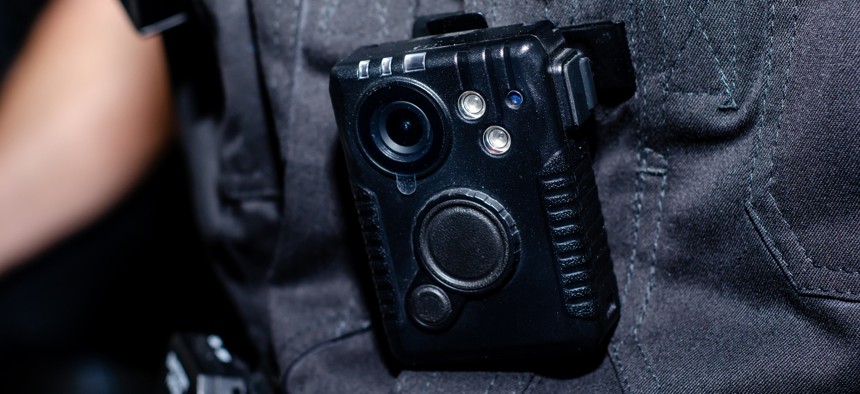
The Utah Investigative Journalism Project filed nearly 170 records requests with 48 Utah law enforcement agencies about body camera use.
This article was originally published by Utah News Dispatch.
When a Unified police lieutenant tried to pull body-worn camera footage for a case where the suspect had confessed to arson and attempted homicide, he discovered something curious. The video wasn’t there — and apparently the missing footage wasn’t a one-off incident.
In fact, officer Mario Widdowson hadn’t uploaded any body camera videos during the first three months of 2023 and had failed to turn on his body camera 103 times during the same period.
When confronted with those facts, Widdowson apologized and said he didn’t know it was that bad and that he was embarrassed by it.
This wasn’t his first time violating the department policy. During Widdowson’s five years with the department, he neglected to properly log body camera recordings, turn in reports on time, and activate his body camera, including during at least one incident involving use of force.
Between 2019 and 2023, Widdowson received several disciplinary actions, according to documents The Utah Investigative Journalism Project obtained through a records request. Those interventions included at least four formal warnings, several informal conversations, two corrective action plans and a no-pay suspension of about 180 hours.
In the arson case, however, Widdowson’s second chances had run out and he was given a notice of termination that chronicled a “pervasive pattern of policy violations.”
“This is not the first time you have been disciplined for dereliction of duty, insubordination, report submission or failure to activate your body worn camera,” the notice reads. “I cannot, in good faith, allow the citizens of Salt Lake County to bear the burden and liability of an employee who demonstrates this type of behavior.”
That notice was among dozens of disciplinary records the UIJP received over the course of a year after filing nearly 170 records requests with 48 Utah law enforcement agencies — specifically to every sheriff’s office and police department of larger cities, ranging from Salt Lake to St. George. The requests asked for disciplinary records of officers who had violated body-worn camera policies between January 2019 and June 2025 as well as the agencies’ policies themselves. The UIJP also attempted to reach the individual officers named in this story through their current or former departments but received no response.
The records identified 25 officers across 11 agencies with such violations. Ogden Police Department had the most at six, followed by West Valley City with five and Salt Lake City and Unified police with three each. Of those agencies, Ogden police was the only agency that did not respond to UIJP’s request for comment.
The 25 officers represent a small fraction of the majority of the agencies’ total number of officers, with some agencies employing hundreds of officers.
Some of the records document what appear to be one-off incidents, while others paint the picture of more egregious patterns of behavior. In several of the cases, the records documented other misconduct, ranging from disrespectful language to mishandling of evidence and failing to fill out reports.
An investigation into former Davis County sheriff’s deputy Tyler Young, for example, found he had accessed and shared information from the state’s criminal justice database without authorization, violated a driver’s constitutional rights after stopping them on private property, and tried to use his position as a deputy to argue against a Brigham City officer’s decision to screen custodial interference charges against him. Young resigned during the investigation.
Former Salt Lake City Police Chief Chris Burbank, who pushed the department to adopt cameras during his tenure and now works as a law enforcement consultant, said body camera violations are often an indicator of underlying problems for both the employee and the agency as a whole.
“You just become less credible — I think that’s more of the problem than the fact of you’re not wearing your body camera,” he said. “When you start to see that, it’s like, ‘Well, OK, what other things are you not addressing as the administrator of this department?’”
Salt Lake City police spokesperson Michael Ruff and Davis County chief deputy Taylor West concurred with Burbank. Ruff said because violations can be indicative of wider issues, the department’s audits go beyond just checking one or two videos and instead include follow up on whether violations are a pattern of behavior. Likewise, West said the office has an early intervention program that will flag issues like a deputy routinely shutting off their body camera. An alert is then sent to the deputy’s entire chain of command.
West Valley City police spokesperson Roxeanne Vainuku, however, disagrees. She pointed to the fact that violations can have several causes, “many of which do not reflect misconduct or systemic problems.” Likewise, Unified police spokesperson Sgt. Aymee Race said some violations are also the result of equipment malfunction or low battery.
Only a few of the disciplinary actions reviewed by the UIJP show what appear to be genuine, one-off mistakes. One West Valley officer, for example, did not turn on his camera during a vehicle pursuit because he was on his way to work, before he could pick up the camera.
“What violations do indicate is that our accountability systems are functioning,” Vainuku said over email. “The fact that we identify, track, and correct issues through transparent processes demonstrates a commitment to continuous improvement, not a deficiency in officer performance or agency culture.”
Facing the Consequences
Adam Schwartz, privacy litigation director for the Electronic Frontier Foundation, agreed that law enforcement personnel should be held to the same accountability standards as any other professional. The foundation has advocated for strict safeguards for body cameras.
“They’re the ones with a badge and a gun who are enforcing the law,” he said. “They, more than anyone else, should be following rules.”
The records obtained by the UIJP show that in the majority of cases, officers received a formal reprimand when they violated body camera policies.
That includes one Ogden officer who neglected to turn on his body camera during an incident where he used force on a female minor who kicked him, according to an employee counseling form. And a West Valley parking compliance officer who failed to turn on her camera during an argument with an armed suspect.
Another officer, this one from Unified police, received only a formal reprimand after failing to wear his camera, including during a domestic disturbance where officers used physical force to arrest a man. The man’s family later filed a complaint alleging excessive force, which triggered an investigation that revealed the officer was not wearing his body camera.
Because of the officer’s failure to address his broken body camera in a timely manner, “valuable evidence in the case was not captured and could not be used as evidence for the criminal case or to dispel the allegation levied by the Family,” reads a letter documenting the officer’s reprimand.
In other cases, officers were suspended without pay, placed on a corrective action plan or removal from specialized teams.
Ogden Officer Karson Garcia, for instance, received two days of suspension without pay, a work improvement plan and removal from the Ogden Metro SWAT team after he failed to activate his body camera during a use of force incident.
An employee counseling form for Garcia states he had been warned three times previously about failing to use his body camera and was suspended for two days without pay over previous misconduct. An internal affairs investigation determined Garcia neglected to turn on his body camera on 47 cases.
Widdowson was one of only two officers who was terminated over offenses that included body camera compliance. The other, officer Brandon Lyman, also worked for Unified police. He had turned on his body camera only seven times — once on accident — during a three-month period while he was on a corrective action plan for previous policy violations, according to discipline records.
The National Police Index, which tracks police employment history data, shows both Widdowson and Lyman continued their careers in law enforcement after they were fired at Unified. Utah data was only gathered after the UIJP and the Invisible Institute fought for the records to be released.
According to that data, Widdowson began working for Cottonwood Heights about six months after being fired; Lyman began working for the Utah Department of Corrections almost a year after his termination.
Unified police declined to comment on Widdowson or Lyman, citing a policy not to comment on personnel matters beyond releasing discipline records.
Cottonwood Heights police did not respond to a request for comment. Utah Department of Corrections spokesperson Karen Tapahe declined to comment on Lyman’s hiring for similar reasons. However, she said the department does perform background checks as part of its hiring process as well as additional interviews or investigations when necessary. That includes for applicants that were terminated by a previous employer.
Burbank said that in his experience as an administrator, a first offense would result in a reprimand and discussion of the policy. After one warning, however, Burbank said termination would be on the table. While that may seem harsh, Burbank said it’s an issue of trust.
“I’m not an advocate for firing people for the little things,” he said. “I’m an advocate for firing people for failing to display the honor and privilege it is to be a police officer in this country and the responsibility that comes with it.”
A Look at Policies
The agencies’ policies on body cameras are largely the same, with many including similar or verbatim language. Many used Lexipol, a private consulting company that provides policy manuals to law enforcement.
Almost all of the policies reviewed required officers to wear their body cameras conspicuously. Likewise, 89% directed officers to make sure their body camera equipment is functioning at the start of each shift, and 91% required officers to report if and why they failed to use their body cameras.
All the policies also identified when officers need to activate their body cameras — a safeguard that Schwartz highlighted. Some of the policies simply referenced state code governing body cameras, while others listed out specific types of interactions that necessitate body camera use, ranging from traffic stops to use of force and execution of warrants.
“If the officer has discretion to decide when they’re going to turn that camera on and off, that absolutely ceases to be any kind of accountability tool,” Schwartz said. “The kind of rule that we like to see is an officer must activate their camera whenever they start an investigative encounter with a civilian.”
The majority of policies did not include explicit requirements for auditing officers’ use of body cameras. In fact, only eight of the 35 policies outlined specific auditing procedures. Another said audits “may be” conducted.
“Everybody’s going to make a mistake at some point, right?” said David Ferguson, executive director of Utah Association of Criminal Defense Lawyers. “I do think that departments need to be aware of and are hopefully keeping track of officers where that’s a repeated problem.”
Of those eight policies, West Valley City Police Department’s was one of the most specific. It states that in addition to random audits by supervisors, the chief will also audit five body camera recordings at least twice a year.
Vainuku, the department’s spokesperson, said the specificity was intentional to strengthen transparency and public trust. She said the department’s auditing process allows it to “proactively identify areas for improvement rather than relying solely on complaints.”
While Provo Police Department’s policy doesn’t mention how frequent audits will be done beyond “on a periodic basis,” it does include how body camera audits should be conducted and what they should look for.
Policies for the South Jordan Police Department and Sevier and Summit County sheriff’s offices include the same language: “Supervisors should conduct audits at regular intervals to confirm BWC media is being properly uploaded and tagged by their subordinates.”
Likewise, Emery, Grand and Davis County sheriff’s offices direct their respective body camera coordinators to conduct “periodic audits to ensure compliance with applicable laws, regulations, and office policy.”
Ruff, the spokesperson for Salt Lake City police, said that a lack of audit procedures in an agency’s body-camera policies doesn’t mean audits aren’t taking place. He pointed to a city ordinance that requires a mayoral designee to review body camera recordings at least monthly as well as a 2024 memo from the department’s chief. The memo outlines a weekly audit (which Ruff equates to about 10% of the department’s officers each month) as well as disciplinary procedures that include a 30-day review of an officer’s recordings and a referral to internal affairs depending on the violation.
Burbank, who is working on a project that would use AI to audit body camera footage, is a big proponent of the accountability mechanism, although he acknowledged it can be a burden for agencies to manually go through such large amounts of footage. But he believes it’s well worth doing so to get in front of issues before they grow.
“Why would you not want to deal with it up front? But I’ve actually had police chiefs tell me, ‘Well, I don’t have a problem now and if I let them review this or I look at them proactively, then I have a problem,’” he said. “That’s irresponsible. That’s doing your job so you sit in the seat longer.”
Human Failings
Schwartz said while there may be some instances where it’s not possible for officers to activate their body cameras, those instances should be extremely rare.
“All you have to do when an officer sees someone they’re going to detain is lift their hand up and press a button on a device which is fixed to their uniform,” he said. “So it’s hard to see when it is not feasible for the officers to turn the camera on.”
Only a few of the records obtained by UIJP include the officers’ reasoning behind not using their body cameras.
One officer reported not feeling like he had to turn on his camera, instead opting to drive away because the encounter had become adversarial. Another said he relied on his car’s dash cam. A third said he wasn’t wearing his body camera because it wasn’t working, even though his department policy required officers to check their equipment each shift. A fourth officer, who had multiple violations, offered a number of explanations ranging from the camera’s battery being low to simply not remembering to turn it on.
Burbank said simply forgetting to use a body camera is a “weak excuse.”
“How many cops do you see wandering around without a gun in their holster?” he said. “They don’t forget their Taser, they don’t forget their flashlight.”
A Tool For Justice?
Body camera footage is often used as a way to hold law enforcement to account. But without the correct safeguards in place, body cameras become a tool for surveillance rather than accountability, said Schwartz of the Electronic Frontier Foundation.
“Whenever a police officer walks up to a civilian and exercises their coercive power to interrupt that person’s day, stop them from going to work, detain them, etc. — this is a situation where police can be abusing their power,” Schwartz said. “If it’s an accountability tool, then every single one of those situations, the officer needs to be turning it on.”
Ferguson, the director of Utah Association of Criminal Defense Lawyers, has a more positive outlook on body cameras, calling them “an exceptionally good” development in criminal justice.
Need to get in touch?
Have a news tip?
“This stuff is just huge. It gets to the truth better and faster than just about anything else can,” he said. “Both sides really benefit from body cameras.”
Defendants, for instance, use it to show they didn’t actually commit a crime, Ferguson said. Meanwhile, law enforcement, who are under increased scrutiny in the modern world, can point to body camera evidence as proof of proper conduct. But those benefits are only present when cameras are used correctly.
Ferguson has litigated cases in which officers have purposefully turned their body cameras away or off. In one DUI case, he said body camera footage recorded an officer telling his partner that he would turn away to avoid recording a field sobriety test.
“So, yeah, this does happen. It’s real; it’s not a figment of our imagination. Officers actually do this sort of thing,” Ferguson said. “Police officers are like everybody else. No one wants to have their failures recorded.”
Burbank, likewise, stressed that they have limitations.
“It’s just one piece of evidence, but we tend to take that and say, no, no, it’s everything,” he said. “I just think we need to be careful of that.”
Four agencies reported that they do not use body cameras: sheriff’s offices in Salt Lake, Piute, Millard, Kane and Emery counties. Wasatch County only provided a copy of its policy on recording systems in police vehicles.
Ferguson said cases can be more complicated when agencies don’t use body cameras.
“As a defense attorney, when you get those kinds of cases and you know that there’s no body camera, and your client is saying something that is different than what the police is saying, it just becomes so much harder to decide the appropriate course of action,” he said. “We’re not better off because of a lack of body cameras.”