He saw an abandoned trailer. Then, he uncovered a surveillance network on California's border
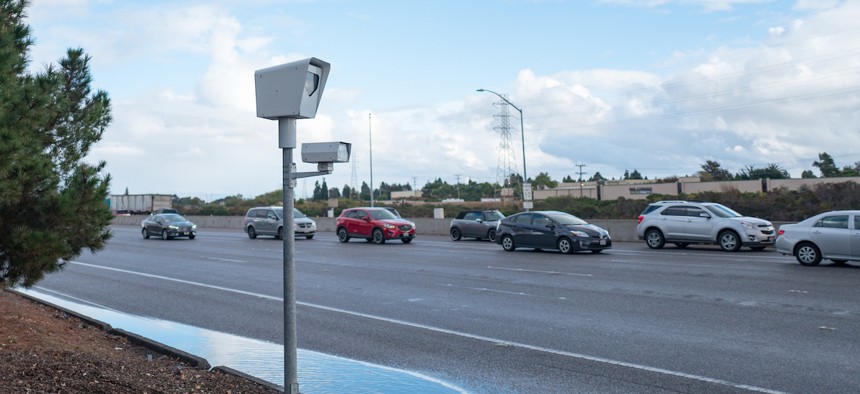
Gado Images via Getty Images



Southern California residents are noticing new license plate readers that appear to be operated by the Border Patrol. Some have had confusing encounters with agents.
This article was originally published on The Markup and was republished under the Creative Commons Attribution-NonCommercial-NoDerivatives license.
On a cracked two-lane road on the eastern edge of San Diego County, James Cordero eased his Jeep onto the shoulder after something caught his eye. It looked like an abandoned trailer. Inside he found a hidden camera feeding a vast surveillance network that logs the license plate of every driver passing through this stretch of remote backcountry between San Diego and the Arizona state line.
Cordero, 44, has found dozens of these cameras hidden in trailers and construction barrels on border roads around San Diego and Imperial counties: one on Old Highway 80 near Jacumba Hot Springs; another outside the Golden Acorn Casino in Campo; another along Interstate 8 toward In-Ko-Pah Gorge.
They started showing up after California granted permits to the Border Patrol and other federal agencies to place license plate readers on state highways in the last months of the Biden administration. Now as many as 40 are feeding information into Trump administration databases as the Democratic-led state chafes over the federal government’s massive deportation program.
The cameras are raising concerns with privacy experts, civil liberties advocates and humanitarian aid workers who say California should not be supporting the surveillance and data-collection program, which they view as an unwarranted government intrusion into the lives of Americans who’ve committed no crime. Moreover, they say the program conflicts with state law.
Supporters say the devices allow law enforcement to quickly identify and locate people they suspect of serious crimes. They also argue the cameras help agencies spot patterns in drug and human trafficking, and could be used to help locate missing persons, such as children or other vulnerable people.
“If you’re not doing anything illegal, why worry about it?” said long-time Jacumba resident Allen Stanks, 70.
“Everyone is talking about privacy, OK. Stop putting everything on Facebook. ‘Here’s a picture of my food.’ Who cares?” said Stanks.
Some locals, however, suspect the cameras are behind some unusual encounters they’ve had in recent months with officers from Border Patrol and its parent agency, Customs and Border Protection. In one case agents questioned a grandmother – a lawful permanent resident – about why she went to a casino, according to her grandson.
Cordero has a different concern. On his days off, he leads volunteers into the far reaches of the county, leaving water, food and clothing for migrants. He fears his colleagues could be detained by agents.
“I’m not so much worried about myself, but I’m worried about a lot of our volunteers that come out,” said Cordero. “I don’t want them to have to deal with any of the nonsense of being tracked or being pulled over and questioned.”
He has good reason to be nervous. During the first Trump administration, federal officials prosecuted volunteers from the humanitarian group "No More Deaths" for leaving water and supplies for migrants in the Arizona desert. The volunteers faced charges, including "abandonment of property" and felony harboring, though the convictions for some were later overturned.
Border Patrol provides little information about its use of license plate readers on its website. In 2020, the Department of Homeland Security issued a report that describes the technology in general, but doesn’t specify where it’s being used. The Markup and CalMatters reached out to Border Patrol and Homeland Security officials for comment, but did not receive a response.
“There’s no transparency, that's the worst part,” Cordero said.
The Homeland Security report says some readers are capturing license plate numbers, as well as the make and model of the vehicle, the state the vehicle is registered in, the camera owner and type, the GPS coordinates for where the image was taken, and the date and time of the capture.
The “technology may also capture (within the image) the environment surrounding a vehicle, which may include drivers and passengers,” the report states. It also says feds can access license plate readers operated by commercial vendors.
Mapping Hidden Cameras
Earlier this month, the Electronic Frontier Foundation and a coalition of 30 organizations sent a letter to Gov. Gavin Newsom and the California Department of Transportation urging them to revoke state permits and remove the covert readers operated by federal agencies like Customs and Border Protection and the Drug Enforcement Agency along California border highways.
The San Francisco-based privacy and civil rights advocacy organization, also known as EFF, mapped out more than 40 hidden license plate readers in Southern California, most of them along border roadways. It contends the devices bypass a 2016 state law that spells out how law enforcement agencies can use automated license plate readers, which are often referred to as ALPRs.
“By allowing Border Patrol and the DEA to put license plate readers along the border, they’re essentially bypassing the protections under (California law),” said Dave Maass, the director of investigations for EFF. “That is a backdoor around it.”
Maass said he believes Cordero’s concerns about the agency surveilling humanitarian volunteers may be valid.
“They claim they might be looking for smugglers or they might be looking for cartel members, but that’s not who they’re collecting data on,” said Maass. “(The program) is primarily collecting data on people who live in the region.
Maass said there’s no way to be certain which agency is installing each camera, but his organization checked with all other agencies operating in the area, such as the San Diego and Imperial sheriff’s departments, the California Highway Patrol, and Cal Fire, among others.
The camera models currently installed on state highways in the border region are the same as ones the Border Patrol purchased in large amounts, according to Maass. Records obtained from Caltrans by EFF from 2016 appear to show Drug and Enforcement Administration and Border Patrol requesting permits to install the same devices in other parts of San Diego County, according to Maass.
Customs and Border Protection did not respond to a request for comment. The governor’s office did not comment. The Drug Enforcement Agency also did not respond to a request for comment.
Caltrans Approves ALPR Requests
By day, Cordero works in water-damage restoration, the crews residents call after floods and burst pipes. Comfortable with emergencies, he’s the type of guy you’d hope to run into if your car broke down in the middle of nowhere.
“People are literally dying out here,” Cordero says of his volunteer work, done through the nonprofit Al Otro Lado, a legal services organization that also provides humanitarian support to refugees, migrants and deportees on both sides of the U.S.-Mexico border. “All we’re trying to do is prevent people from dying.”
In response to questions from The Markup and CalMatters, a spokesperson for Caltrans provided a written statement that the state agency has approved eight permits for license plate readers from federal agencies, like Customs and Border Protection and the Drug Enforcement Administration, to be stationed in state highway rights-of-way.
“Caltrans does not operate, manage, or determine the specific use of technology or equipment installed by permit holders, nor does it have access to any of the collected data,” the statement read in part.
Caltrans said federal immigration agencies haven’t requested permits for the cameras since June 2024. They did not say how long a permit lasts. Between 2015 and 2024, their records indicate Customs and Border Protection and the Drug Enforcement Administration requested 14 permit applications for “law enforcement surveillance devices.” Of the 14, eight were approved, four were cancelled by the applicants and two did not result in projects in state right-of-way, the agency said.
In California, license plates are tracked not only by the federal government and law enforcement, but also by schools and businesses, including some Home Depots and malls. While schools and businesses may not agree to pass that information on to the federal government, local police with access to those cameras may do so.
California law prevents state and local agencies from sharing license plate data with out-of-state entities, including federal agencies involved in immigration enforcement. A Markup and CalMatters investigation in June 2025 revealed that southern California law enforcement agencies, including sheriff’s departments in San Diego and Orange counties, haveshared automated license plate reader data with federal agencies in violation of state law.
Newsom vetoed a bill to strengthen California license plate reader law last fall. Two days later, Attorney General Rob Bonta filed a lawsuit against the city of El Cajon for multiple violations ofthe license plate sharing prohibition. Since 2024, the attorney general’s office has sent letters to 18 law enforcement agencies, including the Imperial County Sheriff’s Office, the San Diego Police Department, and the El Centro Police Department.
Local agencies continue to share license plate data with federal immigration authorities, and not just along the border. The San Pablo Police Department in Northern California, one of the law enforcement agencies that received letters from the attorney general’s office, shared license plate data with the Border Patrol as recently as last month, according to records obtained by Oakland Privacy head of research Mike Katz-Lacabe. Some cameras are easy to spot, but Katz-Lacabe said that local police have concealed cameras that scan license plates for more than a decade, sometimes behind the grill of police cruisers or inside speed limit trailers or in a fake saguaro cactus.
“This has been the practice for years,” he said.
On a recent Saturday, Cordero was dressed for the remote border terrain – flannel, hiking boots, a San Diego Padres cap pulled low against the sun. His dirt-caked Jeep is built for places roads don’t go. On this particular weekend, supplies at one of the drop sites had already been used, indicating people may be crossing in the area.
Cordero has gotten good at finding stuff out here. In the remote Ocotillo washes, where the scrubs claw at people’s shins, he recently found what he believes to be the remains of a human finger.
A year earlier, Cordero found a phone contact list next to human remains. He and his wife, Jacqueline Arellano, were able to use the phone list to notify the person’s family in Arizona about where their missing loved one fell.
That’s why when, months ago, he first saw the abandoned trailer along the side of the road on Old Highway 80, he had to stop to take a closer look.
“It took me passing by a few times before I realized what it was,” said Cordero.
Pulling Over Grandma
An Associated Press investigation published in November revealed that Border Patrol had hidden license plate readers in ordinary traffic safety equipment. The data collected by the agency’s plate readers was fed into a predictive intelligence program monitoring millions of American drivers nationwide to identify and detain people whose travel patterns the algorithm deemed suspicious, according to the AP’s investigation.
Sergio Ojeda, a community organizer with the mutual aid group Imperial Valley Equity and Justice said CBP apparently believed his grandmother’s driving patterns were suspicious because they interrogated her about the amount of time she spends at local casinos in the area.
“She was outraged about it,” said Ojeda. His grandmother, a resident of Imperial Valley with legal status, was crossing the border when agents asked her about her trips to casinos.
“She asked them back, ‘Is something wrong with that? Am I not supposed to be doing that or why are you questioning me about this?’ and they were like “Oh, no, it just seems suspicious,” Ojeda recounted.
Ojeda said he was equally concerned, and he doesn’t enjoy the feeling of being watched just because he lives near the border. “It’s how I feel every day,” he said. “Driving around, I joke with my co-workers: ‘Which chapter of 1984 is this?’”