
Data privacy emerges as a ‘core American value,’ expert says
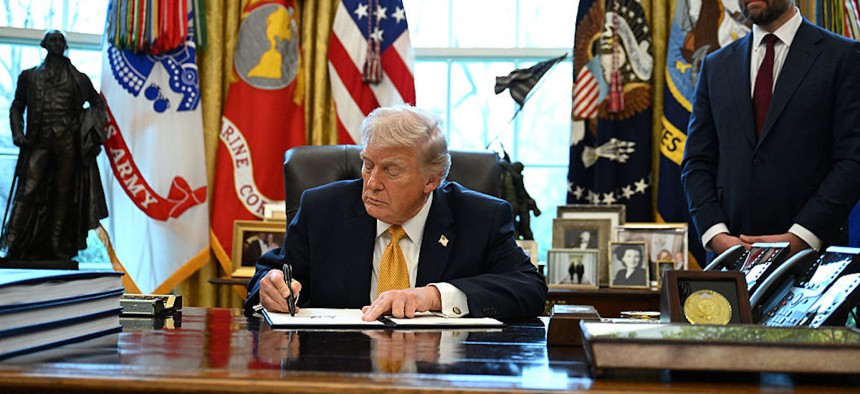
President Donald Trump signs an executive order on fraud in the Oval Office at the White House in Washington, DC, on March 16, 2026. ANNABELLE GORDON / AFP via Getty Images




As the federal government continues its fight to access state’s sensitive data on residents, a new report underscores Americans’ support for stronger data privacy guardrails and protections.
Several states have found themselves embroiled in a data debacle with the federal government, which has increasingly demanded that they hand over their residents’ personal data over the past year. Such efforts have stoked fear among residents who are concerned about how policymakers could leverage their sensitive information for punitive reasons, according to new survey findings.
Across the U.S., 74% of people said they are worried about the privacy and security of their personal data when it comes to what information the government has and how it is stored, according to survey findings released Tuesday by the Center for Democracy and Technology. The results are based on a nationally representative sample of 1,008 people aged 18 years and older.
The findings come two weeks after President Donald Trump signed an executive order that creates a federal task force aimed at stamping out fraud in federally-funded benefit programs. The order suggests increased data sharing between the Trump administration and states to do so, specifically identifying agencies that disburse benefits and law enforcement entities at the state, local and tribal level, Elizabeth Laird, director of the Equity in Civic Technology Project at CDT, said during a webinar hosted by the nonprofit last week.
The recent order reflects a continuing “trend toward data consolidation at the federal level” over the last year, Laird said. As an example, she pointed to another executive order that Trump signed last year stipulating that the federal government has “unfettered access to comprehensive data from all State programs that receive Federal funding.”
Since then, the Trump administration has also requested access to state-held data, including voter rolls, driver’s license information and benefit program records, as part of what some experts say is a broader push to increase immigration enforcement efforts by identifying noncitizens.
Until recently, many people have already felt “like their information is out there anyway, and there’s nothing they can do about it,” Laird said. But the current disagreement between states and the federal government is “distinct [because of] the potential for this to have real life impacts on people,” she explained.
Indeed, 78% of respondents said they were worried about their personal data being shared without their permission among local, state or federal government programs that deliver public service, according to CDT. Another 68% of Americans said they were concerned about their data being shared with local, state or federal law enforcement.
Americans’ skepticism regarding how governments handle their data could also impact their daily lives and how they interact with public services, Laird said.
The report, for instance, found that 73% of people felt it is likely that their personal data could be used by the government to “track and monitor anyone they want to,” and that 44% of Americans said they would not sign up for public benefit programs — even if they were eligible — if they were unsure how officials would use residents’ personal information, according to the report.
In fact, a state agency executive said in the report that their state does “see some reduction in certain populations accessing [public] benefits …. Our dual language line has seen a significant reduction in use.”
Several states have also pushed back against the federal government, which is backed by the sentiments among 68% of survey participants who agreed that “states should have a say over what personal information about participants in government programs they share with the U.S. government, even if the federal government gives them money for that program,” according to the report.
In March, for example, 17 state attorneys general filed a lawsuit against the Trump administration, claiming that the federal government is trying to leverage education data for law enforcement and other political purposes.
Last year, twenty-two states sued the federal government late last year in an effort to halt the sharing of Medicaid clients’ data with U.S. Immigration and Customs Enforcement, and a coalition of 21 states are looking to block the Agriculture Departments’ July request for state-level data on Supplemental Nutrition Assistance Program recipients.
In fact, nearly 80% of respondents expressed support for increased data privacy measures, and 79% agreed that, if an agency ignored privacy laws, “individuals affected should be able to hold those responsible accountable,” the report stated.
Those findings suggest that Americans “not only … want to hold government accountable if their information is misused, they [also] want them to enact proactively guardrails that would minimize the chances of that happening in the first place,” Laird said.
One way states can do that is by requiring agencies to inform residents what data they store, why they collect it and how it is used within the government, a practice that 79% of respondents expressed support for.
Another 78% of people said they would support other privacy rules like only allowing agencies to collect and share "absolutely necessary” data for a public program or service and requiring that an agency obtain a person’s permission before sharing their personal data with another part of the government, the report stated.
The survey data offers policymakers a better understanding of how their residents feel about ongoing data privacy legal battles and policy, as the topic becomes increasingly important to Americans on a personal level, Laird said.
The respondents’ feedback reflects the “core American value of protecting rights” and enabling states and constituents to be “the one who gets to decide who knows what about someone,” Laird said.
The data shows, for example, that as the federal government tries to expand its reach, Americans “still want to exercise those [data privacy] rights and be able to hold government accountable.”