
Fewer phones and more books — Utah governor commends new education laws
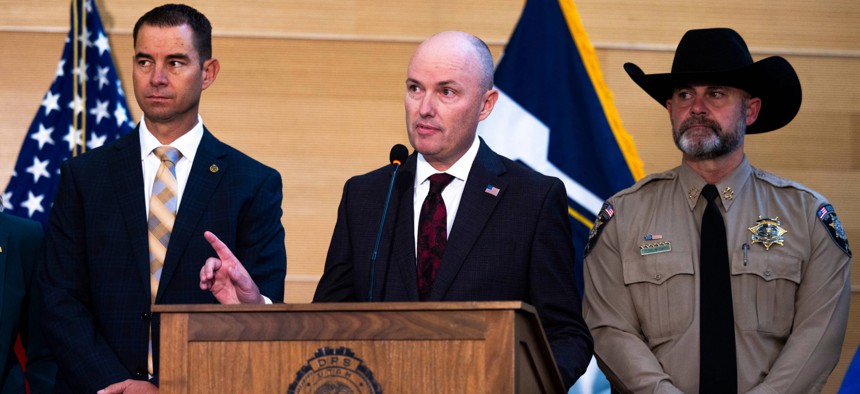
Utah Gov. Spencer Cox (center) speaks during a press conference last year. Michael Ciaglo via Getty Images





A bell-to-bell cellphone ban and an early literacy plan were among Spencer Cox’s priorities this year, while other new laws may help take students’ attention away from social media.
This article was originally published by Utah News Dispatch.
From taxing social media companies in the state, to banning cellphones during the full school day and implementing policies to improve literacy, Utah leaders’ K-12 theme in the past legislative session centered on students going back to basics. The vision, some of them say, is to see children talking more with each other face to face, or working on increasing the list of books they have completed.
Surrounded by classic literature, works of fantasy and Harry Potter decorations at Valley Elementary’s library in Eden, Gov. Spencer Cox ceremoniously signed a set of bills that he, first lady Abby Cox and lawmakers hope can encourage more kids to get off their phones and open their attention spans for books.
“As we’ve seen social media uptick over the last decade, we’ve seen literacy decline, and that is not unrelated, and we need to make sure that, as we’ve done as a state, pull that out of the classrooms, out of the hands of kids, and get us reading again,” Abby Cox said on Thursday in front of a group of fourth through sixth graders, lawmakers and lobbyists that contributed to the new laws.
The governor took a few minutes to explain to the students the legislative process these bills went through and commended teachers for their work, which he said has made a substantial contribution to the high rankings the state has scored in recent years.
“One of the reasons that we’re number one is because we have one of the best education systems in the state. One of the reasons we have one of the best education systems in the state is because we have the best teachers in the state,” Cox said. “And so make sure you thank your teachers for the good work that they’re doing.”
Some of the bills Cox signed in the ceremony were among his biggest priorities, like the bell-to-bell cellphone ban, which establishes a default policy prohibiting phones but that individual schools are free to change. Another was a $16 million investment to boost early literacy among K-3 students, after a report showed that almost half of the state’s third-graders don’t read at grade level.
However, other education bills that didn’t have as big of a spotlight during the legislative session were celebrated at the Eden school, including one that had unanimous approval among lawmakers, creating a required course for seventh and eighth grades on digital skills.
South Jordan Republican Rep. Jordan Teuscher, the bill sponsor, said during the Thursday event the legislation stemmed from parents’ concerns about their kids’ lack of tools to navigate digital spaces.
“One of the areas that was lacking was helping kids understand how to navigate in this important space. I hope none of you get on social media anytime soon,” Teuscher told the kids at the library. “If you can hold out until after you’re adults, that is way better, and you’re going to be healthier and happier and stronger. But for those that are getting involved in that, how can they safely navigate there?”
The course won’t be about “just how bad the technology is,” Teuscher said. It will also tackle the benefits of digital technologies, and help students to balance the virtual and real world.
But the state remains interested in disincentivizing social media use in other ways, like taxing platforms that collect user data for targeted advertising. It’s a law that according to Teuscher, who sponsored the bill on the House floor, may be the most controversial of the set the governor signed Thursday.
“In Utah we don’t like raising taxes, right? We want to keep taxes as low as we possibly can,” he said. “But in this case, when you see that there’s opportunities where we need to get less of something, the best thing that we can do is tax it.”
The funds collected by the 4.7% tax will pay for youth sports and recreation, and volunteerism and mental health programs for young Utahns, a model Cox said he felt “very passionate about.”
“The money that we’ll collect will go back to helping our young people who have been so damaged by social media and the wealthiest (companies) in the history of the world, we think that they should be able to pay a little bit to make up for the harms that they’ve caused,” Cox said about the bill.
Another law Cox highlighted during the ceremony also involved students’ interaction with digital technologies, but focused specifically on artificial intelligence use in public classrooms.
Kaysville Republican Rep. Ariel Defay, who sponsored the legislation, said it limits the use of technology in elementary schools so students can develop foundational skills in literacy and math.
“And then as you move on to junior high and high school, there’ll be more and more and more technology, because it will be important for you to use technology and to navigate it, but in a very balanced way,” she said.
Other laws highlighted during the event included some aiming to intervene earlier in cases of dyslexia by funding tests to detect it, not only in schools but with therapists, as well as partnering with the University of Utah to develop a statewide dyslexia intervention plan.