
Lawmakers look to make old laws on recording relevant in a world of Ring cameras, cellphones
Liubomyr Vorona via Getty Images





Several measures to amend Maryland’s two-party wiretap law are likely to be reintroduced for the 2026 legislative session.
This story was originally published by Maryland Matters.
For Del. N. Scott Phillips (D-Baltimore County), the debate over Maryland’s wiretapping law boiled down to one question.
“We don’t require consent for video, but we do require consent for audio. Does that make sense?” Phillips asked.
That was just one of the questions during a two-hour briefing Tuesday for the House Judiciary Committee on the wiretapping law, as lawmakers consider amending it when the 2026 session convenes in less two months.
Maryland is currently one of only a handful of states that has a two-party consent rule, under which everyone in a conversation must agree to it being recorded. Under the law, a person who records another without their permission could face up to five years in prison or up to a $10,000 fine, or both.
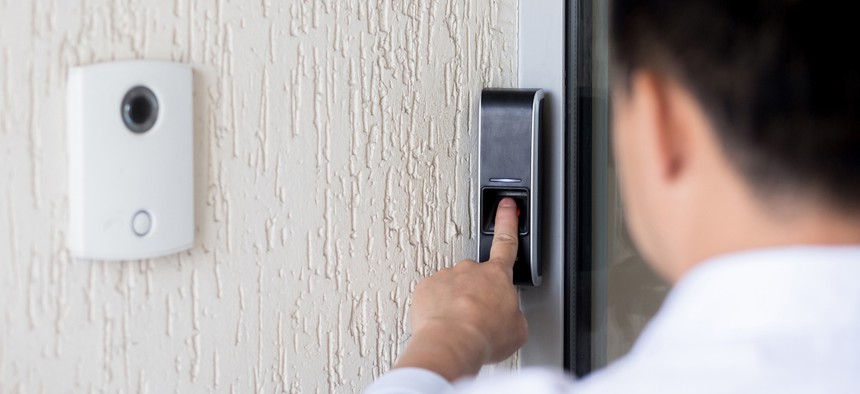
But modern technology has led to some tricky interpretations of the law, said David Gray, a professor at the University of Maryland Francis King Carey School of Law, who participated in the briefing. He said that while a doorbell camera might capture video and audio of an alleged crime, the video can be admissible in court under the current law, but not the audio.
“My understanding of the history of the law is that it was adopted at a time where video recording was relatively unavailable, and so it just wasn’t on the minds of the legislature at the time,” said Gray, who participated in the briefing virtually.
“You’re right to recognize that technology might have overtaken us, and trying to write that law now in our current technological environment,” Gray said. “I would not envy you or your staffers.”
There are exceptions to audio and video recordings that are allowed under the law. Claire Rossmark, an analyst with the Department of Legislative Services, and counsel to the Judiciary Committee, said they include telephone companies employees, 911 calls, police body-worn cameras and court-ordered wiretaps for investigative work.
But lawmakers are looking to clarify other carve-outs to the law, including in cases of domestic violence or housing discrimination.
Legislation Coming Back?
Several bills from the 2025 General Assembly are already being eyed for the next session. They include House Bill 314, sponsored by Del. Robin Grammer Jr. (R-Baltimore County). It would allow any oral or electronic communication to be used as evidence in court if “the interest of justice will be served,” such as protecting domestic violence victims.
A companion bill, sponsored by Sen. William C. Smith Jr. (D-Montgomery), passed the Senate unanimously last year but stalled in the House. Grammer filed a prefile version of the bill Tuesday.
Another bill slated to make a return is House Bill 392, sponsored by Del. J. Sandy Bartlett (D-Anne Arundel), vice chair of the Judiciary Committee who presided over Tuesday’s briefing. Her bill would allow a fair housing tester to obtain evidence of any housing violations under the law.
Sen. Charles Sydnor III (D-Baltimore County) sponsored a Senate version that was approved 28-18 in the Senate, but did not advance in the House.
Heather Morton, who directs the financial services, technology and communications program with National Conference of State Legislatures, said her research did not find any other state with a specific wiretapping exception for fair housing testing programs.
Morton said her research could not find a law similar to Grammer’s HB 314. But she said California does let a domestic violence victim seeking a restraining order record confidential communications with an abuser that “may be held germane as evidence for that restraining order and for it to be admissible” in court.
‘Maryland Is an Outlier’
Morton said Maryland is just one of 10 states that is a two-party, or “all-party” consent state. The majority of states are one-party consent, which lets one person record a conversation without needing the other’s permission.
“So for example, if you’re on a phone call with a colleague in a one-party consent state, you can record that call without telling the other person or obtaining their consent,” Morton said.
Two attorneys at Tuesday’s briefing had differing opinions on what Maryland should do.
Joyce King, chief counsel with the Frederick County State’s Attorney’s Office, said certain recordings should not need any consent, especially when they deal with domestic violence, child or elder abuse, or other violent crimes.
“Maryland is an outlier,” she said. “These cases are limited to crimes committed against a person, that the recording is not just to embarrass or to be salacious … not to capture your private conversations at the dinner table. It’s a material fact of a crime.”
But Baltimore City Public Defender Marguerite Lanaux said two-party consent provides privacy protection from “fabricated evidence” through artificial intelligence and audio manipulation that “helps prevent malicious actors from creating or editing recordings to frame individuals.”
“Just because we are in the minority [among states] doesn’t necessarily mean that we need to move to the majority, where the majority is in a place that doesn’t afford protections that the Constitution is truly rooted in,” Lanaux said.
After the briefing, Bartlett said one of the key points in assessing the use of two-party consent next year will be the admissibility of evidence to be reviewed by judges.
“They would have all the evidence, and they could weigh the evidence and see is this the best evidence? Is this evidence going to help prove the material of fact, just as they will with any other evidence that gets admitted,” she said. “It was a good briefing to have this discussion.”
Maryland Matters is part of States Newsroom, a nonprofit news network supported by grants and a coalition of donors as a 501c(3) public charity. Maryland Matters maintains editorial independence. Contact Editor Steve Crane for questions: editor@marylandmatters.org.