
Demystifying the public sector’s flood risk challenges
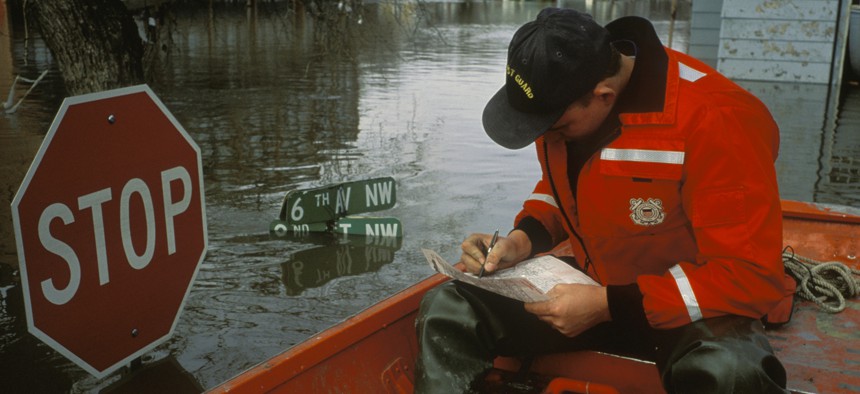
Bob Sacha via Getty Images




COMMENTARY | Current maps are insufficient, especially in the face of rising threats. AI, machine learning and other technologies offer a new path forward.
The climate risks posed to public sector infrastructure planning are unlike anything we have ever seen. And, as damage figures continue to climb, more scrutiny is being placed on the public sector’s abilities to adapt to emerging catastrophe risks – particularly when it comes to flooding.
Insured losses from natural catastrophes are projected to approach $150 billion globally in 2025. These losses have been growing at an average annual rate of 5 to 7% in real terms, and flooding is a major contributor. “Once in a generation storms” now occur several times a year, making flooding perhaps the most dynamic and damaging risk vector today. In 2024, worldwide insured losses caused by floods rose to $20 billion, the third-highest ever recorded by Swiss Re’s Sigma report.Notably, flooding impacts are no longer largely limited to traditionally affected areas, such as Florida and Louisiana. Instead, the fallout from storms is now routinely being felt by inland communities that have been historically considered out of harm’s reach — like North Carolina and Tennessee during Hurricane Helene, for example.
For decades, the private and public sectors alike have relied on legacy tools — like the Federal Emergency Management Agency’s Special Flood Hazard Areas maps — to gauge their flood risk and adapt accordingly. But researchers at Fathom have found that in most US states, more than half of average annual losses occur outside these SFHAs — the areas in which the National Flood Insurance Program’s floodplain management regulations must be enforced. As 2026 rolls on, questions are rightly being asked about these gaps in public sector intelligence, why they exist, and how stakeholders can close them.
Here is a deeper look at the current state of flood risk intelligence and prevention and some of the key ways that the public sector can revamp its flood risk infrastructure to meet the shifting challenges they face.
The State of Flood Management, Mapping and Modeling For the Public Sector
To determine their most pressing risks and where to invest to mitigate them, public sector flood risk managers need a comprehensive and up-to-date view of flood risks. Unfortunately, several factors are making this challenging. Chief among them are the limitations of legacy tools that have not always been kept up to date, and often provide a limited view of the true risk for today's date.
FEMA’s SFHA maps, for example, have served to help provide a key flood risk building block. However, these maps are static, only cover river-related risks for approximately 60% of the continental US, and are oftentimes more than a decade old. This means data is incomplete, out of date, and not reflective of evolving climate-driven risks, particularly for flash flooding.
According to our internal research, nearly 24,000 miles of the US road network and over 18,000 miles of the US rail network is at risk of flood. And given this is expected to rise by 2050 as climate-driven extreme weather intensifies, continuing to rely solely on static historic maps comes with significant flaws.
At the same time, policy changes are also affecting the public sector. At the time of writing, we were waiting for the FEMA Review Council to release its final report, which is expected to include recommendations on overhauling FEMA and the federal role in flood management in the US. But already, funding to FEMA and other agencies is being scaled back, and the responsibility for flood management and mitigation is increasingly being passed from the federal to the state level, leaving local and regional stakeholders to deal with flood priorities with limited prior experience, infrastructure or funding to lean on.
As the risk landscape has evolved, so have the resources that can help provide a more dynamic view of risk. Widening collaboration between the private, public and academic sectors has resulted in public-private data partnerships and innovative hybrid modeling approaches. Even in the face of funding cuts, better preparedness for emergency management and resilience is possible with alternative resources and tools.
Best Practices for Closing These Gaps
Much like in other sectors, technology innovation has helped to reshape what is possible in flood risk management. Arguably, nothing has been more responsible for this shift than the revolution in artificial intelligence, particularly its subset machine learning.
Thanks to the growth of AI and ML, it is now possible to synthesize insights in a matter of seconds vs. weeks or months. Paired with the advances in data volume and quality coming from open-source channels and the expansion of LiDAR — among other sources — the decision-making ability of flood risk managers has accelerated infinitely.
In addition, as these tools have evolved, they have not only helped organizations tackle their flood risk priorities in a way that is more accurate and real-time, but also more efficient and cost-friendly — two long-standing hurdles that organizations have had to overcome in relation to environmental risk management.
Organizations that are able to effectively adopt these tools and integrate them into their existing flood risk and resilience capabilities will find it far easier to navigate emerging challenges as climate-driven factors advance.
Looking Ahead
Despite the challenges that exist today, seeing a reliable map of flood hazards for the US at the county, state, or national scale has never been more accessible. Multiple examples of independent validation have shown that these new techniques are now matching the depth and extent of performance of Base Level Engineering models as well as public sector programs — which have cost billions of dollars and taken decades to deliver, only to quickly fall out of date.
As a result, blending various publicly available regulatory data with private data in a hybrid modeling approach is becoming a more common and popular solution for a complete view of flood risk.
That said, whichever approach public sector stakeholders choose, the most important thing is to make sure it meets their needs. FEMA maps were designed to designate flood plains for insurance purposes, and not to illustrate every area that will flood.
Similarly, large scale private flood hazard data is often not suitable for extremely detailed, local flood risk assessments, or approved for regulatory purposes. Organizations that can strike this balance and build bespoke flood risk infrastructures will be in a better position to manage their short-, medium- and long-term goals and challenges.
Peter Slater is an engineering specialist at Fathom.