‘Contactless’ fares quickly grow popular among T riders
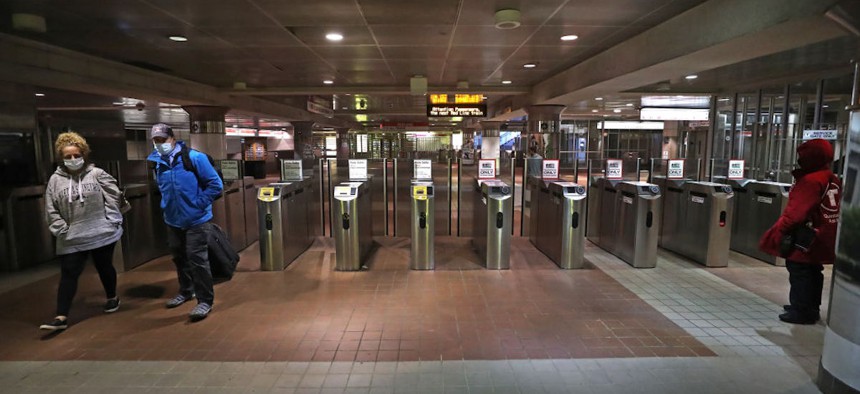
Commuters exit the South Station MBTA train "T" station in Boston on Dec. 7, 2020.


Commuters exit the South Station MBTA train "T" station in Boston on Dec. 7, 2020.

A year into the Massachusetts Bay Transportation Authority's adoption of a contactless payment option, one in four taps are now made using credit card or mobile wallet.

This story was originally published by the CommonWealth Beacon.

If you polled a full rush-hour train or bus across the Massachusetts Bay Transportation Authority system, odds are that at least one in four riders aboard would not have touched a CharlieCard in the past several months. 

It’s been a bit more than a year since the T rolled out the ability to tap a credit card or mobile wallet to get onto the core subway and bus systems, and the new system has quickly become popular with passengers. 

Through the first 12 months of the offering, the share of fares paid using the “contactless” system grew from less than 10 percent to more than 25 percent. That's close to the same share as “stored value” taps, or when a rider puts a set dollar amount on a CharlieCard or CharlieTicket but does not buy a weekly or monthly pass. The remaining roughly 50 percent of trips involve those time-based passes or other options, such as T employees. 

So in other words, by late spring, just about as many riders were turning to Apple Pay, Google Wallet and credit cards as were loading up their trusty old CharlieCards with a set dollar amount. 

MBTA leaders and watchdogs alike are pleased with the uptake so far, describing it as a sign of success for an initiative meant to modernize the system and cater to an increasingly digital public. 

“The approach that [MBTA General Manager] Phil Eng and his team are taking is much more reality-based and designed to meet people where they are, not where the T would like them to be,” said Brian Kane, executive director of the MBTA Advisory Board, which represents cities and towns who help fund the transit system. “The ability to use your phone or use a credit card is obviously ubiquitous in today’s society.” 

In August 2024, the first month with the new payment options live to all passengers, about 904,000 of the roughly 10.9 million taps on the MBTA came from so-called contactless sources such as mobile wallets.  Nearly 4.4 million taps that month involved what the T calls “stored value,” or a CharlieCard or CharlieTicket loaded with a set dollar amount rather than a weekly or monthly pass. 

Those two offerings have been on opposite trends since then. By July 2025, the most recent month with data available, about 3.17 million trips involved contactless taps, just a shade below the 3.26 million trips using stored value taps. 

T leaders think the added ease of payment has been one factor among several contributing to stronger fare collections. While the MBTA — like most other transit agencies around the country — continues to struggle with depleted ridership in the wake of the COVID-19 pandemic, it hauled in $38 million more from fares in fiscal year 2025 than budget-writers forecast. 

Eng, the T’s top boss, said he personally witnessed tourists board buses and trains without paying because they could not find a fare vending machine and did not have cash on hand. 

“We do believe that this is definitely helping new riders [and] visitors pay into our system, whereas before, perhaps they might not have been paying,” Eng told CommonWealth Beacon. “We also know that contactless has become such an easy way of payment, whether you're riding the T, going to a store, going to get a cup of coffee. People are using that.” 

“It’s just more the norm, not having to stop at a [fare vending] machine if you choose not to,” he added. 

While the newest method has grown quickly, a plurality of riders continue to rely on other methods such as weekly and monthly passes. 

window.addEventListener("message",function(a){if(void 0!==a.data["datawrapper-height"]){var e=document.querySelectorAll("iframe");for(var t in a.data["datawrapper-height"])for(var r,i=0;r=e[i];i++)if(r.contentWindow===a.source){var d=a.data["datawrapper-height"][t]+"px";r.style.height=d}}});

That’s likely a financial decision for many riders: contactless taps are convenient, but they also charge à la carte for each ride. Someone who knows they will travel enough in a certain span of time can pay less overall by purchasing an unlimited pass. 

Some other networks, including NYC Transit, have more advanced contactless systems in place that track each user and automatically cap what they pay once they hit the breakeven point for a given period. 

Eng said “all of those [options] are on the table,” but he declined to commit to any timeline for implementing fare-capping at the MBTA. His team is weighing several variables, including whether the change would shift some monthly passholders — who contribute a sizable chunk of fare revenue — to less-impactful single taps. 

“If we offer a product that we think many people would really enjoy, I want to make sure that I can keep that product, and it's not just a pilot for six months, it is something that we're ready to do, we're ready to keep,” he said. 

After extensive delays and a ballooning budget hit previous fare overhaul attempts, the T launched the contactless payment system on subways, buses and trolleys in August 2024. The option expanded to ferries last summer. 

The T recently ramped up its efforts to prevent fare evasion with new civilian teams monitoring the systems. Riders face warnings and then fines for failing to pay. 

Officials are also testing several other tweaks to the fare-collection system this fall, including new fare vending machines in Orange Line stations, online accounts for users, and the option to acquire a digital CharlieCard. 

Eng compared the new ways to pay to the extensive repair campaign the T mounted to eliminate slow zones. Both, he said, tackled issues that had persisted for years with little progress visible to the public. 

“The contactless [project] is just one of many where we're demonstrating that we're a different T, that we are looking to really make wise investments and make sure that when we do deliver something, it’s useful and what the public has been asking for,” he said. 

Kane, who has been critical of past MBTA attempts to overhaul its fare system, said the relative success of contactless payments should encourage agency leaders to focus on “interoperability.” 

“The less customized, the better,” he said. “Using off-the-shelf technology allows people to use what they’re used to and it just makes it more seamless. People don’t care who the provider of their trips is. They just want to get where they’re going. The more we can do to make it easy and seamless, the better.” 

This article first appeared on CommonWealth Beacon and is republished here under a Creative Commons Attribution-NoDerivatives 4.0 International License.

X
This website uses cookies to enhance user experience and to analyze performance and traffic on our website. We also share information about your use of our site with our social media, advertising and analytics partners. Learn More / Do Not Sell My Personal Information
Accept Cookies
X
Cookie Preferences Cookie List

Do Not Sell My Personal Information

When you visit our website, we store cookies on your browser to collect information. The information collected might relate to you, your preferences or your device, and is mostly used to make the site work as you expect it to and to provide a more personalized web experience. However, you can choose not to allow certain types of cookies, which may impact your experience of the site and the services we are able to offer. Click on the different category headings to find out more and change our default settings according to your preference. You cannot opt-out of our First Party Strictly Necessary Cookies as they are deployed in order to ensure the proper functioning of our website (such as prompting the cookie banner and remembering your settings, to log into your account, to redirect you when you log out, etc.). For more information about the First and Third Party Cookies used please follow this link.

Allow All Cookies

Manage Consent Preferences

Strictly Necessary Cookies - Always Active

We do not allow you to opt-out of our certain cookies, as they are necessary to ensure the proper functioning of our website (such as prompting our cookie banner and remembering your privacy choices) and/or to monitor site performance. These cookies are not used in a way that constitutes a “sale” of your data under the CCPA. You can set your browser to block or alert you about these cookies, but some parts of the site will not work as intended if you do so. You can usually find these settings in the Options or Preferences menu of your browser. Visit www.allaboutcookies.org to learn more.

Sale of Personal Data, Targeting & Social Media Cookies

Under the California Consumer Privacy Act, you have the right to opt-out of the sale of your personal information to third parties. These cookies collect information for analytics and to personalize your experience with targeted ads. You may exercise your right to opt out of the sale of personal information by using this toggle switch. If you opt out we will not be able to offer you personalised ads and will not hand over your personal information to any third parties. Additionally, you may contact our legal department for further clarification about your rights as a California consumer by using this Exercise My Rights link

If you have enabled privacy controls on your browser (such as a plugin), we have to take that as a valid request to opt-out. Therefore we would not be able to track your activity through the web. This may affect our ability to personalize ads according to your preferences.

Targeting cookies may be set through our site by our advertising partners. They may be used by those companies to build a profile of your interests and show you relevant adverts on other sites. They do not store directly personal information, but are based on uniquely identifying your browser and internet device. If you do not allow these cookies, you will experience less targeted advertising.

Social media cookies are set by a range of social media services that we have added to the site to enable you to share our content with your friends and networks. They are capable of tracking your browser across other sites and building up a profile of your interests. This may impact the content and messages you see on other websites you visit. If you do not allow these cookies you may not be able to use or see these sharing tools.

If you want to opt out of all of our lead reports and lists, please submit a privacy request at our Do Not Sell page.

Save Settings
Cookie Preferences Cookie List

Cookie List

A cookie is a small piece of data (text file) that a website – when visited by a user – asks your browser to store on your device in order to remember information about you, such as your language preference or login information. Those cookies are set by us and called first-party cookies. We also use third-party cookies – which are cookies from a domain different than the domain of the website you are visiting – for our advertising and marketing efforts. More specifically, we use cookies and other tracking technologies for the following purposes:

Strictly Necessary Cookies

We do not allow you to opt-out of our certain cookies, as they are necessary to ensure the proper functioning of our website (such as prompting our cookie banner and remembering your privacy choices) and/or to monitor site performance. These cookies are not used in a way that constitutes a “sale” of your data under the CCPA. You can set your browser to block or alert you about these cookies, but some parts of the site will not work as intended if you do so. You can usually find these settings in the Options or Preferences menu of your browser. Visit www.allaboutcookies.org to learn more.

Functional Cookies

We do not allow you to opt-out of our certain cookies, as they are necessary to ensure the proper functioning of our website (such as prompting our cookie banner and remembering your privacy choices) and/or to monitor site performance. These cookies are not used in a way that constitutes a “sale” of your data under the CCPA. You can set your browser to block or alert you about these cookies, but some parts of the site will not work as intended if you do so. You can usually find these settings in the Options or Preferences menu of your browser. Visit www.allaboutcookies.org to learn more.

Performance Cookies

We do not allow you to opt-out of our certain cookies, as they are necessary to ensure the proper functioning of our website (such as prompting our cookie banner and remembering your privacy choices) and/or to monitor site performance. These cookies are not used in a way that constitutes a “sale” of your data under the CCPA. You can set your browser to block or alert you about these cookies, but some parts of the site will not work as intended if you do so. You can usually find these settings in the Options or Preferences menu of your browser. Visit www.allaboutcookies.org to learn more.

Sale of Personal Data

We also use cookies to personalize your experience on our websites, including by determining the most relevant content and advertisements to show you, and to monitor site traffic and performance, so that we may improve our websites and your experience. You may opt out of our use of such cookies (and the associated “sale” of your Personal Information) by using this toggle switch. You will still see some advertising, regardless of your selection. Because we do not track you across different devices, browsers and GEMG properties, your selection will take effect only on this browser, this device and this website.

Social Media Cookies

We also use cookies to personalize your experience on our websites, including by determining the most relevant content and advertisements to show you, and to monitor site traffic and performance, so that we may improve our websites and your experience. You may opt out of our use of such cookies (and the associated “sale” of your Personal Information) by using this toggle switch. You will still see some advertising, regardless of your selection. Because we do not track you across different devices, browsers and GEMG properties, your selection will take effect only on this browser, this device and this website.

Targeting Cookies

We also use cookies to personalize your experience on our websites, including by determining the most relevant content and advertisements to show you, and to monitor site traffic and performance, so that we may improve our websites and your experience. You may opt out of our use of such cookies (and the associated “sale” of your Personal Information) by using this toggle switch. You will still see some advertising, regardless of your selection. Because we do not track you across different devices, browsers and GEMG properties, your selection will take effect only on this browser, this device and this website.