Pennsylvania senators weigh consumer protections from cryptocurrency scams
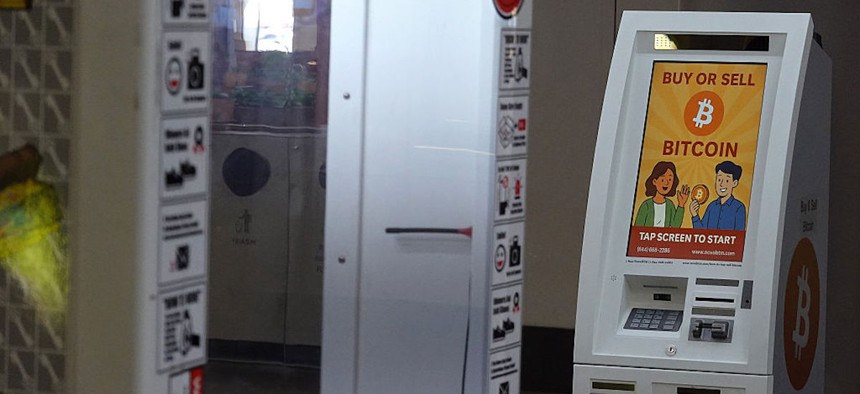
A view of a Bitcoin ATM at Northgate Mall on Feb. 5, 2026, in San Rafael, California.

A view of a Bitcoin ATM at Northgate Mall on Feb. 5, 2026, in San Rafael, California. Justin Sullivan/Getty Images

Lawmakers hope that by regulating ATM-like kiosks, they can protect Pennsylvanians.

This story was originally published by the Pennsylvania Capital-Star.

Millions of Americans fell prey to scammers in 2025, losing nearly $21 billion in cryptocurrency and artificial intelligence scams. It’s an ever-growing industry that takes advantage of society’s most vulnerable, according to the FBI.

In Pennsylvania last year, over 31,000 people lost $538 million.

An increasing number of those victims lose their money after withdrawing cash and depositing funds into scammers’ cryptocurrency wallets at an unknown number of kiosks around the state. Lawmakers hope that by regulating these ATM-like machines, they can protect Pennsylvanians. 

“As with all new technologies, we have a responsibility to ensure that these advances are not exploited by the bad actors that seem to pop up when new technology emerges,” said Sen. Pennycuick (R-Montgomery). “We don’t want to stifle innovation. We want to make sure that our policies keep pace with innovation and encourage progress, while protecting the consumers’ safety, privacy and confidence.” 

Pennycuick is the sponsor behind Senate Bill 1015, a proposal that would require virtual currency kiosks to display anti-fraud warnings and enhance their safeguards against financial exploitation. Operators would also need to establish a 24/7 customer service support line and obtain a money transmitter license. 

Two companies with machines in the commonwealth endorsed the bill as written, detailing before a Senate committee on Wednesday how their systems flag such abuse.

“We have a physical warning to start on every single machine,” said Chris Edwards, the assistant general counsel of Bitcoin Depot, which operates 462 kiosks throughout the commonwealth. 

“We ask folks, ‘Are you sending this Bitcoin that you’re about to purchase to a (digital) wallet that you own and control?’ … the only correct answer to that is ‘yes,’” continued Edwards. “If you answer ‘no,’ the transaction is cancelled and taken back to the start.”

Others recommended further action, saying the current effort would “markedly improve the regulatory market,” but that the machines served “no purpose.”

Paul Edger, a senior deputy state attorney general, said that the office’s Bureau of Consumer Protection had received 90 complaints specifically about cryptocurrency fraud totalling $12.3 million in losses. Of those, 85% of the victims were 60 or older. 

“Our office believes that kiosk operators know scams are occurring at dangerously high numbers and provide only minimal warnings for consumers,” said Edger. “As my office sees it, these kiosks serve no other purpose than for scam. I don’t see a legitimate purpose for these kiosks when an individual, in my opinion, can do (these transactions) online, through a computer, through their bank or through a legitimate service.”

In March, Indiana Gov. Mike Braun signed a bill banning the kiosks entirely, making it the first state to do so after lawmakers said they couldn’t think of “legitimate reasons” for their operation.

How Do the Scams Work?

According to new research from AARP, nearly four in 10 U.S. adults have already experienced fraud and millions more “are worried about becoming victims.” Though 82% of those surveyed could readily identify gift card payments as scams, just 19% could recognize a cryptocurrency kiosk. 

According to testimony, a victim might withdraw large amounts of cash from a bank and deposit it into someone else’s virtual wallet using a kiosk, instantly losing thousands of dollars that are nearly impossible to recover — all while on the phone with a scammer who talks them through the process. 

Teresa Osborne, the state advocacy director of AARP’s Pennsylvania chapter, said that any fraud estimates are likely an undercount, noting the shame many victims feel means many losses go unreported. 

“Until we collectively recognize that fraud victims are crime victims, we will continue to fall short in confronting fraud as the serious and pervasive threat that it is,” said Osborne. 

According to Osborne, roughly 1,000 Pennsylvanians called the AARP’s national Fraud Watch Network hotline, reporting losses of nearly $11 million last year.

Digital currency advocates say that kiosks give people the ability to convert cash into cryptocurrency like Bitcoin, Altcoins or Stablecoins. As adoption of these forms of currency increases, so too will the demand for kiosks, said Edwards.

At right, Chris Edwards, the assistant general counsel of Bitcoin Depot, said his company operates 9,000 digital currency kiosks in the country, including 462 in the commonwealth. (Photo by Whitney Downard/Pennsylvania Capital-Star)

“The original ethos behind Bitcoin was that it provides you the ability to move money using the Internet without involving a centralized intermediary,” said Edwards 

Edwards said consumers in cash-intensive industries gravitated toward cryptocurrencies, but that his company had a “robust compliance regime” for identifying bad actors and blocking their digital wallets. 

When asked specifically about illegal operations, such as laundering money used to purchase drugs, Edwards noted it’d be “a bad idea” to use their kiosks, which photograph each consumer and require a scanned driver’s license to use.

“We of course want to fight the fraud, but we want to do so in a way that allows legitimate business to continue to thrive and continue to exist,” said Edwards. “I think there are a number of smaller operators — and whether they’re bad actors or they just don’t have the ability to do some of these things that we’re doing, I don’t know. 

“But I think some of these smaller operators don’t necessarily have that robust compliance regime that we have built … and that makes a difference,” said Edwards. 

He pointed to an August 2025 report from the U.S. Treasury which reported that some kiosks don’t register with the proper banking authorities or advertise the ability to do transactions using only a phone number or email address. 

What Can Be Done To Protect Pennsylvanians?

Edger, with the state Office of Attorney General, said that many scammers worked overseas, making them difficult to find and prosecute. 

He called for more precise regulation on kiosks, requiring that anti-fraud warnings occur at multiple steps and “appear in large, unavoidable print.” 

Operators should collect more information before allowing someone to open an account and check it against publicly available services, he continued, while also identifying blacklisted wallets associated with criminal activity. 

He also recommended regulations for the owners of convenience stores, gas stations and bars hosting the machines, who he said received rent or other financial incentives, to place the kiosks in well-lit, highly visible locations with anti-fraud signage. 

“Stores should also be required to obtain mandatory training on how to spot a scam, as well as the authority to refuse access to a kiosk should the employee reasonably think a scam has occurred,” added Edger. 

While the Older Adult Protective Services Act includes some banking regulations, Edger said that “many” victims withdrew cash from their local financial institution before depositing into a cryptocurrency wallet and urged allowing banks to temporarily “freeze” suspect withdrawals. 

“We further recommend that if the transaction is temporarily frozen, that the bank immediately notify law enforcement to perform a welfare check on the consumer within 24 hours in order to speak with them and assist in stopping the potential scam,” Edger continued. 

Additionally, if someone using a kiosk is on the phone, Edger said the transaction should be denied. 

“In more than 95% of the consumer transactions reviewed by our office, the consumer engaged in a scam was on the phone,” he added.

Pennsylvania Capital-Star is part of States Newsroom, a nonprofit news network supported by grants and a coalition of donors as a 501c(3) public charity. Pennsylvania Capital-Star maintains editorial independence. Contact Editor Tim Lambert for questions: info@penncapital-star.com.

X
This website uses cookies to enhance user experience and to analyze performance and traffic on our website. We also share information about your use of our site with our social media, advertising and analytics partners. Learn More / Do Not Sell My Personal Information
Accept Cookies
X
Cookie Preferences Cookie List

Do Not Sell My Personal Information

When you visit our website, we store cookies on your browser to collect information. The information collected might relate to you, your preferences or your device, and is mostly used to make the site work as you expect it to and to provide a more personalized web experience. However, you can choose not to allow certain types of cookies, which may impact your experience of the site and the services we are able to offer. Click on the different category headings to find out more and change our default settings according to your preference. You cannot opt-out of our First Party Strictly Necessary Cookies as they are deployed in order to ensure the proper functioning of our website (such as prompting the cookie banner and remembering your settings, to log into your account, to redirect you when you log out, etc.). For more information about the First and Third Party Cookies used please follow this link.

Allow All Cookies

Manage Consent Preferences

Strictly Necessary Cookies - Always Active

We do not allow you to opt-out of our certain cookies, as they are necessary to ensure the proper functioning of our website (such as prompting our cookie banner and remembering your privacy choices) and/or to monitor site performance. These cookies are not used in a way that constitutes a “sale” of your data under the CCPA. You can set your browser to block or alert you about these cookies, but some parts of the site will not work as intended if you do so. You can usually find these settings in the Options or Preferences menu of your browser. Visit www.allaboutcookies.org to learn more.

Sale of Personal Data, Targeting & Social Media Cookies

Under the California Consumer Privacy Act, you have the right to opt-out of the sale of your personal information to third parties. These cookies collect information for analytics and to personalize your experience with targeted ads. You may exercise your right to opt out of the sale of personal information by using this toggle switch. If you opt out we will not be able to offer you personalised ads and will not hand over your personal information to any third parties. Additionally, you may contact our legal department for further clarification about your rights as a California consumer by using this Exercise My Rights link

If you have enabled privacy controls on your browser (such as a plugin), we have to take that as a valid request to opt-out. Therefore we would not be able to track your activity through the web. This may affect our ability to personalize ads according to your preferences.

Targeting cookies may be set through our site by our advertising partners. They may be used by those companies to build a profile of your interests and show you relevant adverts on other sites. They do not store directly personal information, but are based on uniquely identifying your browser and internet device. If you do not allow these cookies, you will experience less targeted advertising.

Social media cookies are set by a range of social media services that we have added to the site to enable you to share our content with your friends and networks. They are capable of tracking your browser across other sites and building up a profile of your interests. This may impact the content and messages you see on other websites you visit. If you do not allow these cookies you may not be able to use or see these sharing tools.

If you want to opt out of all of our lead reports and lists, please submit a privacy request at our Do Not Sell page.

Save Settings
Cookie Preferences Cookie List

Cookie List

A cookie is a small piece of data (text file) that a website – when visited by a user – asks your browser to store on your device in order to remember information about you, such as your language preference or login information. Those cookies are set by us and called first-party cookies. We also use third-party cookies – which are cookies from a domain different than the domain of the website you are visiting – for our advertising and marketing efforts. More specifically, we use cookies and other tracking technologies for the following purposes:

Strictly Necessary Cookies

We do not allow you to opt-out of our certain cookies, as they are necessary to ensure the proper functioning of our website (such as prompting our cookie banner and remembering your privacy choices) and/or to monitor site performance. These cookies are not used in a way that constitutes a “sale” of your data under the CCPA. You can set your browser to block or alert you about these cookies, but some parts of the site will not work as intended if you do so. You can usually find these settings in the Options or Preferences menu of your browser. Visit www.allaboutcookies.org to learn more.

Functional Cookies

We do not allow you to opt-out of our certain cookies, as they are necessary to ensure the proper functioning of our website (such as prompting our cookie banner and remembering your privacy choices) and/or to monitor site performance. These cookies are not used in a way that constitutes a “sale” of your data under the CCPA. You can set your browser to block or alert you about these cookies, but some parts of the site will not work as intended if you do so. You can usually find these settings in the Options or Preferences menu of your browser. Visit www.allaboutcookies.org to learn more.

Performance Cookies

We do not allow you to opt-out of our certain cookies, as they are necessary to ensure the proper functioning of our website (such as prompting our cookie banner and remembering your privacy choices) and/or to monitor site performance. These cookies are not used in a way that constitutes a “sale” of your data under the CCPA. You can set your browser to block or alert you about these cookies, but some parts of the site will not work as intended if you do so. You can usually find these settings in the Options or Preferences menu of your browser. Visit www.allaboutcookies.org to learn more.

Sale of Personal Data

We also use cookies to personalize your experience on our websites, including by determining the most relevant content and advertisements to show you, and to monitor site traffic and performance, so that we may improve our websites and your experience. You may opt out of our use of such cookies (and the associated “sale” of your Personal Information) by using this toggle switch. You will still see some advertising, regardless of your selection. Because we do not track you across different devices, browsers and GEMG properties, your selection will take effect only on this browser, this device and this website.

Social Media Cookies

We also use cookies to personalize your experience on our websites, including by determining the most relevant content and advertisements to show you, and to monitor site traffic and performance, so that we may improve our websites and your experience. You may opt out of our use of such cookies (and the associated “sale” of your Personal Information) by using this toggle switch. You will still see some advertising, regardless of your selection. Because we do not track you across different devices, browsers and GEMG properties, your selection will take effect only on this browser, this device and this website.

Targeting Cookies

We also use cookies to personalize your experience on our websites, including by determining the most relevant content and advertisements to show you, and to monitor site traffic and performance, so that we may improve our websites and your experience. You may opt out of our use of such cookies (and the associated “sale” of your Personal Information) by using this toggle switch. You will still see some advertising, regardless of your selection. Because we do not track you across different devices, browsers and GEMG properties, your selection will take effect only on this browser, this device and this website.