
Shifting politics around data centers scramble Healey AI push
Thomas Barwick via Getty Images


A backlash to data centers is scrambling whether and how the AI industry takes hold in Massachusetts, how it plays politically for Democrats in a deep-blue state and how state officials manage the tradeoffs.
This article first appeared on CommonWealth Beacon and is republished here under a Creative Commons Attribution-NoDerivatives 4.0 International License.
Just as Lowell City Council was preparing to vote for the state’s first data center moratorium, a bat flew into the chamber, sending the packed crowd ducking for cover and prompting a brief recess.
The bit of comic relief that sent the dozens of attendees spilling into the hallway quickly surrendered to the tensions that dominated the night.
During the recess, council members sparred with representatives for Markley, the company that owns a data center in a densely populated Lowell neighborhood that was the subject of debate. Arguments broke out about Markley’s role in the community and the economic and environmental tradeoffs associated with a pause on data centers. IBEW union workers donning T-shirts reading “Stand with Markley” congratulated one another on their earlier testimony about how the data center propelled their careers. Within each camp, there were many heads shaking in exasperation at the opposing side.
But when the meeting resumed and the final 10-0 vote came down from council to back a one-year moratorium on new data center construction, people on all sides of the issue understood that that judgment would reverberate far beyond the confines of Lowell.
“It’s part of a national wave,” Charlie Desourdy, Markley’s chief information officer, told CommonWealth Beacon after the vote.
The vote pitted two core Democratic constituencies against each other: union members, who lavished praise on Markley, which employs about 100 workers at the Lowell site and is expected to pay the city about $12 million in net taxes over a 20-year period, against environmentalists and neighbors along the property fenceline. They worry about the facility’s unfettered growth, diesel fuel stored on site for backup power, noise pollution, and increased water and energy consumption, the latter of which prompted National Grid to increase the electrical load to the data center by upgrading 199 utility poles.
Markley, which also operates Massachusetts’s largest data center in Boston, opened its 350,000-square foot Lowell site in 2015 in what is now a state-designated environmental justice zone on a previously blighted property with the help of a $77 million tax break. The moratorium came about in reaction to Markley’s efforts to expand, including the company’s recent purchase of additional properties in the neighborhood. Markley had also asked the city permission to store another roughly 100,000 gallons of diesel for emergency backup power at the site but withdrew that request. Lowell’s moratorium will allow the city to consider zoning changes and a possible community benefit agreement requirement.
Desourdy said the expansion proposals that have occurred throughout the past decade are a sign that business is booming and that the moratorium may slow new hirings. But the council, ultimately, decided the need for guardrails was greater.
"Since Markley has taken over the property, it's magnificent. I'm not going to deny that,” Rita Mercier, a council member, said before voting to support the moratorium. "I also know neighbors there, and I know of their concerns. I'm faced with a dilemma: Which one of my children do I like the best? Do I like the neighbors or do I like the union? I’m torn,” she added. “My heart is broken.”
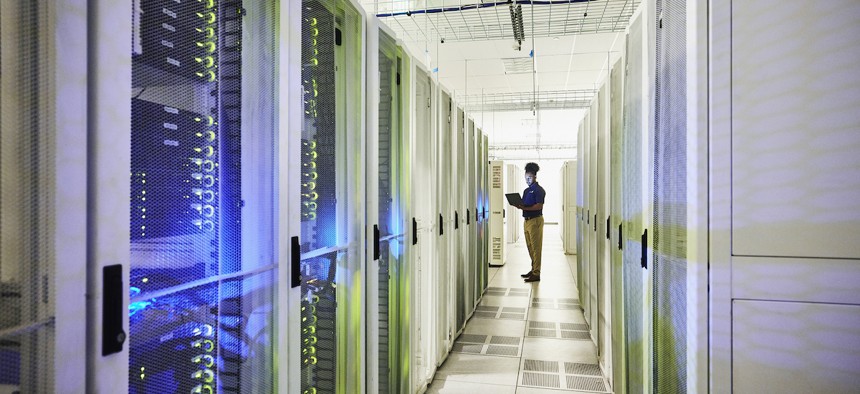
Data centers, which are large warehouses that store companies’ digital infrastructure, servers, and networks, guzzle water to cool the computers and could double their power consumption across the US by 2030, according to Pew Research Center. Some of the larger facilities could even require the equivalent energy and water consumption of entire cities, sparking potentially significant cost increases for ratepayers.
But they’re also seen as critical for the US tech sector to compete and can contribute to the local economy by providing jobs and increasing the property tax base.
Part of Lowell’s pause on data centers can be explained by the opposition that often accompanies attempts to develop or expand infrastructure in a community and the risks for any project that has unhappy neighbors willing to stymie expansion. But it’s also a specific rebuke of the data center boom that’s now proliferating nationwide — and an indication of the buyer’s remorse that can result.
It’s all scrambling whether and how the AI industry takes hold in Massachusetts, how it plays politically for Democrats in a deep-blue state, and how state officials manage the tradeoffs. As the biotech industry stalls, Gov. Maura Healey is pursuing an economic agenda that relies on the artificial intelligence industry powered by data centers, but that plan is colliding with consumer outrage over the state’s high energy costs, which have jostled their way to the top of Beacon Hill’s agenda.
"Things have definitely changed,” said Aaron Vega, president and CEO of the Western Massachusetts Economic Development Council. “We see this opposition at the local level building. In general, residents like the idea of green energy, even if it costs a few pennies more. But if people say, ‘My bill is going up because some data center sucks up all the energy,’ that's going to play much differently.”
In November 2024, Healey signed into a law a major economic development measure that granted data centers sales and use tax exemptions. Though proposed regulations have been released by the Executive Office of Economic Development, the tax break remains unfinalized 16 months after the law was signed, and no data centers can claim the exemption today, the EOED confirmed.
But behind the scenes, there are signs of ongoing discussions as the final tax break takes shape.
Josh Ryor, the state’s assistant secretary of energy, held a previously unreported stakeholder meeting with environmental groups in December to discuss data centers, according to an invitation viewed by CommonWealth Beacon.
While the meeting was more of a general listening session, the tax exemption did come up during the conversation, said Cindy Luppi, senior director for state policy and program at the nonprofit Clean Water Action, who attended the convening. During the discussion, advocates expressed concern about what the siting process would look like for data centers in Massachusetts and what kind of role host communities will play in making those decisions.
"There does seem to be a tamping down of the earlier unfettered excitement about data centers as a potential economic benefit for states," Luppi said. “Given how strong the grassroots opposition has been, people are raising really legitimate questions about whether we should be playing with a technology and a siting process that could have such negative results for affordability of electricity, for carbon pollution and emissions, for availability of fresh water. Those are all really significant issues that should be questioned and examined really carefully."
Ryor himself outlined the tradeoffs with data centers, ticking through several economic opportunities like job creation and property tax revenue while also raising the prospect that the industry can "intensify existing disproportionate impacts," according to a copy of the presentation materials obtained through a public records request. Those potentially negative consequences touch on energy affordability and reliability, water, emissions, and air quality concerns.
Ryor's slides also state that the tax exemption is "among the broadest in the nation" and that Massachusetts's peak electric demand could surge by 25 percent due to data centers.
Around the same time that she signed that economic development law, Healey launched a statewide AI Hub as part of her larger embrace of the tech sector. That AI Hub is projected to deliver $100 million in investments over the next five years. She also later announced plans to grant all state workers access to an “AI assistant” and partnered with Google to provide free AI training to Bay Staters.
Yet a national reckoning around data centers has also been emerging. Congressional Democrats are considering a nationwide data center moratorium, as are lawmakers in Maine, Vermont, Georgia, and Oklahoma.
Virginia, home to “Data Center Alley” and the most facilities in the world, is weighing a repeal of its tax break meant to lure data centers there because of local pushback and concerns over increases in household electricity prices. The influx of data centers there has led to $5 billion in ratepayer costs for planned transmission projects.
New national polling shows a majority of voters oppose data center construction. And the Bay State, which recently ranked energy affordability as the top household concern in a new survey, isn’t immune from the broader rethink on data centers, either.
Now, perhaps sensing the changing political winds, Healey is couching her enthusiasm for data centers with concerns for electricity affordability and efforts to insulate residents from bearing the brunt of the costs of the facilities.
“We need data centers,” Healey said in Cambridge after launching the Google partnership last month. “What you've seen around the country is people being concerned about how much energy that's going to drain from the grid, and how that's going to harm access to energy for residents and businesses. Where we want to be here in Massachusetts is in a place where we embrace what we need to embrace for [computing] power and for the kind of innovative economy that we have here in Massachusetts but do it in a way that doesn't harm our residents. They’ve got to be able to create their own power, and they’ve got to be able to pay for that.”
Healey has some surprising company with those sentiments: President Trump. The budding term BYOP — bring your own power — has become a way for politicians across the political spectrum to show they understand constituents' cost concerns while courting Big Tech’s latest buildout.
It’s also further proof that the data center issue is one that is quickly evolving politically with no party clearly claiming it as their issue. Trump gathered top tech executives at the White House recently to make a nonbinding “ratepayer protection pledge” so companies like Google and Microsoft will pay for the power plants and grid upgrades needed for the AI industry.
But Healey also needs to balance state-mandated decarbonization targets, including a quickly-approaching commitment to halve greenhouse gas emissions by 2030 compared to 1990 levels that Massachusetts is already struggling to meet.
An expansion of data centers, potentially ushered in by a business-friendly tax break that Healey authorized, could push those targets even further out of reach if the facilities themselves are powered by fossil fuels.
The data center industry in Massachusetts remains small in comparison to the bonanza taking shape in places like Virginia due, in part, to New England’s high costs of energy. While data centers are being built across the country, Massachusetts is home to 55 such facilities, according to Baxtel, a data center research, advisory, and procurement company, though none are the largest type of data center known as hyperscalers.
But New England’s grid operator projects that by 2040 there will be about 400 megawatts of new energy demand from data centers entering the region. (For comparison, a 300-unit apartment building typically uses 1 megawatt of power, according to Ryor's presentation.) Coupled with greater power demand from electric vehicles and heat pumps, Matt Kakley, a spokesperson for the grid operator, said the fact that the industry has been slower to take off in New England has its upsides.
“We do appreciate having that benefit of time, particularly to see how some of our counterparts in other regions are able to handle these types of resources,” Kakley said. “There is certainly that benefit in not being that early adopter.”
Data centers will either need to purchase additional power, which could require involvement from state regulators to set electric rates and trigger system upgrades through the regional grid operator. One example is Microsoft’s move to reopen the shuttered Three Mile Island nuclear plant in Pennsylvania to power its data center operations. Or the data center could build or co-locate with an entirely new power supply, like a gas turbine or nuclear reactor, specifically designed for that facility to create a closed electricity loop, raising a host of complicated permitting and siting issues. That’s what’s playing out in Tennessee and Mississippi as Elon Musk powers his xAI data centers.
Dan Dolan, president of the New England Power Generators Association, added that “BYOP” will be virtually impossible in Massachusetts if Beacon Hill moves forward with an amendment added to the energy affordability package just before it was passed by the House last month that would require any new or expanded data center to be powered by at least 80 percent clean power — the latest example of Beacon Hill refining its approach on how to handle data centers.
The vast majority of data centers in the US, Dolan points out, are powered by natural gas.
“It does come down to this question: Are data centers something that the Commonwealth wants to bring in from an economic development standpoint and to meet the commercial needs of some of the largest existing economic drivers in Massachusetts, or not?” Dolan said. “I genuinely do not know the answer to that question.”
It’s a question that’s been underlined by a stalled data center project in Westfield, just outside of Springfield. While the tax exemption was critical in landing interest from a developer to create the campus, the proposal now appears to be struggling to get off the ground.
That data center project would be the biggest in the state and require more energy than all of the state’s current data centers combined, according to an analysis from the Energy Transition Institute at UMass-Amherst that was shared with CommonWealth Beacon.
But, Westfield Mayor Mayor Mike McCabe said that “we are still in a holding pattern” on the project, despite the city reaching a tax agreement with the developers in 2021. (Jeff Daley, president of the Westmass Area Development Corp., which previously helped land the project in Westfield and estimated the tax break could save developers up to $30 million per year, said in a text message that his organization is “not currently involved in the project” and wouldn’t elaborate further.)
Rep. Michael Finn, a Democrat who represents Westfield and led the push for the tax exemption with the potential data center project in mind, also said he didn’t know where the project stands.
But he said he has no regrets over the tax break even after the local backlash that is growing around the country and is now bubbling up at home. He noted that proposed regulations require at least 100 permanent full-time employees for any data center to qualify for the exemption.
Case in point: The data center explosion in Virginia, for all the concerns it prompted, allowed for residential property tax cuts.
“If this comes to fruition, the first day that the data center would open, they would instantly become the city of Westfield's number one taxpayer,” Finn said. “There's real economic challenges out here in Western Massachusetts, and if you could bring a $1 billion investment into a small community like Westfield, that would really make a positive financial impact. For me, it was worth the effort.”
