
Data center dilemma: Who should decide where they go in North Dakota?
MattGush via Getty Images




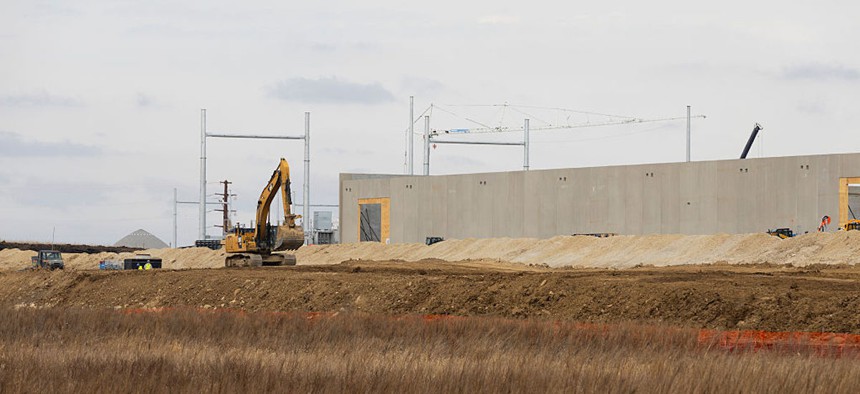
There is no formal environmental review or centralized body in charge of overseeing data center developers.
This story was originally published by the North Dakota Monitor.
Tech corporations are coming to North Dakota farm fields to build massive, resource-intensive computer warehouses that feed artificial intelligence. But with minimal public oversight, residents and local governments are struggling to manage the rapid infrastructure sprawl.
The only approval data center developers in North Dakota have to obtain before building is permitting from local governments, like townships and county commissions. There is no formal environmental review or centralized body in charge of overseeing their developments.
Locals aren’t necessarily looking to relinquish control over that process, nor are state leaders wanting to gain that authority — but both agree planning needs to be more thorough and transparent.
“It came so fast. No one was really talking about data centers until they were actually starting to build,” said Association of Counties Director Aaron Birst.
On one hand, bringing the tech industry to the state helps diversify its economy, providing a heavy tax base and economic development outside of the ag and oil industries. But it is quickly changing the landscape in ways people aren’t used to, said Birst, a lifelong North Dakotan.
At least four western North Dakota counties have placed temporary bans on AI data center projects, though some have since lifted the moratoriums.
While locals want to hold onto authority over where the campuses land, Birst said “there has to be a partnership between the state and the feds with counties” to responsibly do so.
The Public Service Commission evaluates permit applications for siting energy generational facilities, like coal plants and wind farms.
But the commission has virtually no say over where data centers go, said PSC Chair Randy Christmann. AI data center campuses do not power the electric grid; they are merely consumers.
Christmann said he’d favor a process that would allow the PSC to weigh in during the planning process, especially to give advice on projects’ impact to the grid.
“I’m not saying that they (AI data centers) have to be approved by us, but if there was some process that included us, I think we could provide a lot of information that would prove to be beneficial to whoever is going to make the final decisions,” he said.
Jen Neumiller, tax equalization and land use administrator for Mercer County, said state guidance could provide consistency in planning for the projects on the county level.
“It’s just so new, and happening so fast,” she said.
Wes Klein, a Mercer County rancher, is worried about the impacts of a proposed data center on wildlife and hunting in the area. He suggested during a news conference last week that thorough environmental impact studies be conducted for data centers to minimize those impacts.
Klein also advocated for more public reporting about tax breaks granted to data centers.
During the last legislative session, Rep. Anna Novak, R-Hazen, attempted to pass a bill that would have required data center developers to obtain a certificate of public convenience and necessity before building. The North Dakota Planning Association favored the bill, while the Data Center Coalition of North Dakota, Applied Digital and various electric cooperatives opposed it.
Instead of landing as an enforceable policy, the legislation later passed as a study relating to the “impact of large energy consumers on the state’s electrical grid.”
Terry Effertz, executive director for tech industry advocacy group TechND, said having a set of standard ordinances tailored to individual communities is the ideal approach to planning the projects, not state regulations.
“I don’t think a statewide approach does much other than shut down other possible projects from coming into the state,” she said.
Effertz applauded the League of Cities and Association of Counties for creating a standard ordinance for local governments to use when planning for hyperscale campuses.
On the Grid
If planned well, AI data centers could help alleviate power grid issues.
Data center builder and operator Applied Digital has a campus in Ellendale, for instance, that is positioned to consume power that’s otherwise produced in excess, which has historically contributed to power bill increases.
If planned poorly, however, the campuses can overwhelm the system and spike those bills.
This happened in Williston, when the Atlas Power Data Center’s huge power consumption strained the grid by consuming more power than what was being produced and subsequently contributed to higher energy costs. Its noise levels also spurred a lawsuit.
Christmann said he “cringed” when learned about the facility after it was completed. He knew the region was already experiencing grid congestion issues.
The commission’s understanding of the grid and various power providers could raise alarm to such issues that might end up being problematic, he added.
Mike Swartz lives within 2 miles of Applied Digital’s Harwood site, and said more state oversight could establish a system to monitor the statewide impact of such campuses, particularly when it comes to the grid infrastructure.
“Sure, we have a surplus of energy and costs are low. But in three years time, if all these centers are built, that surplus is gone,” he said. “We are going to be in for a big surprise.”
Secret Contracts
Making the planning process more transparent could help increase public confidence, local government leaders say. Local officials are often asked to sign nondisclosure agreements during planning stages of AI data centers.
The contracts are typically used in land development scenarios when information about a project, if made public, could implicate the negotiation process.
But to Birst, it’s a “balancing act.” Though he said some proprietary information should remain under wraps, disclosing some details tied to the footprint of a hyperscale AI data center campus “doesn’t seem like a competitive disadvantage.”
“It’s completely unfair that public officials can’t say anything about it until the approval process,” he said.
Residents of the greater Harwood area protested when Applied Digital first announced to the public it would be building a campus in the area after local officials and planners had known about the project months before the public did; permitting was already in motion and the groundbreaking was just weeks away.
It’s “shady” and “not fair” to the people, Neumiller said of staffers and elected officials signing the agreements.
Swartz said the act of local governments planning for such large projects under such agreements should be “abolished.”
“By signing an NDA, you are no longer operating in the capacity of your constituents, you’re working for the company,” he said. “City officials come and go. It’s a lot harder for residents to leave their entire life behind or uproot because of a hasty decision that changes the atmosphere of the community you thought you were settling into.”
Birst said he anticipates the Legislature will address the use of nondisclosure agreements in the 2027 session.
In the meantime, TechND is putting together an education coalition to teach landowners about infrastructure, including data centers. Effertz said the group hopes to host town halls in communities with concerns about the technology and its infrastructure.
The controversy tied to hyperscale AI data center campuses is bringing together North Dakotans of varying political beliefs.
Democratic-NPL candidate for agriculture commissioner Vern Thompson said he has been summoned, on multiple occasions, to Republican-dominant farming communities over the matter — including Ellendale, where Applied Digital has a campus.
Thompson doesn’t want to stop the tech industry from doing business in the state, but he said he wants to avoid the land becoming the “wild west.”
“The way things are going, people and property are going to be harmed,” he said. “We have to do it right.”
North Dakota Monitor reporter Jacob Orledge contributed to this report.
North Dakota Monitor is part of States Newsroom, a nonprofit news network supported by grants and a coalition of donors as a 501c(3) public charity. North Dakota Monitor maintains editorial independence. Contact Editor Amy Dalrymple for questions: info@northdakotamonitor.com.