
ICE may be tracking you via your cell phone. A Minnesota law can help.
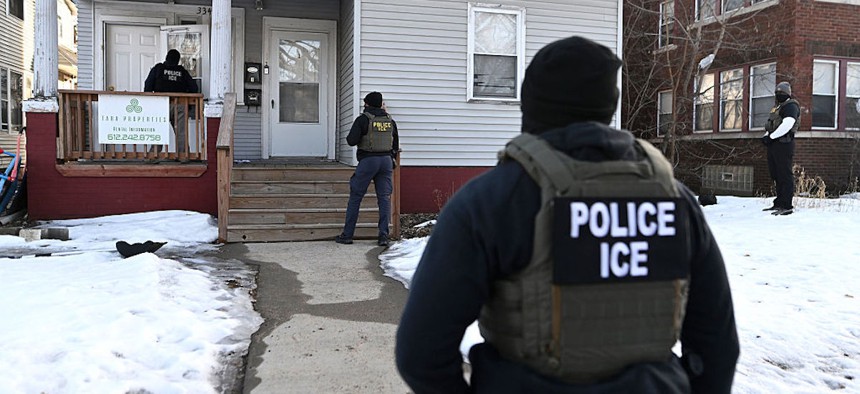
ICE agents approach a house before detaining two people on Jan. 13, 2026 in Minneapolis. Stephen Maturen/Getty Images





A data privacy law — signed into law in 2024 — gives Minnesota residents the right to tell companies “no” when it comes to selling their data or using it for profiling and targeted advertising.
This story was originally published by the Minnesota Reformer.
As U.S. Immigration and Customs Enforcement steps up the use of digital surveillance to track immigrants and citizens alike, Minnesotans can use a new, little-known law to push back.
The Minnesota Consumer Data Privacy Act — signed into law in 2024 — gives Minnesota residents the right to tell companies “no” when it comes to selling their data or using it for profiling and targeted advertising. The problem is that even with the help of the legislation, the data market has become too vast and opaque for the average person to rein in their information.
Still, this power became newly relevant when ICE bought access in September to a social media and phone surveillance system that allows them to monitor city blocks and neighborhoods — and track the movements of people’s smart phones, watches and other devices, 404 Media reported last week.
ICE obtained the technology from the Nebraska-based contractor Penlink, which uses commercial and publicly available location data acquired from hundreds of millions of phones. ICE can access the data without a warrant, 404 Media reported.
ICE didn’t respond to the Reformer’s request for comment about whether it was using surveillance systems to track people in Minnesota in its latest immigration surge.
Minnesota has been the focus of President Donald Trump’s mass deportation efforts since December, with tensions escalating last week when ICE agent Johnathan Ross fatally shot Renee Good in her car in south Minneapolis.
John Boehler, a policy counsel with ACLU Minnesota, said that the organization is aware of ICE using facial recognition software and license plate readers in Minnesota. Federal agents have reportedly for years been using surveillance mechanisms to track people.
To use the new Minnesota data privacy law, people need to reach out to companies, such as data brokers, to request that their information be deleted and not sold to a third party. This is difficult for people who are unfamiliar with the expansive and elusive web of data brokerages that gather and profit off of millions of peoples’ data every day — including those with ICE contracts.
People often do not know when their data is being collected, used and sold for profit; the Minnesota law was designed to give people more agency in how their information is used.
The Minnesota law is unlikely to completely delete a person’s personal data from all sources, but it provides an avenue to ensure at least one company doesn’t use their information.
The law defines personal data as any information that is linked to an identifiable person. It does not cover publicly available information.
Data brokers and surveillance companies often gather cell phone location data from software development kits, which are bundles of code used by developers to make applications, like weather apps. The software development kit owners then pay app developers for user location data.
Real-time bidding is also a source of location data, according to 404 Media. Companies in online advertising place bids to get their advertisements in front of certain demographics. But many popular apps, like Candy Crush and prayer and dating apps, are likely being co-opted to harvest location data, Wired reported.
In short, there are many ways data brokers and companies can acquire a person’s location data and personal information. At least one of these companies, Penlink, has contracted with ICE, so it’s possible ICE is using geolocation data to track people’s location.
Penlink didn’t respond to the Reformer’s request for comment about whether their surveillance systems were being used by ICE to track Minnesotans.
Data privacy advocates are alleging that federal agents are using private data to intimidate observers and activists during “Operation Metro Surge,” MPR News earlier this week reported.
“Data is being weaponized,” Boehler said. “It’s being weaponized by a hostile federal government, and that was always the intended use for all that data collection.”
How Do I Use the Minnesota Law To Keep My Data Private?
Minnesota residents will need to reach out to individual companies. They can ask to obtain a list of third parties to whom their data was sold; tell a business “no” to selling their data; obtain a copy of what sensitive information a company has about them; and demand that a company delete the personal information it has about them.
The company must respond to their request within 45 days, and they could face a $7,500 fine per violation of the Minnesota Consumer Data Privacy Act. The Minnesota Attorney General’s Office is responsible for enforcing the law, and people can use AG forms to send to companies.
The most all-encompassing measure a person can take is to download a “universal opt out mechanism” onto their internet browser. This allows your browser to send a signal that tells websites you visit that you don’t want your data sold.
Most data brokers are subject to Minnesota’s law, but the state doesn’t have a list of brokers that operate in Minnesota. California, however, keeps a list of data brokers that operate there. A person could start with that list, as many of those brokers also do business in Minnesota.
Businesses that control or process the personal data of 100,000 Minnesota consumers or more are subject to the Minnesota law. In addition, companies that process personal data of 25,000 Minnesotans and derive over 25% of their gross revenues from the sale of the data are also subject to the law.
The process is wonky, and Minnesota lawmakers, who convene for the 2026 session next month, would need to act if they wanted to make it easier for everyday Minnesotans to utilize this law.
The Attorney General has a Q&A and forms on its site that you can use as templates for requests to companies.
Learn more about the data privacy law here.
Minnesota Reformer is part of States Newsroom, a nonprofit news network supported by grants and a coalition of donors as a 501c(3) public charity. Minnesota Reformer maintains editorial independence. Contact Editor J. Patrick Coolican for questions: info@minnesotareformer.com.