
Hidden in plain sight: Surveillance at the Arizona border
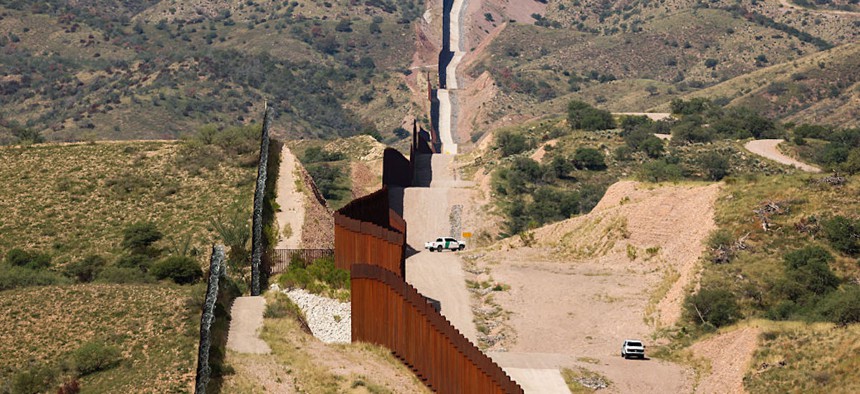
View of the US-Mexico border wall in Nogales, Arizona on Sept. 17, 2025. CHARLY TRIBALLEAU/AFP via Getty Images




From hidden license plate readers to AI-powered cameras, federal agents have built a vast monitoring network that stretches deep into Arizona.
This article is a result of a collaboration between the Arizona Mirror and The Border Chronicle.
It happens every time Clarice Garcia visits from Paradise Valley, says her brother Warren Garcia.
It’s a long drive to the U.S.-Mexico border on the Tohono O’odham Nation — an area in southern Arizona the size of Connecticut — to a cemetery where some of the Garcias’ relatives are laid to rest. At times it’s desolate and heavily patrolled by U.S. Customs and Border Protection.
Except some of the patrols are invisible.
On one particular drive back, past the Tohono O’odham capital of Sells, a CBP agent on an all-terrain vehicle stopped Clarice’s car. Five patrol vehicles surrounded her, banging their batons on the vehicle.
“Open up! Open up!” they yelled at her.
The agents claimed she was smuggling. Her brother has heard that before, and has been told by CBP agents who have pulled him over that he “drives like a smuggler.”
“It almost feels like they’re monitoring the communities,” he said.
They are.
Checkpoints operated by the U.S. Border Patrol are on every paved road leading off tribal land. For years, there has been an influx of surveillance technology in and around the communities on the Tohono O’odham Nation, including 10 integrated fixed towers, the backbone of CBP’s virtual wall.
And now there is a new layer of enforcement.
Records obtained by the Arizona Mirror show that CBP and the Drug Enforcement Administration have built a network of surveillance equipment surrounding the Tohono O’odham Nation. At entry and exit points, cars and people are scanned by high-tech cameras, many of them clandestine.
The cameras form part of the surveillance network of automated license plate readers, or ALPR. They are disguised in various ways. Some are hidden in orange traffic cones, yellow barrels, or speed trap signs, or affixed to the back of overhead highway signs, which drivers pass under without a second thought.
Emails between CBP and the Arizona Department of Transportation obtained by the Mirror show that ADOT has asked CBP to stop using orange cones because they are a hallmark of construction zones and could confuse drivers. The agency is now shifting to hiding its ALPR cameras in large yellow barrels disguised to look like crash cushions.
But these cameras are not just on Tohono O’odham tribal land near the border.
Records and an investigation by the Mirror and Border Chronicle show multiple cameras that are over 100 miles from the border. One is just outside of Apache Junction, another is outside Buckeye and a third is near the town of Maricopa.
These cameras are part of a larger network that federal immigration agents and local law enforcement are tapping into and using, with little oversight.
Some of the cameras come from Flock Safety, the nation’s largest ALPR surveillance network, whose expansive national database of drivers and software powered by artificial intelligence has alarmed civil libertarians.
The ALPR cameras have led to an outcry from local citizens who discovered that U.S. Immigration and Customs Enforcement had been using Flock data gathered by local police to make immigration arrests. There have been other abuses — including a police officer in Texas who used Flock data to track a woman who received an abortion, police in Arizona who used it to track protesters and an agency that used an ethnic slur when searching the Flock data.
Some of that data is being integrated into even larger systems and shared with national and international law enforcement agencies, as well as third parties.
With an administration that is laser focused on deporting millions of immigrants, Arizona is taking center stage for surveillance technologies and policing strategies that have advocates worried.
“The scary thing for me are the tools that can increase the effectiveness of all these tools,” said Dugan Meyer, a Tucson-based photographer and researcher who has spent the past few years documenting the technology trends along the border, as a surveillance tower loomed behind him. To him, the advent of artificial intelligence, a tool he can’t photograph or see, is scarier than the ones that tower ominously over border communities.
Those AI technologies are being sought aggressively by the administration. Last year’s annual Border Security Expo featured multiple AI vendors looking to impress government officials. The border security tech market has been on the rise for decades, reaching its highest point in 2025 in terms of contracts to private companies at $14.2 billion, a $5 billion jump from 2024.
According to the U.S. Department of Homeland Security, the ALPR market is “evolving rapidly, with continuous advancements in technology and increasing adoption by law enforcement agencies across the country.” This is confirmed by the ALPR market itself, which is growing at a 10.3% rate and is expected to eclipse $2 billion by 2031.
The seen and unseen surveillance at the border both have one thing in common: They’re quiet, and they have an impact on those who live in their presence.
The Constantly Surveilled
ALPR devices have been around for years, and police in Arizona have had access to the tech, often using the surveillance cameras to investigate a variety of crimes, from murders and kidnappings to automobile theft.
The technology has also had a long history of controversy.
In 2019, Perceptics, a company that contracted with CBP for ALPR technology, was hacked, and license plate data was leaked online.
An unknown hacker published stolen images of travelers’ faces, license plates and much more. After the hack, CBP admitted that the company had transferred data onto its own servers, violating federal policy.
In 2024, Vigilant Solutions, another ALPR company used by local Arizona law enforcement and federal law enforcement, was reported to have seven major vulnerabilities, according to the Cybersecurity and Infrastructure Security Agency.
Today’s Flock systems haven’t fared well, either — researchers have found that they are just as vulnerable to hacks.
Garcia said he wasn’t too familiar with ALPRs, but he is much more aware of the visible surveillance tech that dots the southern Arizona landscape.
Integrated fixed towers, or IFTs, can be seen from miles away, towering above everything else. Some say the towers amount to persistent surveillance, and the company that makes them has bragged about how they can cover hundreds of miles.
An IFT quickly pivoted its high-powered camera to observe reporters from the Mirror and Border Chronicle as they walked on public land for an up-close look. A Freedom of Information Act request for footage taken that day was denied by CBP.
“What can you do? What can you say?” Garcia said about the ever-present surveillance in his community. He has voiced his concerns, but some people in his rural community view CBP as their first responders, making it a complicated issue for tribal leadership.
“Our law enforcement is spread so thin,” Garcia said.
As the Mirror and Chronicle traveled onto the Tohono O’odham Nation, both reporters noticed an increase in CBP presence. Once off tribal land, that presence began to diminish.
At the entrances to the Tohono O’odham Nation, every vehicle is scanned by CBP ALPRs. As each vehicle exits tribal land, license plates are scanned and cataloged by DEA cameras.
“This feels very similar to the ways we had towns where Indigenous communities were not allowed to be out after sundown,” said Dave Maass, the director of investigations for the Electronic Frontier Foundation. “This feels like a digitized version of that.”
Maass, Dugan and EFF have been tracking surveillance tech at the border for years, mapping changes and investigating how it is deployed.
ALPRs can make mistakes, and Maas emphasized that, when combined with more “invisible types of surveillance” — monitoring social media, probing databases and covert cameras — it becomes difficult to “know when you’re being abused.”
Federal officials say the cameras are vital in the sprawling lands along the border.
“CBP’s mission is complex and relies on a layered mix of personnel, technology, and infrastructure to detect illicit activity while supporting lawful trade and travel. As part of that approach, CBP uses license plate readers—often the same systems employed by state and local law enforcement nationwide—to help identify threats and disrupt criminal networks,” a CBP spokesperson said in a statement responding to a series of questions about how the technology is used, audited and overseen by the agency. “Our use of technology is governed by a stringent, multilayered policy framework, as well as federal law and constitutional protections, to ensure the technology is applied responsibly and for clearly defined security purposes.”
The CBP statement continued, “For national security reasons, we do not detail the specific operational applications of LPRs. Similarly, for operational security reasons, we don’t disclose the specific number or location of LPRs as that would enable drug smugglers and other bad actors to circumvent detection and tamper with LPR equipment.”
The Arizona Mirror and Border Chronicle did not ask CBP to disclose locations or specific numbers.
But people in other areas along the border are starting to wonder when the hammer that has fallen on New Orleans, Minneapolis, and Chicago will swing at them.
The Border Towns
The towns that sit alongside the U.S.-Mexico border have felt a sense of unease in recent months.
In Nogales, a town that straddles both sides of the border, residents are hesitant to talk to reporters, and those who do say they haven’t seen the mass raids that have occurred across the country.
CBP and ICE have made headlines for their actions in larger cities like Chicago, Los Angeles, New Orleans, and Minneapolis, but those immigration enforcement blitzes haven’t happened in towns like Nogales. Day laborers still wait outside stores for a chance at work, a sight that was once commonplace in larger cities that have become targets of ICE’s deportation operations.
Perhaps this is because they are already under the scrutiny of the border surveillance apparatus.
“We get used to it. It’s normal for us,” music teacher Gustavo Lozano told the Mirror and Chronicle from his studio near downtown Nogales. The buzz of law enforcement drones overhead at protests, the cameras, CBP’s presence — it’s all nothing new for Nogales and other border towns, which have, for decades, been a proving ground for these technologies and practices.
But now there is a heightened sense of fear.
Certain activities that were once mundane now require a level of caution.
Did you remember to bring your ID and papers when going for a jog or walking the dog? What about before checking your mail? You never know when you may come face-to-face with la migra.
“We’re being observed, and at some point, all these little towns, it is going to impact us somehow,” Lozano said, noting that the systems being used aren’t just targeted at one individual but often become “the extreme surveillance of every single person.”
“Now we don’t leave the house without documents,” Lozano said.
He noted that this is beginning to affect how he and his fellow artists work. There’s more fear when writing songs about current events. He never used to feel this way.
“They can just create a story about you,” Lozano said, citing the Trump administration’s fictitious claims about Kilmar Abrego Garcia, the Salvadoran man mistakenly deported last year. Some artists he has spoken to still sing about CBP and other issues and worry about being arrested for their work.
Meanwhile, those who travel back and forth across the border in Nogales are finding things increasingly difficult.
“They, like, think I’m a criminal,” Richard, a Mexican man in his 20s who did not want to give his last name, told the Mirror.
Richard recalled an incident that has been happening to him with greater frequency. While driving his uncle’s car from the Mexican side of Nogales to see a sick family member in the small Yavapai County community of Congress, CBP agents told him that their dog “alerted” on his car.
He was held in handcuffs for 30 minutes, had photos taken of him and his car, and was then finally released without a word.
He said it keeps happening.
Michelle, who works at a Nogales sporting goods store and also did not wish to share her last name, described harassment while crossing the border as an everyday occurrence.
“First, there are hours and hours waiting to cross the border. Then they put you in a small room and lock the door. They take away your phone. This happens every time,” she said.
Like social media, surveillance technology operates on algorithms. With new advances in technology and AI, a person’s license plate can trigger alerts repeatedly.
“A lot of people don’t renew their visas because they don’t want to deal with that,” Lozano said of the harassment Mexicans now face when attempting to enter the United States for work or business, or to visit family. “People are really, really angry. Not toward law enforcement but toward Border Patrol.”
Border communities are surveilled just as much, if not more, than many others.
Along the 20-foot-tall rust-colored border wall in Nogales, CBP towers equipped with lights and cameras stare directly at homes on the other side. Meyer pointed out a hidden trail camera encased in a metal box on a vacant lot near another home. On the rooftops of businesses, CBP cameras peer down, often swiveling around.
The border wall itself has become a piece of surveillance technology, as CBP begins installing “smart wall” technology with a cable that extends along its top in a thin metal casing. Exactly how the Smart Wall works is unclear, but it includes cameras and other detection equipment.
And while CBP and other law enforcement drones may hover over the heads of those walking around in Nogales, drones used by anyone else were restricted without a permit in a large flight restriction implemented by the Trump administration last summer and reissued early this year.
But for the administration and its supporters, the border is more than just southern Arizona. It is a policy that extends far beyond towns like Nogales. Places like Nogales become a testing ground for technology, policy, and practices farther into the interior.
‘Every State Is a Border State’
Most people understand that CBP’s job is to patrol the borders of the United States.
Many don’t know that CBP’s jurisdiction — established by the Supreme Court in the late 1940s — extends 100 miles from the border.
In Arizona, that means CBP has the authority to operate in Tucson, Willcox, Sells, and more.
But that 100-mile perimeter is shifting, thanks largely to technology.
The Mirror found one of CBP’s covert ALPR devices 132 miles from the U.S.-Mexico border and another 111 miles away. These devices do not account for ALPR devices that ICE has access to, such as Flock cameras or the Arizona-based National Law Enforcement Telecommunications System, which also has ALPR data.
CBP contends that “other laws” allow them to operate anywhere.
“While the U.S. Border Patrol primarily operates within 100 air miles of the border, the legal framework provided by the Immigration and Nationality Act, Title 8, Title 19 of the U.S. Code, and other laws allow them to operate anywhere in the United States,” a CBP spokesperson said.
Before becoming Trump’s border czar, Tom Homan traveled across the United States to give speeches that often included the phrase “every state is a border state.”
Now Homan is taking a more central role in Trump’s deportation operations after shootings in Minneapolis involving immigration agents created a public outcry. Surveillance technology has played an important role in those recent actions.
The Quiet Surveillance at the Border
Surveillance is moving away from cameras with powerful lenses and large towers equipped with high-tech sensors. A more subtle form is starting to take center stage—one that doesn’t require permits for installation and can be used anywhere.
AI has been embraced by law enforcement, pumping out police reports, while AI-infused ALPR platforms like Flock have enabled a new, pervasive form of surveillance.
In August 2023, the Tucson Police Department signed a 28-month contract with Cobwebs Technologies for its Tangles Open-Source Intelligence software. The police department then submitted a request to the Arizona Department of Emergency and Military Affairs to be reimbursed from the state’s Border Security Fund.
In the reimbursement document, which the EFF received in response to a public records request and provided to the Mirror, TPD requested that the state reimburse it $277,500 for the purchase and installation of the software.
The Border Security Fund allows law enforcement agencies across the state to seek reimbursement for activities related to border enforcement or security. But TPD did not use the Cobwebs technology for border-related crimes, according to the documentation it sent to DEMA.
While TPD stated that it intended to use Cobwebs for “sex trafficking investigations,” the agency’s primary example of its successful use of the technology was to locate a “serial robbery suspect.” The agency also detailed its use in surveilling the annual Gem and Mineral Show, the 4th Ave Street Fair, and a visit by then-Vice President Kamala Harris to Tucson.
The Tangles Open-Source Intelligence software scours social media for posts by specific people and can connect them to contacts, locations and events. Some versions of the software also include “AI face detection.”
A leaked copy of a user manual provided to law enforcement showed how the software can be used to target protesters and journalists.
Similar technology is being used by ICE and CBP to identify immigrants through facial recognition, although it hasn’t been effective.
“There are ways that they are invading that are not just as obvious to us,” Maass said about these other forms of surveillance, mentioning an ICE tool that scrapes data from over 200 websites. “That is gathering data on everyone, but it is also, at the same time, breaking the trust in our government not to surveil our First Amendment activities.”
Courts are considering constitutional challenges to ALPR tech, but local jurisdictions are also trying to keep pace with the technology. In Arizona, there are no laws regulating how law enforcement can use license plate readers. In fact, there are few laws regulating how any police surveillance equipment is used.
A proposed law at the Arizona Capitol would provide a basic framework for ALPR use in the state, but it would be a mostly hands-off policy—police agencies would be allowed to design their own training, audits, and more. Additionally, it would exempt ALPR data from public record disclosure, removing a key oversight tool. Across the nation last year, attempts in statehouses to regulate ALPRs mostly failed.
Back on the Tohono O’odham Nation, thoughts of regulation, court battles, and AI are not the first things on people’s minds. Taking care of their families is what they often think about the most.
Clarice Garcia regularly comes down to clean and maintain her family’s cemetery and to do cleanups.
When pulled over, the Border Patrol was yelling, “Open up!” and banging on the car with a baton. She rolled down the window, and her 10-year-old son in the back seat was frightened. Her mother, Nancy Garcia, sat next to her in the passenger seat.
This isn’t an anomaly, she told us: “I’ve been through so many of these things, so many times. It’s very intimidating, very forceful.”
Nancy asked the Border Patrol agent why she had been pulled over and was told, “Because we can.” The agent then added that it was because she was speeding.
Warren Garcia said stops like that “happen to my sister all the time.” He said he thinks it may be because of her license plate. It’s registered in Paradise Valley, and her husband is foreign-born, so he can’t help but wonder if the foreign name — or whatever information her plate has linked to it — prompts border agents to stop her.
They probably won’t ever know. Such is the quiet surveillance on the border.
For Warren Garcia, that surveillance is the cost of “just doing your life, just doing your day-to-day activities” in southern Arizona.
Arizona Mirror is part of States Newsroom, a nonprofit news network supported by grants and a coalition of donors as a 501c(3) public charity. Arizona Mirror maintains editorial independence. Contact Editor Jim Small for questions: info@azmirror.com.