
Surveilled and sold: Privacy and sanctuary in Portland
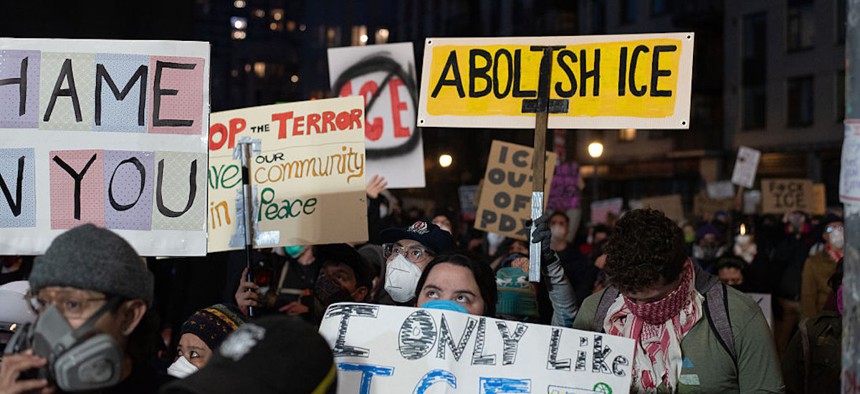
ICE deploys pepper balls, tear gas, and flashbang grenades on hundreds of people who march from Portland City Hall to the ICE facility to protest against the agency's actions in Portland, Oregon, on Feb. 1, 2026. Sean Bascom/Anadolu via Getty Images





How effective are Portland, Oregon’s sanctuary city policies when ICE can track and surveil immigrant communities with ease?
This story was originally published by InvestigateWest.
When I first see Nemorio, he is sitting by himself at the Voz Worker Center in Southeast Portland, Oregon. The 56-year-old is bundled up in neon-colored winter clothes and watching a soccer game on his phone.
Job hunting looks a lot different than it used to. When he joined the Worker Center 14 years ago, he left behind standing on a cold street corner for a safer, warmer place to find work. Nemorio is a professional landscaper, but he takes all sorts of jobs: a request to help someone move, paint their house, clean their business’s exterior, or other construction or landscaping-related needs. A Portlander of 22 years, he has worked for some of the same clients for over a decade.
Nemorio is one of dozens of immigrant day laborers searching for work at the Worker Center. Along with central heating, coffee, pastries, and conversations to pass the time, the Center also provides a degree of security for its workers, some of whom are undocumented. A poster that says in big block letters, “NOT OPEN TO THE GENERAL PUBLIC,” is pasted over the front door, next to a Ring camera. Volunteers regularly sign up for shifts to sit on a folding chair and guard the front door. Often bundled up in rain jackets with hot tea in hand, they observe the Worker Center’s surroundings — watching who approaches the building. With increased ICE presence in Portland over the past year, their job is to alert workers if they spot masked agents.
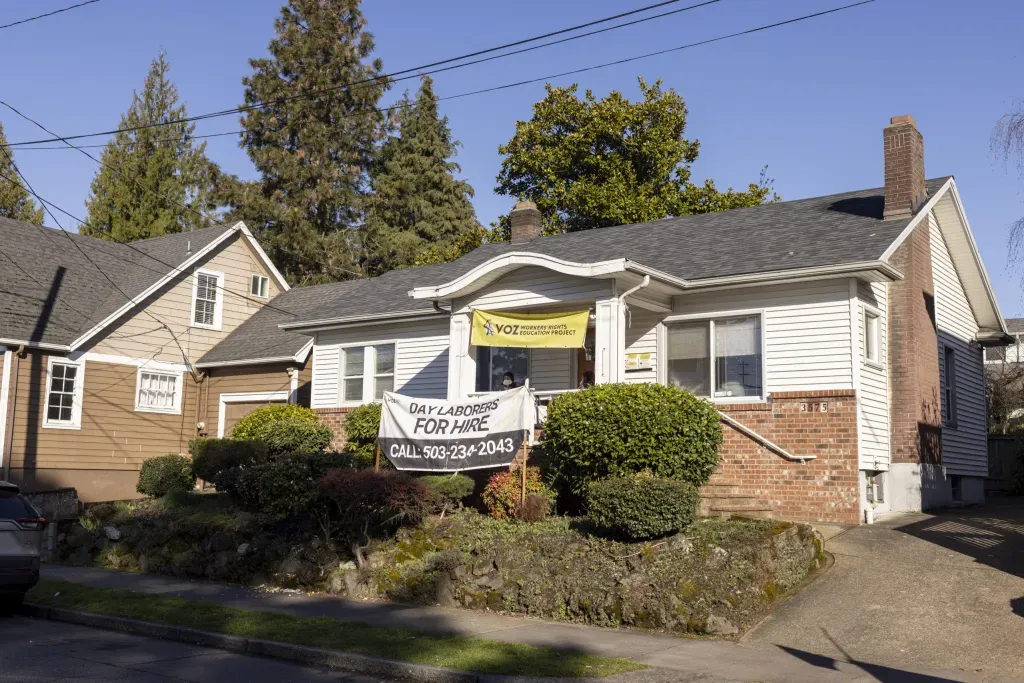
When I initially approach Nemorio, he politely declines to participate in an interview. But he stays in the same room as I speak to another member: a house cleaner from Oregon City, fresh off a two-hour bus ride into town. Not long after we begin talking, one word piques Nemorio’s attention — enough to join in on the conversation.
“Camera.”
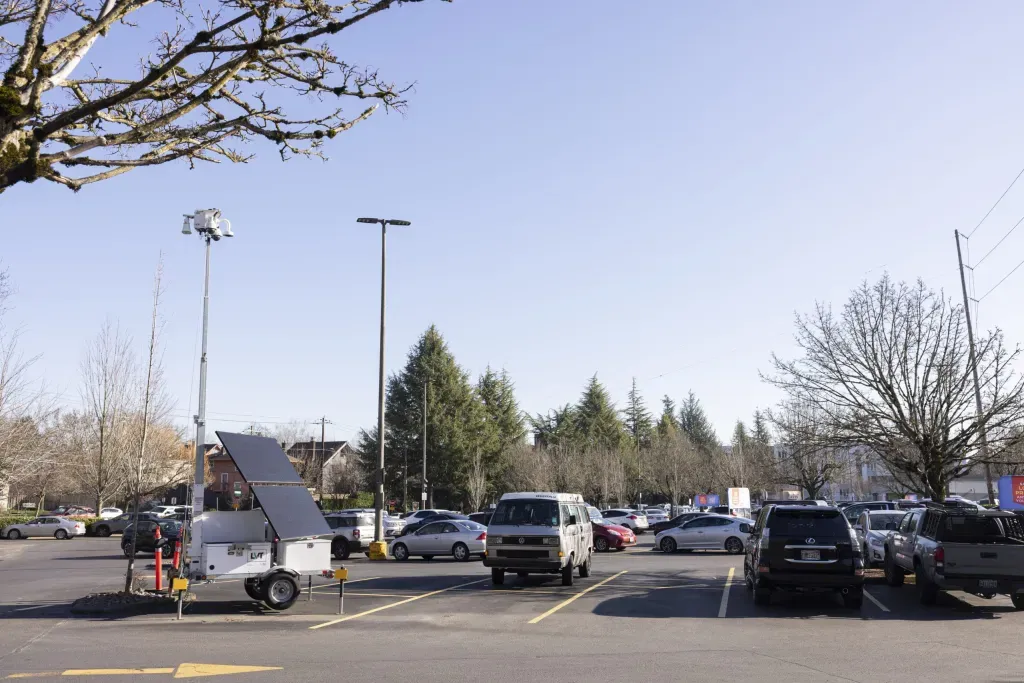
The house cleaner and I are discussing high-tech cameras that are installed all over the city of Portland. They’re hard to miss, with big solar panels and a recording of a male voice repeating the same message: “This property is being monitored by video surveillance 24/7.” When I show Nemorio a photo I took of a camera in a Lowe’s parking lot, he recognizes it immediately. He’s seen the cameras everywhere, he says. He begins listing grocery stores like WinCo and Fred Meyer. He remembers one in particular at La Tapatia, a Latino grocery store in Gresham — a city bordering Portland. “ICE was looking for somebody there,” he says.
He’s seen the cameras out in nearby towns like Beaverton, too. “There are more undocumented immigrants and more troubles there.”
Any one of those cameras in the parking lots he named could be capturing his truck’s license plate every time he drives past, silently recording his routine movements.
And any of them could’ve been the one that led to an encounter last October, when an ICE vehicle followed Nemorio’s truck, landscaping equipment in tow, after he left a work site. He says he was lucky, because the agents eventually split off to follow a different car instead.
“It’s better now,” he says. “I’m lucky to have no problems. Maybe Jesus protects me.”
This happened to him despite living in a sanctuary city within a sanctuary county and state. In 2026, Nemorio and other immigrant Portlanders face daily threats and fears of being targeted or profiled while driving. Surveillance technologies are helping federal immigration agents bypass state and local sanctuary protections to reveal immigrants’ personal information and track their movements — in many cases, leading to their arrests without a warrant or reasonable suspicion.
Over the past year, immigrants in Portland and across the country have had growing suspicions of being watched and followed. It’s not unwarranted: ICE arrests quadrupled last year, and street arrests increased by 1100% nationwide. The number of ICE detainees went up 75% in just one year.
This has all been disrupting immigrants’ daily lives. A 2025 survey by KFF and the New York Times shows that 41% of immigrants are worried that they or a family member could be detained or deported. About 14% avoided seeking medical care. Around 13% were not showing up to work. While their fears are valid, what they don’t know is how they’re being surveilled.
These concerns have prompted Portland community organizers to take action. Elizabeth Aguilera is the Director of Communications of an immigrants’ rights advocacy group called Adelante Mujeres. Last year, they started organizing volunteers to drive children to school and pick up groceries for families who are afraid to leave their homes.
Allies in Portland’s city government are also responding in their own ways. As Portland’s only immigrant City Councilor, Angelita Morillo co-sponsored an emergency ordinance last fall to codify Portland’s sanctuary city declaration into law. “The community wanted us to indicate that we were working on these issues and taking a critical look at them,” says Morillo.
While Nemorio doesn’t know the mechanisms behind the cameras, he has a hunch about why they’re here.
“Somebody is looking in the cameras,” he says.
Tools of Control
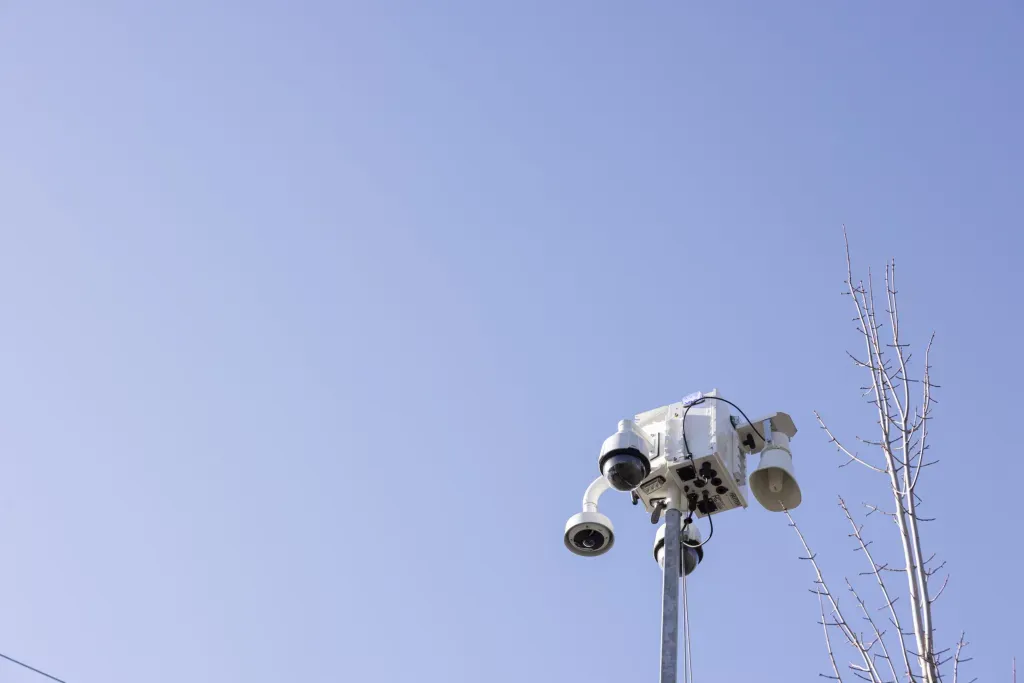
The cameras are automated license plate readers (ALPRs). They are typically installed on road signs or bridges. They can also be mounted on police cars or left on mobile trailers for extended periods of time in the parking lots of grocery stores, shopping centers, banks, and gas stations.
You’ve most likely seen them around your neighborhood. ALPRs are used in all 50 states by over 4,000 local law enforcement agencies. In the Portland metro area, there are approximately 130 ALPRs installed. Nationwide, these ALPRs have captured millions of people’s movements — likely including yours.
ALPRs record every vehicle they see, capturing and logging its license plate number and characteristics, along with the date and time. These cameras all feed into one network, which can reveal a person’s daily routines — recording what streets one takes to go to work, school, places of worship, medical appointments, and so on. Those details are then stored in an easily searchable database.
It’s a system that runs with little to no oversight.
Police don’t need a warrant to look up a license plate. Curiosity alone is often enough reason to search for a track record of a car’s movements. Officers can construct a list of targeted plates and receive an immediate alert once an ALPR detects one, detailing exactly when and where it was found. Police can also access data from cameras owned by private businesses such as Home Depot and Lowe’s, which are popular gathering sites for day laborers.
Two companies, Flock Safety and Vigilant Solutions, corner the market on selling these tools to law enforcement agencies and private corporations. These companies claim their missions are in service of public safety and crime solving. But both have been known to collaborate with the Department of Homeland Security on immigration enforcement efforts.
ICE routinely taps into vehicle location data collected by local and state police departments for deportation operations. A lack of federal data privacy protections allows ICE agents to buy access to private databases through data brokers. The agents can use these databases to match license plate numbers and ALPR data to DMV records as a loophole circumventing sanctuary laws. It’s a quick and easy way to reveal someone’s image, address, and daily movements.
During President Donald Trump’s second term, license plate reader data — combined with subscriptions to private data brokers — are increasingly being exploited to find and seize immigrants. ICE does this without warrants across the country, including in sanctuary cities and states like Portland, Oregon.
“About a third of the detentions are happening out in community, and usually [while someone] is in a vehicle going between one place to the other,” Aguilera says. “Part of that is because of these surveillance techniques, including tracking license plates.”
Local sanctuary protections only function on the local level, determining what city and state resources and personnel can and can’t be used for. They are not enough to stop federal agencies from buying access to data brokers and using surveillance technology to monitor Portlanders. And these sanctuary protections have not stopped the Portland Police Bureau from sharing its residents’ information with a database ICE can access.
Tracked and Hunted
According to Aguilera, most detentions in Oregon last year occurred along the highway through Washington County, where one-sixth of all Latino Oregonians live. Smaller towns within the Portland metro area (like Beaverton, where Nemorio was followed) are where day laborers often find work. 90% of these vehicle stops, Aguilera says, usually happen between six and nine a.m., when people are heading to work or school.
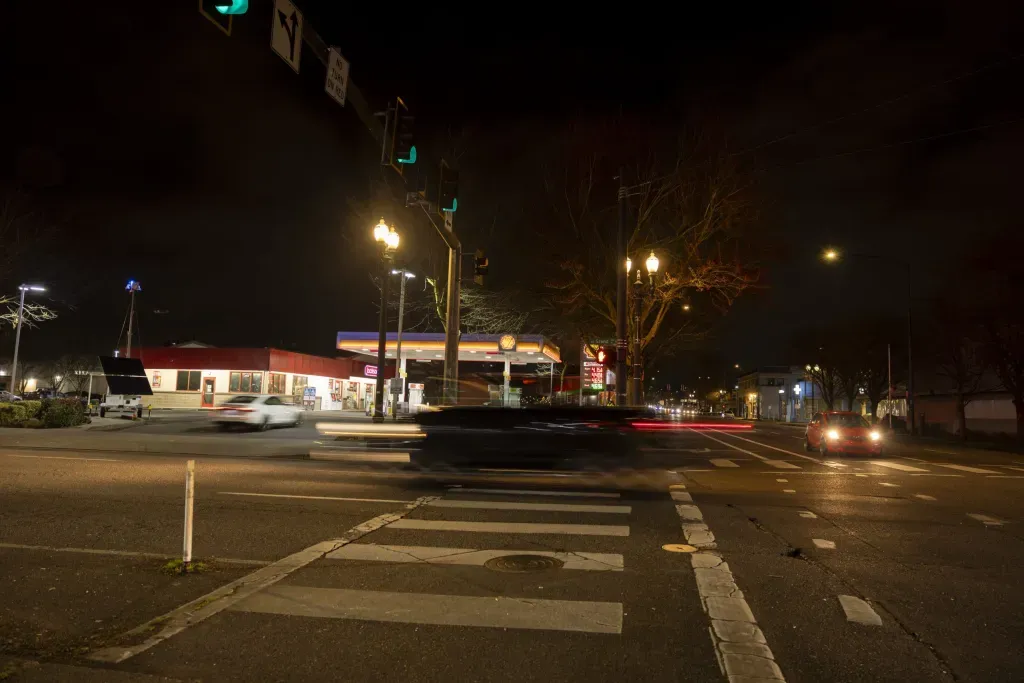
On an early morning last October, a farmworker in Woodburn, Oregon was on her way to a job. Just like Nemorio, that same month — in a town 30 minutes away — she was being followed while in transit.
But unlike Nemorio, her car was pulled over by DHS officers. The agents who stopped her did not ask her name or show any papers. They broke the glass of her car window and detained everyone in the car. Immigration enforcement swept her up along with 30 others that day. Their arrests were part of an ongoing surveillance and deportation campaign in Oregon called Operation Black Rose.
“They sit and surveil and run license plates,” says Aguilera. “And then they’re doing sweeping arrests without [reasonable] suspicion.”
In February, a federal judge issued an emergency order to halt warrantless arrests in Oregon. By that point, over 800 ICE arrests had occurred in Oregon between January and October of 2025, with over 500 immigration arrests in Portland alone.
“What does that say about us as a sanctuary city?” Marina Ortiz asked the city council at a hearing in September. Ortiz is co-chair of Latinx PDX, a resource group for city employees. “Sanctuary must be more than a word. No one should have to fear that a lunch break or commute home could change their life forever. Yet for many city employees and community members, that fear is real. We need more than your symbolic words.”
Incomplete Promises of Sanctuary
A month after Ortiz’s plea, Portland City Council passed an emergency ordinance to codify the city’s sanctuary status. The ordinance legally prohibits all Portland city employees and resources from assisting any federal agency with immigration enforcement.
“I’m really not a fan of resolutions that say we care about X group of people but we’re not gonna do anything materially for them,” Councilor Morillo says. In 2017, during President Donald Trump’s first term, the city council passed a resolution declaring Portland a sanctuary city. “City Council encourages all Portlanders to unite and work together to promote kindness and understanding in our shared community,” the city council wrote in the conclusion of the 2017 resolution.
But resolutions are not legally binding. They merely express the formal opinion of the city council. Without specific policies that define what sanctuary status means in practice at the city or state level, these declarations remain mere political statements.
This criticism was echoed by city residents who urged city council to codify sanctuary protections at the public hearing in September.
“Prior to this year, sanctuary policies sort of felt like the equivalent of a company changing their logo to a rainbow during June,” said Portland resident Jack Dickinson at the hearing. “We no longer live in a world where that can be justified as sufficient.”

But even with the new emergency ordinance, local sanctuary laws cannot override federal policies. That means sanctuary laws cannot protect immigrants from deportation or criminal prosecution by the federal government.
By the time the city’s sanctuary status became law last October, immigration arrests in Oregon had shot up almost 80 times more than the year before.
Portland resident Nick Kai remembers that two of those arrests involved immigrant fathers in their neighborhood in the same week. Kai is a trained legal observer with the National Lawyers Guild. One of Kai’s neighbors was taken by ICE on his way to work. At the same hearing, Kai shared that they now drive their friend’s daughter to school because her mother is afraid to leave her home.
“True sanctuary means safety in every part of your daily life, not just when you enter a city building,” says Kai. “It’s sanctuary in schools, churches, hospitals, grocery stores, post offices, community centers — every essential thing that we need. No one should live in fear of being torn from their family simply by leaving home. That is sanctuary.”
Contracts Reveal Police Share Portlanders’ Data
Both the Portland Police Bureau and the Sheriff’s Office in Multnomah County, which encompasses the city of Portland, have denied any active contracts with Flock Safety. Yet in January 2026, the police bureau confirmed a recent contract with Motorola Solutions, the owner of Vigilant Solutions.
This relationship suggests Portlanders’ private information may be being shared without their knowledge, regardless of citizenship status.
“That information is being funneled systematically all over the country to private data brokers,” says Laura Rivera, a senior attorney with Just Futures Law, an organization that provides legal support to immigrants’ rights organizers. “[They] sell it to law enforcement agencies and private parties that could exploit it.”
Since 2017, Vigilant Solutions has sold license plate data to DHS and its agencies via Thomson Reuters, a data broker company. The data is searchable through a Thomson Reuters investigative database called CLEAR.
Through its new contract with Motorola Solutions, any plates read by ALPRs owned by Portland Police Bureau will feed into CLEAR — right into the hands of ICE — in direct violation of the city’s ordinance and the state’s Sanctuary Promise Act.
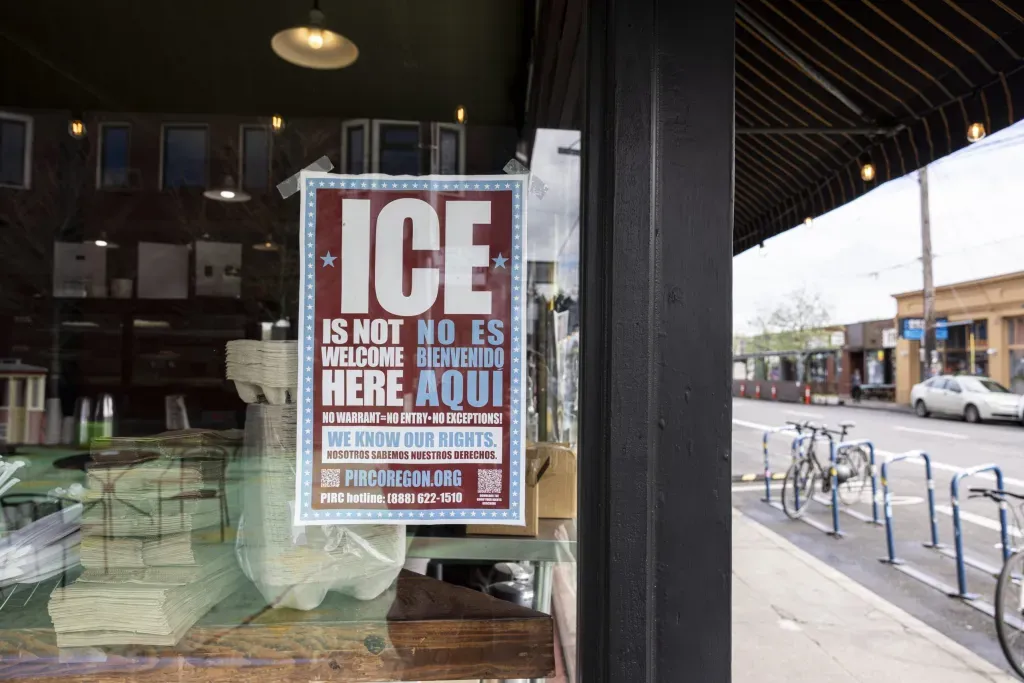
That’s not the only way ICE can access Portlanders’ data. A public records request Feet in 2 Worlds submitted to the Portland Police Bureau showed its active subscription to LexisNexis Accurint, a different investigative database with access to millions of people’s names, social security numbers, addresses, vehicle registrations, utility bills, and ALPR data, among many others.
In an email to Feet in 2 Worlds, Sergeant Kevin Allen — the Public Information Officer at the police bureau — said that the bureau uses the database to “assist in identifying and locating subjects involved in investigations.”
The police bureau’s subscription includes access to another investigative database originally developed for the federal government after 9/11. The Accurint Virtual Crime Center (AVCC) was created to conduct mass personal data searches of Muslims to generate suspect lists following the 9/11 attacks.
As a condition of access to AVCC, the police bureau and other local law enforcement agencies must share their data with the Public Safety Data Exchange database (PSDEX). PSDEX compiles data from thousands of law enforcement agencies nationwide.
ICE has access to both AVCC and PSDEX.
The Portland Police Bureau is handing over its data to the same investigative database ICE uses to find immigrants. That means even if Portland law enforcement is not directly cooperating with ICE, Portlanders’ data can still be accessed by ICE.
Importantly, ICE can also access jail release data through AVCC. ICE often asks local police to hold someone in their custody for an extra 48 hours through a form called a detainer request. Once ICE knows the exact date and time of a detainee’s release, agents can arrive at the jail and directly transfer them into federal custody. The police bureau’s FAQ says that “officers shall not honor or comply with federal agency immigration detainer requests,” in compliance with sanctuary city laws. Their data-sharing with PSDEX — formalized in a contract — undermines that claim.
When Feet in 2 Worlds reached out to the Portland Police Bureau, Sergeant Kevin Allen denied any participation in PSDEX via an email statement. “We do not see this anywhere in the current contract with LexisNexis,” he wrote. He also denied that the police bureau is contractually required to share license plate data and jail release data to LexisNexis’s databases, including the post 9/11 tool AVCC.
Yet the addendum Feet in 2 Worlds received via a public records request states that the police bureau “agrees to submit to LexisNexis Customer Data Contributions.”
“ICE is looking to exploit data brokers increasingly to power its deportation machine,” says Rivera, the attorney with Just Futures Law. “We’re seeing right now under this government how data brokers and other surveillance tools are being weaponized to criminalize our community members and expose them to arrest and deportation on a new scale.”
Without strong federal data privacy laws preventing the sale of people’s personal information, sanctuary protections will remain toothless against these loopholes. Meanwhile, the federal government is building and bolstering a vast surveillance infrastructure to harvest our data — targeting immigrant communities first.
Feet in 2 Worlds is supported by the John D. and Catherine T. MacArthur Foundation, The Ford Foundation, the Fernandez Pave the Way Foundation, the Elizabeth Bond Davis Foundation, an anonymous donor, and contributors to our annual NewsMatch campaign.
InvestigateWest (investigatewest.org) is an independent news nonprofit dedicated to investigative journalism in the Pacific Northwest. Visit investigatewest.org/newsletters to sign up for weekly updates.