
REPORT: How states can help close growing gaps in LGBTQ+ data
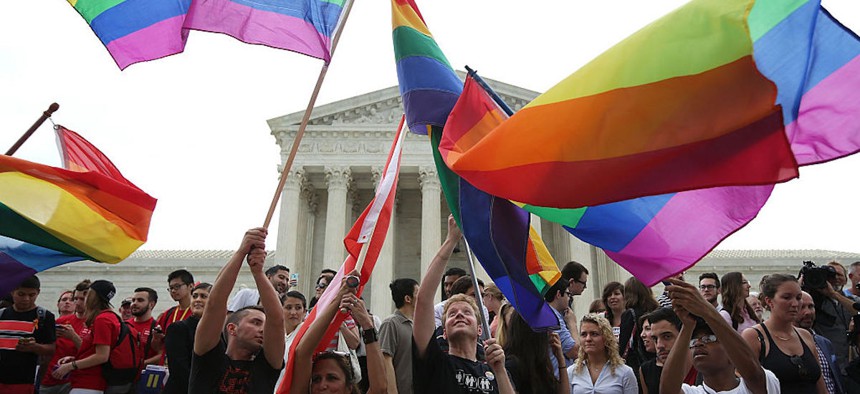
Supporters of same-sex marriage rejoice outside the Supreme Court in Washington, DC., after the U.S Supreme Court hands down a ruling regarding same-sex marriage on June 26, 2015. Alex Wong via Getty Images






State-level data on LGBTQ+ issues is becoming increasingly important amid the federal government’s efforts to limit its collection and presence, experts say.
This June marks 11 years since the U.S. Supreme Court legalized same-sex marriage in the Obergefell v. Hodges case, creating a historic moment for the legal, social and cultural recognition of LGBTQ+ people. But now, a decade after the landmark decision, the federal government is trying to chip away at the policies and procedures aimed at supporting diverse sexual orientations and gender identities.
Amid heightened scrutiny toward the LGBTQ+ community, a new report highlights how responsible and actionable data management practices at the state level can help plug emerging gaps in LGBTQ+ representation and protections.
Since President Donald Trump’s second term began, the federal government has limited the collection and sharing of data related to LGBTQ+ issues. As of January, at least one measure referring to sexual orientation or gender identity — or SOGI — data has been removed from 360 federal data collections, according to The Williams Institute.
Last year, Trump signed an executive order in January that halted the federal government’s recognition and mention of gender identities — besides the male and female sexes — in policies and documents. That spring, the Centers for Medicare and Medicaid Services also directed federally-funded hospitals to share data on transgender patients with the agency, leading to the Justice Department issuing subpoenas for information on such patients to at least 20 hospitals.
Such policy and regulatory efforts can have significant impacts on the health, well-being and treatment of LGBTQ+ people and broader communities, according to a report jointly released earlier this month from the Actionable Intelligence for Social Policy, Center for Democracy and Technology and Movement Advancement Project.
To address discrimination, bias and stigma toward the LGBTQ+ community, particularly amid the federal government’s anti-LGBTQ+ actions, state officials can implement responsible, ethical and secure data governance and practices, according to the report.
“When SOGI are collected and used responsibly, it makes LGBTQ people visible in the systems that shape policy, funding [and] service delivery, and … those data can be used to support more equitable allocation of resources, more targeted program designs and more evidence-based policymaking,” said Caroline Medina, Movement Advancement Project, speaking during a webinar on Thursday about the report findings.
“When SOGI data are missing from administrative records or surveys … it becomes harder to identify inequities, monitor whether programs are working as they're intended to or ensure that funding is actually reaching the populations it's intended for,” she added. “It really limits the capacity of government to design responsive and effective policy.”
One way states can create more visibility on LGBTQ+-related data is by increasing efforts to conduct statewide surveys and needs assessments. These data collections should be inclusive or specific to LGBTQ+ populations, according to the report.
A good example, the researchers say, is the California Health Interview Survey, which is conducted by a partnership among California health departments and the University of California, Los Angeles. The annual CHIS has included questions on sexual orientation since 2001 and gender identity since 2015, researchers wrote.
Survey findings have helped state policymakers and other stakeholders identify disparities in the LGBTQ+ community’s access to healthcare and health insurance. Data also indicated that LGBTQ+ youths reported higher rates of psychological distress. These findings helped inform policymakers’ budgeting and policy decisions, such as targeting outreach for public assistance and mental health programs to LGBTQ+ populations, according to the report.
Eleven states, including D.C., have enacted laws or executive orders requiring government entities to collect SOGI data, Medina said.
“It’s worth noting that in all of these cases, the data collection requirement is paired with a key safeguard, which is that folks are not required to answer the SOGI questions,” she added.
State legislatures can also leverage policy to protect how sensitive SOGI data is collected, accessed and shared. Indeed, a recent CDT survey found that 74% of people said they are worried about the privacy and security of personal data when it comes to what information the government has and how it is stored.
New Mexico lawmakers, for instance, passed a law aimed at strengthening the privacy and security of administrative data, including SOGi information. The bill, signed by Gov. Michelle Lujan Grisham last April, prohibits state agency staff from disclosing residents’ personal data to external entities, such as the federal government.
The Massachusetts State House passed a similar consumer protection law earlier this month that aims to protect LGBTQ+ people from having their data used against them. For instance, if passed, the bill would ban the sale of geolocation data that could be used to track and surveil individuals seeking gender-affirming care.
Other legislative strategies include implementing more stringent data retention and deletion requirements for agencies that manage SOGI data.
“Limiting the time period for which information is retained and using best practices to delete personal data reduces the overall amount of sensitive information held by the government,” the report reads.
Administrative action can also offer pathways for state leaders to further enhance and protect SOGI data collection and management without having to wait for the legislative process, according to the report. For example, state agency leaders can conduct more regular audits on data sharing agreements with vendors to ensure privacy and security measures are consistently applied.
“States have a lot of room here to think thoughtfully and creatively about how to strengthen their existing [SOGI data] practices right now, and use [legislative and administrative] mechanisms to increase protections and safeguards in this moment,” said Della Jenkins, executive director of AISP.