
How Dayton’s citizens’ assembly showed a new path for community engagement
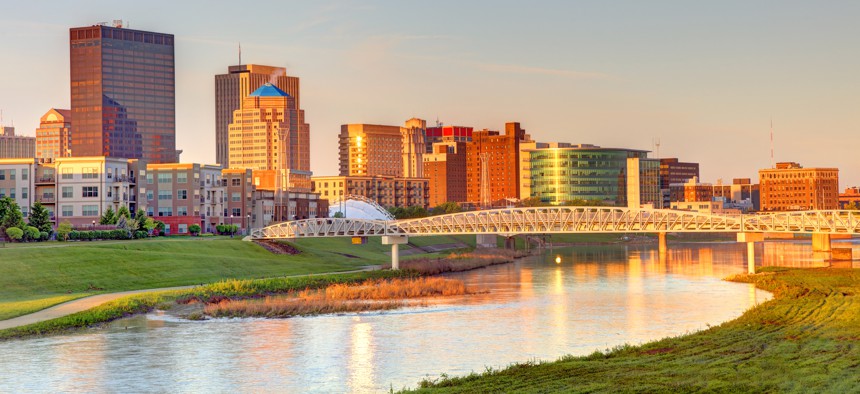
DenisTangneyJr via Getty Images





 By
Chris Teale
By
Chris Teale
The Ohio city already has a long history of civic participation, but the prospect of a new hospital on its west side made officials want to get residents involved in a new way.
PHILADELPHIA — Dayton, Ohio has a long history of community engagement, with a system of what it calls Priority Boards for different areas of the city.
Those geographically based boards are composed of elected volunteers who meet to address concerns in their neighborhoods and advise the city’s elected officials in areas like planning, development and how funds are allocated.
But the city realized recently that the system had not evolved or kept pace with modern needs, and it risked being too insular with only a few people representing their neighborhoods and liaising with the city council. Instead, Dayton is experimenting with a different tactic: a citizens’ assembly.
Participants are selected at random in a lottery system to reflect an area’s demographics and social features, and they then spend around four days analyzing a specific issue, learning about it, deliberating and presenting a decision. Mike Squire, Dayton’s division manager of community engagement, said he attends hundreds of meetings throughout the year in communities and neighborhoods, so is “well versed” in community engagement but wanted to expand the pool of participants.
“The assembly addressed a pain point for us as a city government, where we hear from those same people in every one of those venues,” Squire said during a panel discussion at the International City/County Management Association’s Local Government Reimagined conference in Philadelphia last week. “I have 1,000 or so best friends out of the 140,000 people in our city that I spend time with a lot, but I don't necessarily hear from those other 130,000 people.”
Dayton used its first citizens’ assembly to discuss a future public hospital in the west of the city, for which voters approved a 1 mill property tax — which establishes $1 of tax for every $1,000 of assessed property value — last year. Residents and community groups there had been pushing for a public hospital for years, and the citizens’ assembly came together over several days to discuss the services and facilities it would contain. Squire said a focus group had suggested the hospital as a topic for discussion.
What quickly became apparent was that, while the city had an advisory committee set up to discuss the future hospital, officials also needed what they called a “learning committee” to help educate the community and bring in people with expertise. But Squire acknowledged the effort quickly ran into bumps.
“What we underestimated, I will say, is the public hospital was a very emotional topic,” he said. “There were a lot of people in the community that had very deep feelings about the hospital passing, how it's to move forward and things like that.”
Given that, the citizens’ assembly has taken a pause until the fall, Squire said, to allow for more relationship building and community outreach. But officials said that is the point of a citizens’ assembly: to take on a hard issue, collaborate and find solutions and recommendations that are palatable to a broad swath of the community.
“This is a great issue because citizens’ assemblies — from someone who just works on assemblies specifically — are meant to be directed at real problems,” said Marjan Ehsassi, North America executive director of the Federation for Innovation in Democracy, which backs the citizens’ assemblies worldwide. “You want to do something that is really difficult, where there are tradeoffs, where people have to negotiate. And this was a great topic.”
Ehsassi said citizens’ assemblies have grown in popularity around the world and tackled some of countries’ thorniest issues, whether it be marriage equality and abortion in the Republic of Ireland or end-of-life care in France. The city of Petaluma, California introduced the first citizens’ assembly in the U.S. in 2022, and FIDE officials said there are expected to be six or seven such assemblies this year. Cole Speidel, a program manager at FIDE North America, said there is “momentum” behind them.
Nonprofit New America said in 2024 that they represent a new way to “engage citizens in democracy, foster public participation, and restore faith in democratic processes.” The group pointed to a survey from the Pew Research Center that found people in 24 countries think their democracy can be improved with better participation.
Technology can play a role in fostering that participation too, New America said. Letting people participate remotely has the benefit of “minimizing attrition rates and maximizing engagement throughout the process,” the nonprofit said.
Despite the optimism, there is a long way to go to improve public discourse, as officials acknowledged from their experience in Dayton, which they said was positive but showed where the gaps are.
“We tend to have this idealized view of public participation, that people will generally get along with each other,” said Valerie Lemmie, a senior advisor for state and local government at the nonprofit Kettering Foundation, a research group. “They may not trust government, but they'll get along with each other, they will try to find common ground because they share common interests, living in the same neighborhood, the same community. What we found is that may be a bit naive and unrealistic, that they have small-p politics and communities, just as there are in public institutions.”