
North Carolina lawmaker sues over AI-generated ad campaign
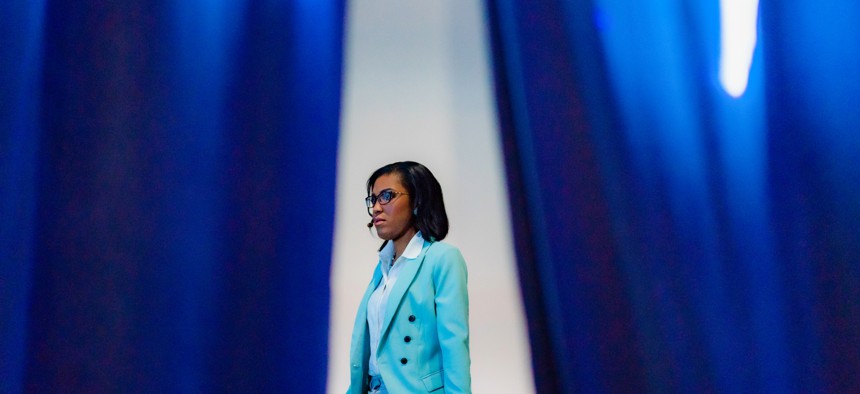
North Carolina State Sen. DeAndrea Salvador waits to take the stage for her 2018 TED Talk. Salvador is suing several companies in federal court for manipulating that TED Talk using AI. Lawrence Sumulong via Getty Images



 By
Chris Teale
By
Chris Teale
State Sen. DeAndrea Salvador’s TED Talk was manipulated and used in a campaign for energy efficient appliances in Latin America, and won awards at a major event in Cannes.
A North Carolina lawmaker filed a federal lawsuit late last month against several companies she said used artificial intelligence to manipulate her image, voice and name for use in advertising campaigns.
State Sen. DeAndrea Salvador, who represents a Charlotte-area district, alleged in a lawsuit filed in U.S. District Court that marketing firm Omnicom; appliance manufacturer Whirlpool; DDB Worldwide Communications, an Omnicom subsidiary; and DM9, a Brazilian ad agency that is part of the DDB group, altered a 2018 TED Talk she gave and used it for an ad campaign to promote energy efficient appliances.
That ad campaign was then submitted to the Cannes Lions International Festival of Creativity, which is often referred to as the “Oscars of Advertising,” and won 11 trophies, including the Grand Prix, the top prize that recognizes excellence across branded communications. Those honors were subsequently withdrawn.
In her complaint, Salvador said she was alerted to her name, image, likeness and voice being used by a journalist who emailed her for comment. The complaint said the ad campaign “subjected her to ridicule and embarrassment,” and left her “shocked and upset.”
“At first, sometimes you'll get an email, and you wonder, is this phishing or spam of some sort,” Salvador told Route Fifty in a recent interview. “But then after multiple, and certainly once the Brazilian media also started to reach out, that's when I dug more into it and was really shocked to see myself saying things I never said. It was initially brought to light by folks who blew the whistle and shared that information with me.”
In the wake of the awards’ withdrawal, DM9 announced it had carried out an internal investigation and found “serious inconsistencies related to the veracity or legitimacy” of its ads, and said it would return any prizes won. It also pledged to implement an AI ethics committee, to “establish clear guidelines and best practices for the responsible use of AI and technology in its creative processes.”
Cannes Lions also announced “new integrity standards and measures” for its awards, and that entrants starting next year “will be subject to new accountability measures and integrity standards, designed not only to safeguard the integrity of the benchmark, but to reaffirm the cultural and commercial value of creativity that is real, representative, and responsible.”
But Salvador said that is not enough, and it is too little, too late. Any communications she has received, she said, do not go into the “heart of the matter,” which she said shows “a lack of genuine accountability and a willingness to move forward in a way that hopefully will protect many more people.”
Salvador’s lawsuit is seeking damages “for reputational harm and emotional distress,” as well as “grotesque, willful and malicious misconduct,” and a court order to remove the ads from the internet. Omnicom did not respond to requests for comment on the lawsuit.
The ad campaign, Salvador alleges, manipulated a TED Talk she gave in 2018 on how to make energy more affordable for low-income families. The lawsuit said it “was grounded in personal experience, research and focused on expanding access to essential solutions.” But the ad campaign manipulated the TED Talk and CNN Brazil news broadcasts to make it look like Salvador was urging consumers to upgrade to Consul appliances, a Latin American brand under Whirlpool.
“As a result, not only was [Salvador’s] message distorted, but the public’s understanding of [her] knowledge, statements and policies were wrongfully manipulated,” the lawsuit says. “[The companies’] wrongful acts misappropriated and inaccurately associated [Salvador’s] TED Talk with her endorsement of [the companies’] goods and services.”
The lawsuit comes as a growing number of states have tried to regulate deepfakes and other AI-generated content, especially as they are worried about political fallout during campaigns. Salvador herself has introduced several pieces of legislation on AI, including one to require digital media be labeled with its origin, and another to ban deceptive AI content in political campaigns.
Salvador was recently named to the North Carolina AI Leadership Council, a new body established by an executive order signed by Gov. Josh Stein to find solutions to issues raised by AI and to explore how best to harness the technology. Understanding AI and mitigating its harms are top priorities, she said.
“I do believe there is an appetite among legislators and elected officials to become more informed and to try to understand the right balance,” Salvador said. “I do believe that there's appetite, and it could likely be bipartisan in some of the conversations that I've had. I won't speak for others, but there is a growing interest, for sure.”
In the meantime, the lawsuit continues. Salvador said she is “still processing” what happened and how her likeness and voice were manipulated in the ad campaign and how they could have won awards.
“To change the voice, to say things I never said, to change the slide content behind me, to be in a context of another country that I've never directly worked with or spoken on, it was pretty extensive in terms of mistreatment and misuse, and I do think is telling of the broader concerns,” around AI, she said.