
Trump signs order targeting ‘cumbersome’ state AI regulation
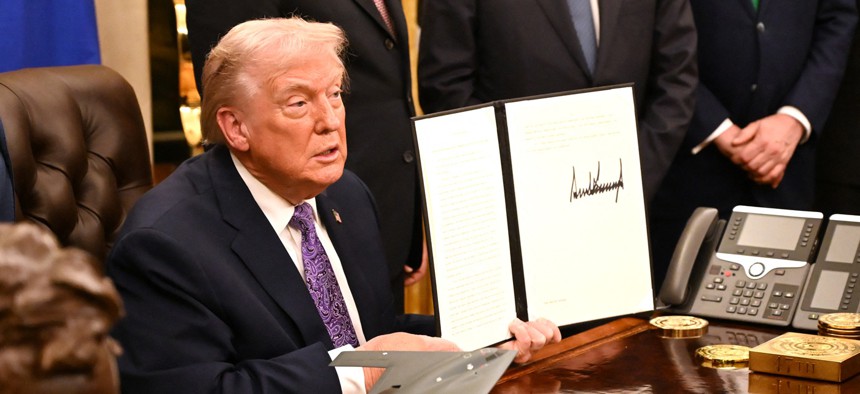
US President Donald Trump holds up his signed AI initiative during a signing ceremony in the Oval Office of the White House in Washington, DC, on December 11, 2025. Alex WROBLEWSKI / AFP via Getty Images






The order instructs certain federal agencies to identify which state laws undermine federal efforts to help the U.S. lead globally in AI.
President Donald Trump signed an executive order late Thursday evening to federally preempt state artificial intelligence regulations, taking multiple steps to identify state AI laws that “warrant change” — including establishing a new AI Litigation Task Force, restricting broadband grant funding to states deemed to have noncompliant laws and beginning preparations for a uniform federal AI policy framework.
The order, which targets “cumbersome regulation” that stands to undermine the Trump administration’s broader agenda for the U.S. to lead the global race to AI dominance, will leverage federal resources to evaluate which state AI laws are overly burdensome.
In the next 90 days, the Commerce secretary, with help from White House AI and Crypto Czar David Sacks and other executive branch staff, will identify and evaluate which state laws interfere with the federal agenda to spur AI innovation.
This evaluation of state AI laws will “at a minimum, identify laws that require AI models to alter their truthful outputs, or that may compel AI developers or deployers to disclose or report information in a manner that would violate the First Amendment or any other provision of the Constitution.”
A newly formed AI Litigation Task Force –– formed by the attorney general –– will be charged with challenging the laws identified as overly burdensome.
The next steps will be for officials within the Commerce Department to issue formal policy notices to states with “onerous AI laws” that are ineligible to receive Broadband Equity Access and Deployment Program non-deployment funds. Those policy notices will also justify the decision to withhold select BEAD funding by saying a patchwork of AI legislation inherently undermines BEAD-funded connectivity projects.
Simultaneously, Sacks and the chairman of the Federal Communications Commission will determine whether to adopt a federal reporting and disclosure standard for AI models preempting conflicting state legislation. Sacks and the assistant to the president for science and technology will also begin preparing legislative recommendations to establish a unifying federal AI policy framework.
Notably, some state laws are exempt from federal preemption via the proposed legislative recommendations. These include any regulations dealing with child safety protections, permitting reform for data centers, state government procurement and use of AI, and other topics “as shall be determined.”
Opponents of the order have already decried its approach to state AI regulation.
“If the President really wants to address contradictory state laws, he can work with Congress on both sides of the aisle to debate and pass a federal standard,” Rep. Zoe Lofgren, D-Calif., said. “Unfortunately, the Republicans in Congress and the White House have been missing in action on creating AI legislation in Congress. I call on Speaker [Mike] Johnson to make Congress relevant again and engage in a bipartisan conversation on AI governance.”
Advocacy groups that have called for greater restrictions on powerful Big Tech companies also took issue with the order undermining more protective state law.
“The Trump-Sacks executive order proves that the White House only listens to powerful Big Tech CEOs who fund ballrooms rather than the everyday people they pretend to serve,” Sacha Haworth, executive director of the Tech Oversight Project, said. “This is bad policy married with even worse politics, and the AI EO will go down as an unmitigated disaster that puts the Trump Administration at odds with over two-thirds of Americans, and his AI-skeptic MAGA base.”
But other advocacy and industry groups welcomed the executive order. Kristian Stout, the director of innovation policy at the International Center for Law & Economics, said that permitting a diverse array of differing state laws would be “self-sabotage” within the U.S. as it continues advancing in the global AI race, but called for respect toward states’ rights.
“Allowing core technical rules to be fragmented across 50 states … would slow deployment, stifle investment, and the U.S. competitive advantage to foreign jurisdictions,” Stout said. “At the same time, it is important to ensure that states’ traditional rights and responsibilities in areas like consumer protection, fraud enforcement, privacy, and criminal law remain fully intact.”
The Information Technology Industry Council, a trade association that represents tech companies, also welcomed the order.
“We stand ready to work with the Trump Administration and Congress to prepare a legislative recommendation that promotes American AI leadership and innovation and ensures all Americans can reap the benefits this transformational technology offers,” ITI President and CEO Jason Oxman said in a statement.
Trade association NetChoice also backed Trump’s move.
“As [Trump] pointed out, startups and small businesses will greatly struggle to create and compete with a 50-state patchwork of red tape. The federal government is the appropriate regulator to govern interstate commerce like AI tools, and we look forward to working with the White House and Congress to set nationwide standards and a clear rulebook for innovators,” said Patrick Hedger, NetChoice director of policy.
NEXT STORY: Still early days for state chief AI officers