GOP policy leads highlight child safety as key step in national AI legislation
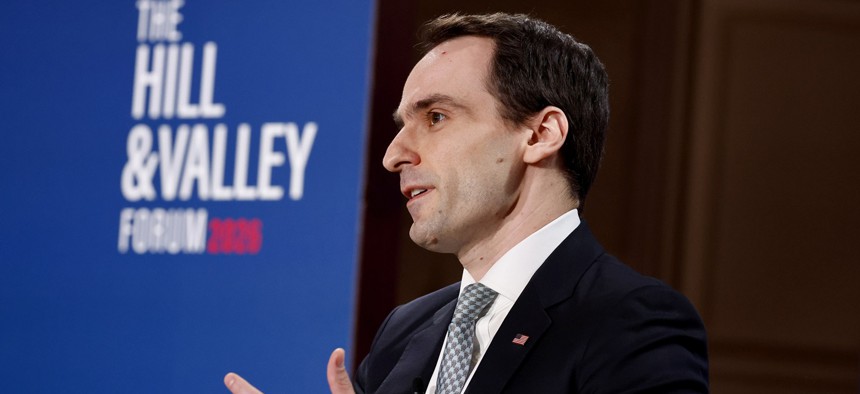
Michael Kratsios participates in the Winning the AI Race: From Strategy to Execution panel during The Hill & Valley Forum 2026 at Andrew W. Mellon Auditorium on March 24, 2026 in Washington, DC.

Michael Kratsios participates in the Winning the AI Race: From Strategy to Execution panel during The Hill & Valley Forum 2026 at Andrew W. Mellon Auditorium on March 24, 2026 in Washington, DC. Paul Morigi/Getty Images for The Hill & Valley Forum

Legislators are still working through options for what that legislation will look like, including the possibility of reviving the proposed moratorium on state AI regulations.

White House officials pressed the need for a uniting federal artificial intelligence regulatory framework on Tuesday, following the Trump administration's March 20 recommendations to Congress. They underscored the passage of child safety bills as a critically important legislative step to comprehensive AI law. 

Speaking on various panels during the Hill and Valley Forum, White House Office of Science and Technology Policy Director Michael Kratsios and AI and Crypto Czar David Sacks reiterated the administration’s chief AI policy priority: avoid a patchwork of regulations through one national standard. 

“We have a big challenge ahead of us,” Kratsios said. “We have to find a way to create a bipartisan piece of legislation that can pass both houses of Congress and get to the president's desk. I think David and I are confident that the framework is an amazing starting point, and it touches a lot of points we've seen on both sides of the aisle, and we're optimistic that we can try to get something done this year.” 

White House AI and Crypto Czar David Sacks echoed Kratsios’s comments. 

“Probably the most salient area is child safety, or online child safety,” Sacks said. “I think our North Star on that issue has been parental empowerment. We want to ultimately allow parents to decide what's right for their children.”

Later during the conference, House Speaker Rep. Mike Johnson, R-La., also highlighted child safety as a top policy goal for Congress. 

“The first thing is we have to deliver a single national framework that protects children, safeguards communities, supports creators and avoids a patchwork of state regulations,” Johnson said, referencing the pillars in the White House’s new policy recommendations. “We recognize that constant shifts in policy don't just confuse the market, they run contrary to our national interest.”

Congress has been working on two major child online protection bills, the Kids Online Safety Act, known as KOSA, and the Children and Teens' Online Privacy Protection Act, or COPPA 2.0, an update to the original 2011 law.

The Senate version of KOSA is currently a standalone bill that has been referred to the Senate Commerce Committee and is awaiting a vote. The House version looks different, having been packaged with other online safety bills into the KIDS Act sponsored by Rep. Brett Guthrie, R-Ky.

COPPA 2.0 has also been introduced in both chambers of Congress, with the Senate version passed on March 16. It is still pending action in the House.

Along with digital child protections, the administration has consistently pushed for a moratorium on AI laws at the state level to ensure Congress has a chance to pass unifying nationwide regulations. According to The Washington Post, administration officials and Republican lawmakers are trying to determine if existing online child safety legislation would be a suitable vehicle to reintroduce the AI moratorium.  

Sen. Marsha Blackburn, R-Tenn., spearheaded an amendment to the One Big Beautiful Bill Act last summer that would have placed a 10-year moratorium on the enforcement of state-level AI laws, but it proved widely unpopular and was removed in a 99-1 Senate vote.

Tony Samp, principal and the head of AI Policy at DLA Piper, said that the future of the omnibus kids online safety bill package is more challenging if the moratorium is present.

“There's a possibility that a package becomes an omnibus, but I'm not sure how successful that tactic would be, given everyone starts piling on making it harder to pass, especially if an AI moratorium is included,” Samp told Nextgov/FCW.  

A separate industry source who spoke on the condition of anonymity to offer perspective on ongoing deliberations said they do not think that federal preemption of state AI regulations and AI child safety legislation are inextricably linked, citing individual dynamics of the bill and its popularity dictating its process. 

“Federal preemption will certainly be a bargaining chip in negotiations if there is a larger AI package,” they said. “From recent proposals (e.g. the White House AI Framework and the Blackburn bill), it’s clear that there is bipartisan interest in AI safety for kids at a high-level, but there is no consensus around blanket preemption.”

Samp added that, as Congress mulls over acting on the White House AI Framework’s recommendations, time will tell where the AI moratorium will fit. 

“Congress will now need to turn these recommendations into legislative text where the devil is in the details and actual negotiations can happen,” Samp said. “Only then will we know what’s in the realm of possible for an AI package, and kids’ safety will certainly be part of that negotiation.”

X
This website uses cookies to enhance user experience and to analyze performance and traffic on our website. We also share information about your use of our site with our social media, advertising and analytics partners. Learn More / Do Not Sell My Personal Information
Accept Cookies
X
Cookie Preferences Cookie List

Do Not Sell My Personal Information

When you visit our website, we store cookies on your browser to collect information. The information collected might relate to you, your preferences or your device, and is mostly used to make the site work as you expect it to and to provide a more personalized web experience. However, you can choose not to allow certain types of cookies, which may impact your experience of the site and the services we are able to offer. Click on the different category headings to find out more and change our default settings according to your preference. You cannot opt-out of our First Party Strictly Necessary Cookies as they are deployed in order to ensure the proper functioning of our website (such as prompting the cookie banner and remembering your settings, to log into your account, to redirect you when you log out, etc.). For more information about the First and Third Party Cookies used please follow this link.

Allow All Cookies

Manage Consent Preferences

Strictly Necessary Cookies - Always Active

We do not allow you to opt-out of our certain cookies, as they are necessary to ensure the proper functioning of our website (such as prompting our cookie banner and remembering your privacy choices) and/or to monitor site performance. These cookies are not used in a way that constitutes a “sale” of your data under the CCPA. You can set your browser to block or alert you about these cookies, but some parts of the site will not work as intended if you do so. You can usually find these settings in the Options or Preferences menu of your browser. Visit www.allaboutcookies.org to learn more.

Sale of Personal Data, Targeting & Social Media Cookies

Under the California Consumer Privacy Act, you have the right to opt-out of the sale of your personal information to third parties. These cookies collect information for analytics and to personalize your experience with targeted ads. You may exercise your right to opt out of the sale of personal information by using this toggle switch. If you opt out we will not be able to offer you personalised ads and will not hand over your personal information to any third parties. Additionally, you may contact our legal department for further clarification about your rights as a California consumer by using this Exercise My Rights link

If you have enabled privacy controls on your browser (such as a plugin), we have to take that as a valid request to opt-out. Therefore we would not be able to track your activity through the web. This may affect our ability to personalize ads according to your preferences.

Targeting cookies may be set through our site by our advertising partners. They may be used by those companies to build a profile of your interests and show you relevant adverts on other sites. They do not store directly personal information, but are based on uniquely identifying your browser and internet device. If you do not allow these cookies, you will experience less targeted advertising.

Social media cookies are set by a range of social media services that we have added to the site to enable you to share our content with your friends and networks. They are capable of tracking your browser across other sites and building up a profile of your interests. This may impact the content and messages you see on other websites you visit. If you do not allow these cookies you may not be able to use or see these sharing tools.

If you want to opt out of all of our lead reports and lists, please submit a privacy request at our Do Not Sell page.

Save Settings
Cookie Preferences Cookie List

Cookie List

A cookie is a small piece of data (text file) that a website – when visited by a user – asks your browser to store on your device in order to remember information about you, such as your language preference or login information. Those cookies are set by us and called first-party cookies. We also use third-party cookies – which are cookies from a domain different than the domain of the website you are visiting – for our advertising and marketing efforts. More specifically, we use cookies and other tracking technologies for the following purposes:

Strictly Necessary Cookies

We do not allow you to opt-out of our certain cookies, as they are necessary to ensure the proper functioning of our website (such as prompting our cookie banner and remembering your privacy choices) and/or to monitor site performance. These cookies are not used in a way that constitutes a “sale” of your data under the CCPA. You can set your browser to block or alert you about these cookies, but some parts of the site will not work as intended if you do so. You can usually find these settings in the Options or Preferences menu of your browser. Visit www.allaboutcookies.org to learn more.

Functional Cookies

We do not allow you to opt-out of our certain cookies, as they are necessary to ensure the proper functioning of our website (such as prompting our cookie banner and remembering your privacy choices) and/or to monitor site performance. These cookies are not used in a way that constitutes a “sale” of your data under the CCPA. You can set your browser to block or alert you about these cookies, but some parts of the site will not work as intended if you do so. You can usually find these settings in the Options or Preferences menu of your browser. Visit www.allaboutcookies.org to learn more.

Performance Cookies

We do not allow you to opt-out of our certain cookies, as they are necessary to ensure the proper functioning of our website (such as prompting our cookie banner and remembering your privacy choices) and/or to monitor site performance. These cookies are not used in a way that constitutes a “sale” of your data under the CCPA. You can set your browser to block or alert you about these cookies, but some parts of the site will not work as intended if you do so. You can usually find these settings in the Options or Preferences menu of your browser. Visit www.allaboutcookies.org to learn more.

Sale of Personal Data

We also use cookies to personalize your experience on our websites, including by determining the most relevant content and advertisements to show you, and to monitor site traffic and performance, so that we may improve our websites and your experience. You may opt out of our use of such cookies (and the associated “sale” of your Personal Information) by using this toggle switch. You will still see some advertising, regardless of your selection. Because we do not track you across different devices, browsers and GEMG properties, your selection will take effect only on this browser, this device and this website.

Social Media Cookies

We also use cookies to personalize your experience on our websites, including by determining the most relevant content and advertisements to show you, and to monitor site traffic and performance, so that we may improve our websites and your experience. You may opt out of our use of such cookies (and the associated “sale” of your Personal Information) by using this toggle switch. You will still see some advertising, regardless of your selection. Because we do not track you across different devices, browsers and GEMG properties, your selection will take effect only on this browser, this device and this website.

Targeting Cookies

We also use cookies to personalize your experience on our websites, including by determining the most relevant content and advertisements to show you, and to monitor site traffic and performance, so that we may improve our websites and your experience. You may opt out of our use of such cookies (and the associated “sale” of your Personal Information) by using this toggle switch. You will still see some advertising, regardless of your selection. Because we do not track you across different devices, browsers and GEMG properties, your selection will take effect only on this browser, this device and this website.