
Forensic crime labs are buckling as new technology increases demand
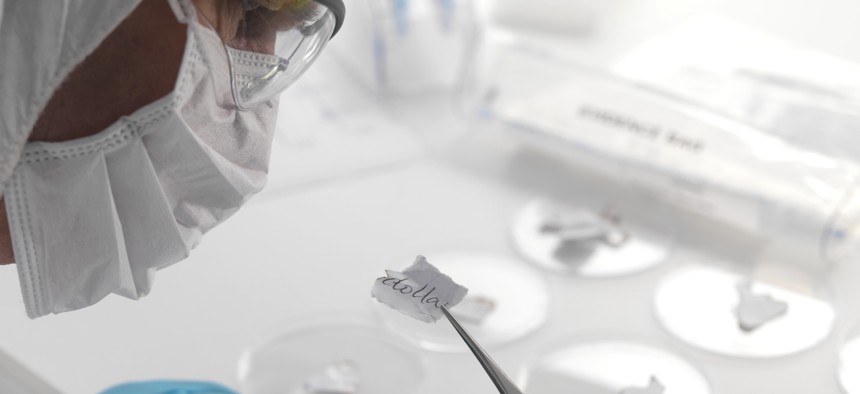
Science Photo Library - TEK IMAGE via Getty Images





A major federal funding cut could make labs’ struggles worse.
This article was originally published by Stateline.
Across the country, state and local crime labs are drowning in evidence.
From rape kits to drug samples to vials of blood, delays in forensic testing are stalling prosecutions, stretching court calendars and forcing impossible choices about what gets tested — and what doesn’t.
Now, as the need for forensic testing grows, state and local crime labs may face steep federal funding cuts that could further delay justice for victims, derail criminal investigations and overwhelm already backlogged systems.
Two key federal grant programs that support state and local forensic labs are at risk: One faces a major cut, while the other is funded below its authorized cap despite growing demand.
The proposed cuts have alarmed forensic experts and crime lab directors who say some labs rely heavily on these federal grants to keep up with mounting caseloads.
“That would have dire consequences on a lot of crime laboratories who depend on those funds for maintaining operations,” said Scott Hummel, the president of the American Society of Crime Laboratory Directors, a national nonprofit professional organization.
“If you limit those resources even further, there will be backlogs,” said Hummel, who also works as a quality assurance manager at the Kansas City Police Crime Laboratory in Missouri. “Those backlogs just keep growing and growing, and labs are forced to make difficult decisions on how they prioritize their casework.”
When Labs Fall Behind
Crime labs are often invisible to the public but essential to criminal investigations. They test DNA, analyze drug samples, match ballistics and verify evidence in everything from rape cases to gun homicides. The evidence may lead to arrests, but it’s also critical in court, shaping outcomes for victims, defendants, prosecutors and defense attorneys alike.
But years of underinvestment have left many labs without enough scientists, equipment and funding to keep up. As forensic technology has advanced — particularly in digital evidence and DNA testing — demand also has risen sharply.
“As technology gets better, there’s an expectation, I think, that labs can do more than they have the capacity for,” Hummel said.
At the same time, new state laws and testing mandates are increasing pressure on already strained labs. In some states, changes in drug laws — such as renewed crackdowns on marijuana or stricter DUI thresholds — have led to a surge in requests for toxicology and drug analysis. Other states have expanded mandatory evidence testing requirements, often without providing additional funding.
Some lab directors who spoke with Stateline said that even well-intentioned policies can create bottlenecks when resources don’t keep pace with demand.
“It’s important for policymakers to realize that the criminal justice system is demanding more from us, and so we need the resources to keep up with the increased demand,” said James Carroll, the crime laboratory director with the Los Angeles County Sheriff’s Department.
Low pay is also a challenge, with some analysts opting for private-sector jobs that offer higher salaries and better benefits. Training new analysts can take months or even years, making it difficult to quickly fill critical positions and retain experienced staff.
“We have to be absolutely perfect, and if you have something that isn’t perfect, that can be a career ruiner,” said Mike Lyttle, the assistant director of the forensic services division at the Tennessee Bureau of Investigation. “That is a lot of pressure.”
But that pressure can come at a cost — especially when analysts bear the brunt of it.
Lab directors and managers who spoke with Stateline said that overworking staff is not only inappropriate, but also risky. It can lead to quality issues, including “dry labbing,” or fabricated results, which could call hundreds or even thousands of cases into question.
As delays mount across the country, some state and local governments are rethinking how their crime labs are structured and funded.
In Colorado, officials are dealing with the aftermath of a major DNA testing scandal involving state-run labs, and several new laws have been enacted to establish a review board and address backlogs. Lawmakers in Rhode Island considered a bill earlier this year that would have shifted oversight of its state crime lab to the state attorney general’s office, but the bill was tabled for further study.
In Shelby County, Tennessee, a new $1.5 million investment will go toward the region’s first local lab focused on rapid DNA analysis, digital forensics and weapons ballistics. Memphis City Council officials also are working on funding at least two new positions at a state laboratory to prioritize cases from the Memphis area.
Hard Choices
The national push to test sexual assault kits has helped bring attention to forensic evidence backlogs. But in some labs, it has also forced tough choices about what gets tested first.
In Oregon, for example, Brian Medlock, the director of the state police forensic science division, announced in January that the state lab had halted DNA analysis for all property crime evidence. Testing won’t resume until the sexual assault kit backlog is cleared — a goal the agency doesn’t expect to meet until the end of the year. As of June, 474 sexual assault kits were still awaiting testing, according to the state’s dashboard.
Like Oregon, the Tennessee Bureau of Investigation also is deprioritizing nonviolent cases as it works through its rape kit backlog. The agency currently has six forensic biology analysts in training across the state, limiting how many cases it can process, according to Lyttle.
The goal is to eventually process lower-priority cases, he said, but the current focus remains on sexual assault kits. Still, Lyttle acknowledged that delaying the analysis of evidence in nonviolent cases can be a missed opportunity. Uploading DNA profiles from those cases to the national database, CODIS, could help identify offenders earlier — potentially before they go on to commit more serious crimes.
“You may be losing people early because you’re deprioritizing those nonviolent cases and not getting them identified as quickly as you could,” he said. “Every case is important.”
Looming Cuts
Trump has proposed slashing one major forensic science grant program and holding funding flat for another — a combination that some officials fear could worsen evidence backlogs amid rising demand.
The Paul Coverdell Forensic Science Improvement Grants Program, which aims to help labs replace aging equipment, train staff and reduce case backlogs, would be cut by 71% under President Donald Trump’s proposed fiscal year 2026 budget — from $35 million to $10 million.
Another, the Debbie Smith DNA Backlog Grant Program, would receive $120 million under the proposal — below the $151 million cap authorized by Congress in 2023. While Congress can approve up to that amount, it often allocates less: $130 million in fiscal year 2023, and $120 million in both fiscal years 2024 and 2025.
The program helps labs process backlogged evidence, including sexual assault kits, and supports the expansion of the national DNA database, CODIS.
These proposals are part of the administration’s annual discretionary budget request; Congress must finalize federal agency yearly spending by Sept. 30. Presidential budget proposals are often reshaped by Congress, but Trump’s spending plans have found strong backing among Republicans on Capitol Hill. With the GOP holding majorities in both chambers, proposals to cut or limit funding for forensic science programs may be more likely to advance.
A State in Crisis and a Model for Change
The Colorado Bureau of Investigation’s crime labs are under intense scrutiny following a major DNA testing scandal and widespread staffing shortages that have slowed down forensic work across the board. The bureau is facing backlogs in every discipline or type of case, according to Lance Allen, a deputy director who oversees forensic services.
Much of the current crisis stems from the case of Yvonne “Missy” Woods, a former DNA scientist now facing more than 100 criminal charges for allegedly manipulating DNA results over her 30-year career. Her alleged misconduct, combined with long-standing understaffing issues, has led to severe delays.
As of June, the average turnaround time for processing sexual assault kits in Colorado was 570 days, or about 1 1/2 years, with more than 1,200 kits still awaiting testing, according to the state’s dashboard. The agency’s goal is to reduce that timeline to 90 days.
“We are not satisfied with this turnaround time either, and this backlog is also unacceptable to us, and we know we have to do better,” Allen told Stateline.
But the backlog isn’t limited to sexual assault cases. Blood alcohol testing has also slowed dramatically, according to defense attorney Matthew Haltzman, who said he has handled cases in which results took five to six months to come back.
In that time, he said, even clients who were ultimately found not to be intoxicated were forced to navigate the court system — attending hearings, undergoing weekly drug and alcohol testing and complying with pretrial supervision.
“It’s just a lose-lose for everybody in the legal process, but more so for the accused than anyone else,” Haltzman said. “It’s a massive deprivation of liberty.”
The current turnaround time for all toxicology tests is 99 days, or just over three months, according to Vanessa Beall, the Colorado bureau’s toxicology program manager. About 80% of cases are completed within that time frame or less, and all toxicology tests include blood alcohol and drug analysis.
With additional toxicologists, the bureau is already meeting its 2025 goal and aims to reduce that turnaround time to 70 days by the end of 2026.
This year, the bureau and state lawmakers have rolled out measures aimed at restoring trust in the system. Those efforts include sending more than 1,000 rape kits to private labs to reduce turnaround times, expanding staff training programs and establishing a review board within the state attorney general’s office to improve oversight.
Lawmakers also approved $3 million to support outsourcing and lab operations, along with a separate law requiring the reporting of misconduct within Colorado’s state-run forensic laboratories.
Meanwhile, Connecticut is drawing national attention for its consistent performance and growing capabilities.
Once plagued by serious issues — including a suspended accreditation in 2011 that disrupted criminal proceedings — Connecticut’s forensic lab has steadily strengthened its operations. This year, it earned a perfect accreditation score for the third year in a row.
Following its accreditation loss, the lab faced a backlog of 12,000 cases, and by 2013, turnaround times stretched up to 2 1/2 years. Today, the average turnaround is just 20 days across all disciplines.
DNA cases, including those involving sexual assault evidence, are typically processed in about 27 days. Firearms cases take about 35 days, and computer crimes about 60, according to Guy Vallaro, the director of the Connecticut Division of Scientific Services.
He credits much of the lab’s progress to its team of scientists and staff, who he says are deeply committed to both accuracy and improvement.
“When you have a good staff, you can do incredible things,” Vallaro said.