
Transit leaders look to efficient, tech-driven future
Stephen Kaiser/Staff





 By
Chris Teale
By
Chris Teale
Amid funding uncertainty, speakers during the GovExec Efficiency Summit said tech could help with predictive maintenance and making the trains run smoother. A lot of work lies ahead.
Few things stir images of government inefficiency more than waiting on a train platform or at a bus stop with no information about when said bus or train will show up, or sitting on hold with a transit agency’s customer service phone line.
But agencies across the country are embracing technology in areas like fare collection, operations, route planning and customer service, while also finding ways to improve their back-office processes. Meanwhile, agencies themselves are reexamining their business operations, all in the name of increasing efficiency. It’s taken on extra importance given the uncertainty around federal spending on transportation.
“The world, all business and government, we see that there's no money, to be very honest,” Shafiq Rahman, chief information and digital transformation officer at the Maryland Department of Transportation, said during a panel discussion at the GovExec Government Efficiency Summit last week. “There's no extra money pouring in from the sky. There aren’t any leaves turning into dollars, obviously.”
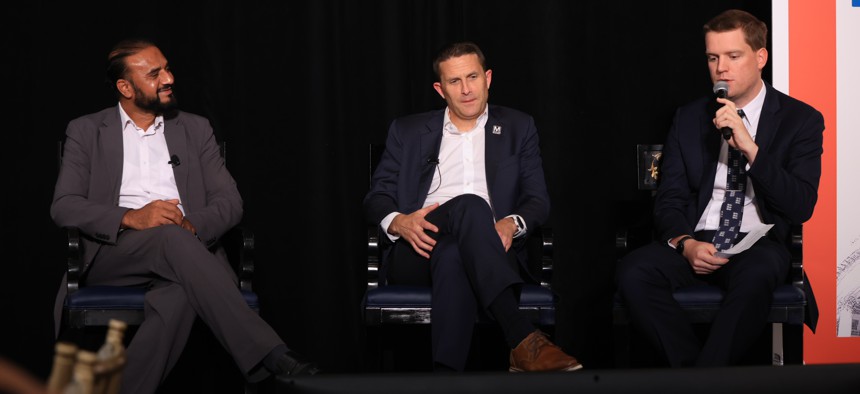
In Washington, D.C., the Washington Metropolitan Area Transit Authority, known as WMATA, recently rolled out a redesigned bus network and is using artificial intelligence to help catch bus lane violations. WMATA General Manager and CEO Randy Clarke said during the panel discussion that since rolling out the latter initiative, buses are moving 14% faster, wheelchair ramp deployment on buses is up over 10% and ridership on the impacted corridors is up 8%.
Moving buses faster, making it easier for people with disabilities to ride, and increasing ridership are key ways transit agencies can be efficient, Clarke said.
“If we're going to run a million-dollar vehicle and pay someone to drive it, we might as well put as many people on that thing as possible,” he added, noting that the system has rebounded spectacularly since the COVID-19 pandemic.
WMATA has also resumed using Automatic Train Operation on its entire rail system for the first time since 2009, when it was partially blamed for a fatal crash. Since it returned to one of the system’s lines to control trains’ speed, acceleration and deceleration, Clarke said trip times are six minutes faster and on-time performance has jumped 6%. Transit agencies must embrace technology, or they risk being left behind, he said.
“We were the only transit system in the history of the world to be regressive in our use of technology,” Clarke said. Embracing some form of automated control improves reliability, increases capacity and so makes the whole system more efficient, he added.
Rahman said MDOT is looking to be more efficient by combining its seven IT shops, and cutting its portfolio of applications from 856 to 620, in a bid to reduce redundancies. Those efforts, and others, reflect the fact that funding is not likely to noticeably increase in the coming years, so agencies must find ways to save money themselves. Rahman said MDOT is “trying to find the opportunities within ourselves where we can be more efficient and can reduce the redundancies and the waste.”
It's a similar story at the U.S. Department of Transportation, which is also working to make its technology arm more efficient. Pavan Pidugu, USDOT’s CIO, said the agency is centralizing its IT and moving away from so-called “shadow IT,” where employees use hardware, software or applications without central approval.
Grant management has been a complex operation at USDOT for decades, but Pidugu said things are becoming simplified. The agency is moving away from having 14 systems to manage its grants to a more centralized system, giving staff more “visibility.” The previous system was “painful and something to be ashamed of,” Pidugu said, not just inefficient.
“Why should it be so hard to get the information that we already have?” Pidugu said during an on-stage interview at the Government Efficiency Summit.
Moving forward, Clarke said predictive maintenance is the next frontier for WMATA finding efficiencies, as it further embraces technology to help identify when buses or trains need fixing before they break down.
“The amount of data that comes off a bus or a train would blow people's minds away,” Clarke said. “Every moment I can have that $3 million vehicle providing revenue service versus getting maintenance is a massive difference, not just on operating costs, but capital costs and the fleet plan.”
Agencies are reducing friction, too, whether it be through allowing customers to pay fares with their credit or debit card, or digitizing documents. Rahman said MDOT intends to go paperless by September, and continue to make customer experience more seamless. Now, he said, customers can carry out many tasks online with the Maryland Motor Vehicle Administration, meaning in-person appointments last mere minutes.
Having reliable money will be key, however. With it, Clarke said the sky is the limit for WMATA as it plans ahead.
“It's going to be a really fun time if we can actually just maintain our heads and have predictable funding,” Clarke said. “What could happen in the next decade around transportation is revolutionary.”