
Police reflect on Hurricane Katrina’s public safety communications legacy
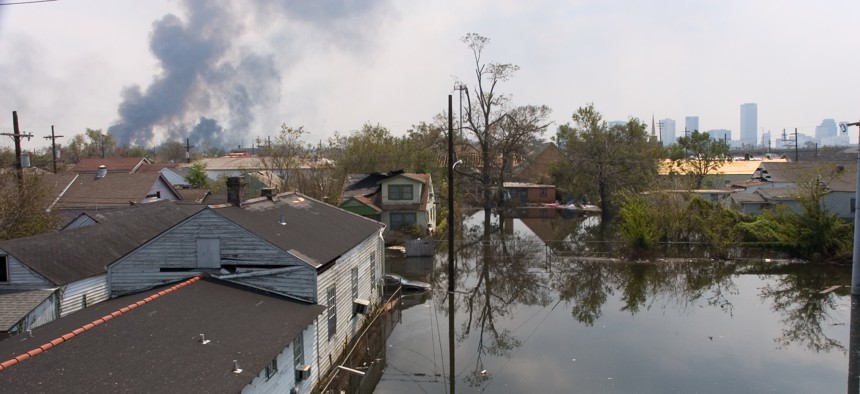
joeynick via Getty Images




 By
Chris Teale
By
Chris Teale
Amid commemorations of the hurricane’s 20th anniversary, those who responded remember how tough it was to communicate and said people must take those lessons into the future.
Twenty years after Hurricane Katrina made landfall and wreaked havoc in New Orleans and other communities in Louisiana, Mississippi and Florida, it’s the smell that Kelley Adley remembers most.
Then an investigator and police officer with the Collin County, Texas, District Attorney’s Office near Dallas, Adley was deployed to New Orleans to help provide security for a switching center owned by what was then known as Southwestern Bell, a telephone company in the region. At that time, local infrastructure was being rebuilt in the city after the storms and flooding that left an estimated 1,800 people dead.
“It smelled like death,” Adley said. “People had been out of power for weeks at this point, and it was probably at least a week and a half to two weeks after the hurricane that they started asking for help from other states. These people had no power for about two weeks, and they had to take the food out of the refrigerator and do something with it, so the meat was spoiling. You could smell the spoiled meat everywhere that people had put out on the curbs for the trash pickup, but trash pickup never came.”
Making life more difficult for Adley — and for his partner from Collin County and colleagues from inside and outside of the city — was that, with networks either destroyed or severely strained, it was hard to communicate. Even radio networks used by public safety agencies were limited, so Adley had no way of communicating with those in New Orleans. And to communicate with his agency and family in Collin County, he relied on a flip phone connected to one of the major networks.
Living at the switching center for two weeks with very limited communication in the wake of one of the most devastating natural disasters to hit the United States, then, was a real challenge.
Enforcing the law in New Orleans as an out-of-state officer was challenging too. Adley said at that time, the idea of mutual aid — where public safety agencies tap each other for help in extraordinary circumstances — was a relatively rare phenomenon. Officers from outside the city needed a letter from the state identifying themselves as law enforcement, to prevent any issues if they were pulled over during nighttime curfew hours.
“It was such desperate times,” Adley said. “We were basically on our own. If we needed help, we would have to call 911 and hope that they would come to us.”
Out of that disaster and its challenging aftermath came a renewed push for public safety to have a dedicated communications network, something that was first recommended by the National Commission on Terrorist Attacks Upon the United States, known as the 9-11 Commission. That commission noted that first responders struggled staying in touch as they dealt with the attacks in New York City and at the Pentagon, as phone networks became overwhelmed with people ringing their loved ones at the same time.
Hurricane Katrina, 9/11 and other disasters led to the creation of the First Responder Network Authority, which Congress authorized in 2012. AT&T won the contract to build out the network in 2017 as a public-private partnership, and estimates its coverage footprint is now 2.99 million square miles.
And Adley is using his experience in New Orleans to work in other active disaster zones and help provide communications. He is a member of the FirstNet Response Operations Group, a 21-person team that quickly deploys satellite and other equipment when disaster strikes. That way, first responders can keep communicating even as other networks experience downtime.
Adley has responded to the recent floods in Texas, as well as Hurricane Helene and others in this role, while the ROG also provides support for first responders during major events like the Super Bowl and Formula One motor races.
“They are our first line of defense, and we want to make sure that they can always communicate, and so we're bringing equipment to them,” he said.
It’s a far cry from Adley’s experience in New Orleans two decades ago, when he was largely isolated from the outside world and struggling, like thousands of others in that area, to communicate.
That could be about to change, however, as the FirstNet Authority will sunset in 2027 unless it is reauthorized by Congress. Fear of the impact that the network’s authority lapsing could have has already set off a furious lobbying campaign as law enforcement, public safety, emergency management and government leaders push for a clean reauthorization and the removal of any future sunset date.
Having the ability to maintain communications during a disaster is crucial, Adley said, and would have been helpful in 2005.
“I was in my mid-20s, I was still young in law enforcement, but just to have that technology back in 2005 going into an area like that, it would have been easy to communicate back to Collin County,” he said. “I would have been able to have a two-way radio and be able to talk to a dispatcher back in Collin County or back in Texas, just like I would be on the streets several miles away.”