
Alaska signs first-of-its-kind permit streamlining deal with feds
Screenshot via Facebook





 By
Chris Teale
By
Chris Teale
The state agreed to receive assistance from the federal Permitting Council to work together on certain projects in a bid to move them through the process more quickly.
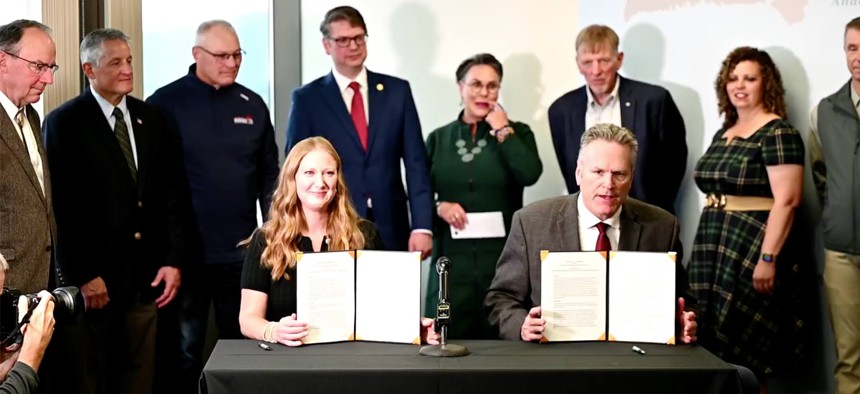
Alaska Gov. Mike Dunleavy last week signed a first-of-its-kind memorandum of understanding with a federal agency to help streamline the state’s permitting process and get projects moving along more quickly.
Dunleavy signed a memorandum of understanding with the Federal Permitting Improvement Steering Council, known as the Permitting Council, to work with the state under its FAST-41 program to identify projects that can receive more federal help to make them a reality. That includes technical assistance, greater transparency and more predictability, and will take the form of dedicated Permitting Council staff and new tools.
Projects covered under FAST-41 receive comprehensive permitting timetables and transparent management of those timetables on the Federal Permitting Dashboard. Projects eligible for FAST-41 assistance can be in areas like energy production, electricity transmission and energy storage, among others.
“So often, we see projects that don't anticipate the federal permitting that they need down the line, and that causes delays along the process,” Emily Domenech, the Permitting Council’s executive director, said during a press conference. “We want to help fix that with this MOU. It'll allow us to partner early to identify projects. It'll allow us to provide expertise and value to the state through looking at best practices and technology implementation to help streamline their permitting process.”
During the press conference, Domenech and Dunleavy said this new partnership would benefit proposed mining projects in Alaska, especially as President Donald Trump has expressed a preference for new fossil fuel discovery throughout the U.S. But the effort can also help get other energy projects off the ground, especially if they get caught up in years of red tape.
“Whether you believe in fossil fuels, whether you believe in renewables, we all believe in protecting the environment by getting together and making things a little more streamlined helps everybody,” Dunleavy said during the press conference. “It helps the consumer get low-cost electricity, helps us get cheaper minerals and metals, and helps ensure our national security.”
Approval for federal permits can take a long time, too. A study by McKinsey & Company earlier this year found that more than 650 infrastructure projects are waiting on federal approval before they can begin construction, but various permitting laws have prevented them from moving forward more quickly. McKinsey estimated that between $240 billion and $280 billion in infrastructure capital expenditures across eight key sectors enters the federal permitting process each year, but that every dollar takes about four to five years, on average, to move through the permitting process.
“These findings combined suggest there is $1.1 trillion to $1.5 trillion of infrastructure capital expenditure currently in federal permitting, costing stakeholders billions of dollars in lost revenue and withholding project benefits, including increased GDP, increased power generation capacity, lower carbon emissions, and opportunities for public transit,” McKinsey continued.
Domenech said there is more to do in Alaska to promote and speed up approvals for mining projects. She estimated there are now more than 30 mining projects on the Federal Permitting Dashboard, including some in the state. The Permitting Council wants to “triple” the projects pending in Alaska, Domenech said, after what she called “neglect by the previous administration.”
“When we think about this partnership here with Alaska, it's an opportunity to say, ‘Okay, where are all these sectors that have been stuck in the process, and how can we get them moving more quickly with more predictable processes?’” she said. “I think that's just as true for renewables as it is for our traditional oil and gas sector and our mining sector.”
Officials hope this first-of-its-kind partnership can be a model for other states, and show that they can work closely with the Permitting Council to speed up projects that may have been languishing and awaiting approvals. Leaning on state experts can also be a benefit, they said.
“There's so much opportunity here, particularly in the mining development sector, but in other sectors too, where projects, frankly, are getting stuck in the process where the federal government doesn't have the opportunity to access that state expertise and knowledge that we need to be able to build our permitting in a quick way and be efficient, and where we can perhaps provide some expertise and best practices to the state to speed the state permitting process,” Domenech said.
Dunleavy said he hopes this is the first step towards a more streamlined federal permitting process, especially for energy projects. He pointed to legislation previously introduced by U.S. Sen. John Barrasso, a Republican from Wyoming, and former U.S. Sen. Joe Manchin, a Democrat from West Virginia, that would have accelerated the permitting process for certain projects, and said that should be a model for the future.
“It's our hope that this [MOU] is part of that conversation and that there's a larger effort by federal officials in Congress and in the Senate to do something like that,” Dunleavy said.