
Defense law includes expanded counter-drone authority
aerogondo via Getty Images




 By
Chris Teale
By
Chris Teale
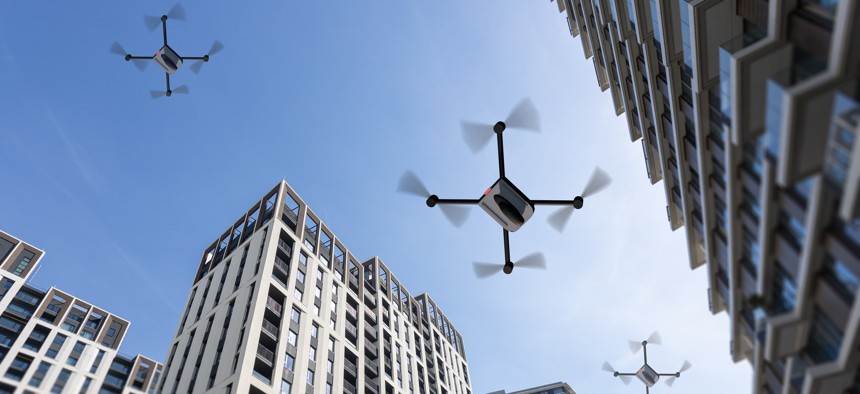
The National Defense Authorization Act included legislation to reauthorize federal agencies’ authority to bring down drones through 2028 and help state and local agencies do the same.
Ahead of a big year of internationally watched competitions and spectacles where drones have proven a security concern, President Donald Trump signed a law to allow state and local law enforcement to bring down drones at such events.
Trump signed the Safer Skies Act as part of the National Defense Authorization Act late last month. That bill, which was introduced in October by U.S. Sen. Gary Peters, a Michigan Democrat, extended the authorities of the Departments of Justice and Homeland Security to detect, track and safely disable drones that threaten public safety through 2028. Those authorities had expired when the government shut down last year, leaving communities vulnerable.
It also creates a nationwide framework that allows state and local law enforcement agencies to receive training and technology to help them disable unauthorized drones during public gatherings and major sporting events.
“As drone technologies evolve and become more readily available, we must take every step necessary to protect our national security and ensure law enforcement can respond to threats that drones could threaten sporting events, gatherings of large crowds and critical infrastructure,” Peters said in a statement when he introduced the bill. “This bipartisan legislation would give federal law enforcement the continued authority they need to disable dangerous drones that pose an immediate safety threat and protect the public and property from serious harm.”
The law comes at the start of what promises to be a busy couple of years in the United States. The Super Bowl is weeks away, then later this year the FIFA World Cup will be held in various cities, while celebrations for America’s Semiquincentennial are set to reach their climax on July 4. Then in 2028, Los Angeles will welcome the Summer Olympic and Paralympic Games.
Meanwhile, threats from unauthorized drones continue to be a real headache for state and local leaders. The Federal Aviation Administration said it receives more than 100 reports of drone use near airports each month, which could impact the safety of airplanes, helicopters and other air traffic in those areas. Other illegal uses include delivering contraband to prisons and around other sensitive sites including critical infrastructure.
Sporting and other major events have been impacted too. The NFL estimated that 2,300 drones were detected during the 2024 season around its stadiums, in violation of Temporary Flight Restrictions put in place during game days. Those TFR rules generally ban drones that operate below 3,000 feet within a radius of 3 nautical miles around a site, starting one hour before the event and ending one hour after.
Some states have looked to act with their own counter-drone efforts, especially in Louisiana and Wisconsin, although they risk preemption by the FAA, as it has overall responsibility for the nation’s airspace. This legislation helps that process move forward, and received bipartisan backing as well as support from various leagues.
“We thank President Trump and our Congressional champions from both political parties who took decisive action to keep fans safe,” NFL Commissioner Roger Goodell said in a statement. “With a rising number of drones flying in restricted airspace, it is critical that state and local law enforcement have the tools to prevent harm. This important step will help protect fans at stadiums across the country.”
Separately, the Federal Emergency Management Agency announced late last year it had awarded $250 million to the 11 states that will host matches in this year’s World Cup, as well as the National Capital Region ahead of America’s 250th celebrations, through its new Counter Unmanned Aircraft Systems Grant Program.
The grants are designed to help state and local agencies better detect, identify, track or mitigate drones, and are part of a two-year, $500 million program. The next round of grants, set to be distributed later this year, will go to all states and territories to build detection and response capabilities nationwide. The program was established under the One Big Beautiful Bill Act.
“We knew we needed to act quickly to keep the World Cup safe from the rising threat of unmanned aircraft systems and that’s exactly what we did,” Acting FEMA Administrator Karen Evans said in a statement. “This is the fastest non-disaster grant program ever executed by FEMA with funds being awarded just 25 days after the application deadline. This efficiency is a testament to the Secretary’s commitment and the Administration’s laser-focus on cutting red tape, getting resources into the hands of law enforcement, and protecting the American people.”