
Metaverse takes ‘guesswork’ out of Georgia city’s planning, official says
Luis Alvarez via Getty Images




 By
Chris Teale
By
Chris Teale
Peachtree Corners, Georgia, now has a digital twin of its downtown in the metaverse, which it can use to make data-driven decisions.
Enormous hype surrounded the metaverse just a few years ago, as technology companies including Facebook parent Meta spent millions to create a world based in virtual reality. It quickly got overtaken by the hype surrounding artificial intelligence and appeared to have taken a back seat to the new technology.
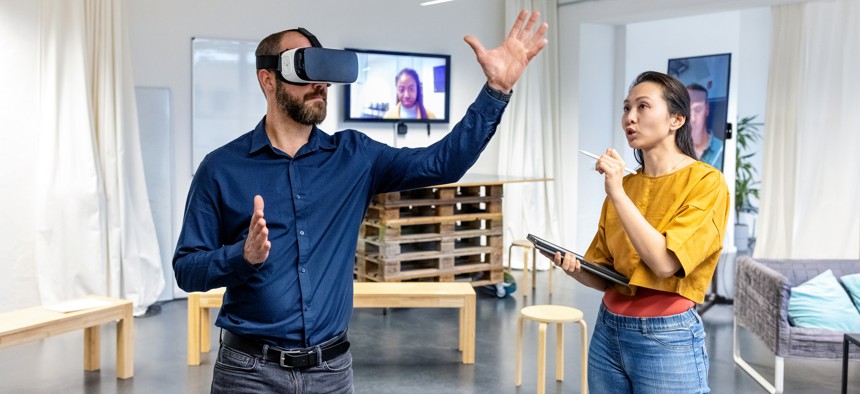
But the metaverse appears to have been reborn with a use case beyond gaming, virtual events and other activities. Peachtree Corners, Georgia, is using it as a tool to support smarter city planning by building a digital twin of its downtown in the metaverse and then navigating around using either augmented reality or a standard computer screen.
The digital twin is a complete replica of downtown, right down to its streetlights, trees, buildings and other infrastructure. Such twins have grown in popularity as cities and other jurisdictions use them to plan and make better decisions, and it’s a similar story in Peachtree Corners. Using this metaverse-based digital twin through a collaboration with AI metaverse company BizzTech, planners there can use live sensor feeds, traffic analytics, weather data and AI to make decisions about how the city can be improved.
“The bottom line is, this is about reducing a lot of the guesswork we have in city planning and management,” said Brian Johnson, Peachtree Corners’ city manager, in a recent interview. That could include something as simple as counting streetlights to assess whether the city is overpaying or underpaying its utility for power to run them, for example.
Peachtree Corners has been something of a leader in the smart city and technology space through its Curiosity Lab, a 500-acre technology park with 5G designed for startups and other companies to pilot various smart city technologies including smart mobility and internet of things sensors, among others. Those pilot programs are designed to be carried out with “no roadblocks” or bureaucratic hurdles, something Johnson said leads to long-term benefits for the city and its more-than 40,000 residents.
“When we created [Curiosity Lab], companies wanted to be associated with it, they want to use it for the purposes of enhancing their product or showing it off, demonstrating it to others,” he said. “We oftentimes find ourselves building our metaverse by companies offering it up at free or discounted rates because they're wanting to show off their technology. We win because taxpayers are not having to pay for every deployment of this stuff. They win because we give them an environment to test their product in and to collaborate with other companies that are already in the ecosystem.”
In time, the city intends to have a digital twin of its entire 18 square miles. And initially, it will use this metaverse version to optimize traffic lights to make traffic flow smoother, rehearse incident response and model how autonomous vehicle corridors might function before breaking physical ground on them in the real world. It’s a long way from the city planning tools of the past.
“Engineers using slide rules and calculators is not that long ago,” Johnson said. “Then you integrate computer aided design and other software to make it easier. This is just another step in organizations, and in this case cities, being able to use technology and leverage it to be a little bit smarter.”
Companies will also have the opportunity to trial their technology in the Peachtree Corners digital twin, Johnson said, before they deploy an actual asset, which can “get expensive.” And the city already has big plans on what to do next beyond technology. Johnson said the digital twin could soon include topographical information about the city to assess where water flows naturally. Doing that could help determine where and where not to build new developments depending on if any area is likely to flood during a severe storm.
And in time, the city might host community engagement meetings in the metaverse to make them feel more real and accessible than standard meetings on Zoom, Johnson said. “The sky is the limit,” he added, on the future possibilities of the metaverse-based digital twin.