
North Dakota’s ‘aviation spirit’ lives on through drones
Anton Petrus via Getty Images




 By
Chris Teale
By
Chris Teale
The state used drones to examine damage from last month’s severe storms and is experimenting with delivery as a way to make life easier for its rural residents and military bases.
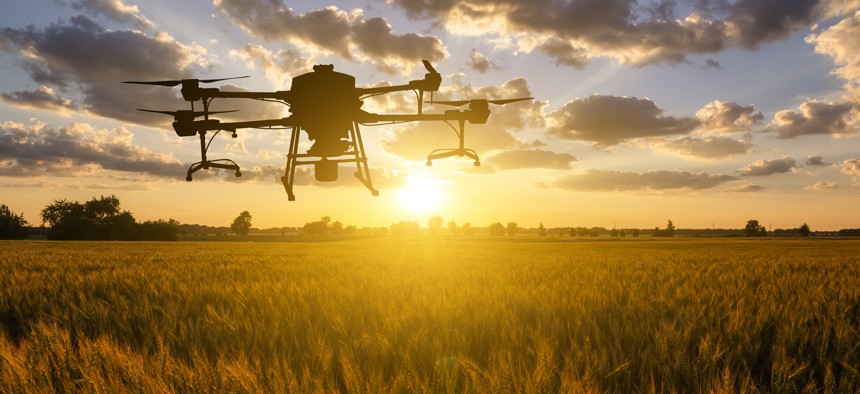
After severe storms and tornadoes descended on North Dakota last month, resulting in the deaths of three people and widespread damage to the state’s agriculture industry, drones have played a big role in dealing with the aftermath.
Tornadoes, hail and gusts of up to 100 miles per hour left thousands without power, while fields and agricultural equipment — crucial for the state’s economy — were left in various degrees of disrepair. In response, four drone pilots mobilized from the Northern Plains UAS Test Site in Grand Forks along with 150 volunteers to assess the damage to various fields, find any debris that needed removing and locate any items that may have gone missing.
“Let's just take the 150 that were walking the field,” said Hunter Hegel, Unmanned Aerial Systems operations lead at Northern Plains. “You're walking a couple miles per hour looking at different debris. We were able to comb the field in a fast and efficient manner compared to walking. The fact that we could put those drones up and fly between 30 to 40 miles per hour going up and down the field, that really helped locate debris, and those personnel on the ground were walking to the right spot to remove those items.”
Using drones to help with disaster response shows the role they now play in the state’s economy, after years of investment and research from the state government, the University of North Dakota, the military and the private sector. And it helped rescue the Grand Forks Air Force Base, which saw its mission changed and jobs lost under the Department of Defense’s by the Base Realignment and Closure Commission away from aerial refueling tanker planes. The Northern Plains site is now housed at the base.
Now, officials in the state are looking at ways drones can be used, especially to help those in rural areas. Delivery of food, medical supplies and other resources is one use case receiving a lot of attention, including through Project Rural Reach, an effort by the University of North Dakota and corporate partners that aims to prove that delivery can work beyond visual line of sight, as well as help with sustainable power generation and emergency response.
Given how many residents live in rural areas of the state, drones can help bridge the gap. That could mean delivering blood to rural hospitals, sending medical samples and supplies to and from testing sites, delivering food and making any number of other tasks easier for rural residents, who otherwise may feel cut off from the resources their urban peers enjoy.
“That's what gets us excited, is, how can we think differently, and how can we take some of these innovations and truly impact lives in a way that enables us to really embrace the fact that we have a rural state with a rural culture that we want to maintain, yet we also recognize that the world is changing,” said Amy Whitney, director of the University of North Dakota Center for Innovation. “How can we embrace that culture and heritage of North Dakota and then take what we learn in North Dakota and bring that to the rest of the world, where other people also want to have rural life, but are not able to take advantage of some of the things that make life possible.”
Similar efforts to test drone delivery are underway between Grand Forks Air Force Base and the Cavalier Space Force Station, which is 60 miles north. That effort is part of the Defense Department’s Project Unmanned Logistics, Traffic, Research and Autonomy, known as Project ULTRA. The initiative is designed to help the military better understand how to use drones, as well as the best uses of counter-drone technology to neutralize threats from the sky.
A key partner on Project ULTRA is Grand Sky, a 217-acre drone business park also located at Grand Forks Air Force Base that recently celebrated its 10-year anniversary. Companies in the sector, like Northrop Grumman and General Atomics, lease space, as do the Air Force Research Lab, the Defense Advanced Research Projects Agency and others on the public sector side.
Military drone investment is set to accelerate in coming years, including via Republicans’ One Big, Beautiful Bill, which established billions of dollars in UAS spending for the military, homeland security and other uses. Grand Sky, and North Dakota, are ideally placed to take advantage, not just for the military but commercial uses too.
“These cargo flights that we're doing between Grand Sky and Cavalier Space Force Station, we are demonstrating exactly how rural food delivery, rural healthcare delivery and rural emergency response can happen with these aircraft that we have with the process we've put in place,” said Thomas Swoyer, Jr., Grand Sky’s founder and president. “If we can get the right regulatory environment, this could be ready to go tomorrow, and that's a big deal because drone delivery is a hard concept, but I think we’ve figured out how it could actually work.”
North Dakota has a long history in aviation that stretches back to 1910, and a demonstration by the Wright Brothers Exhibition Team during the Grand Forks Air Meet. That has continued with UND’s John D. Odegard School of Aerospace Sciences, which was the first to offer a degree in UAS operations.
As drones grow in use and importance, Hegel said the “aviation spirit has spread throughout the whole state, making it one of the UAS hubs in the U.S.”