
Where are driverless cars going in New York City?
JasonDoiy via Getty Images





Google’s parent company has been pumping money into politicians to get Waymo robo-cars cleared for city streets.
This story was originally published by THE CITY. Sign up to get the latest New York City news delivered to you each morning.
Years before Mayor Eric Adams gave Waymo the green light to test its robot cars in parts of Manhattan and Brooklyn, the company spent millions trying to woo public officials in hopes of someday having its autonomous vehicles cleared to cruise New York City streets.
Lobbying records reveal that Waymo — a subsidiary of Alphabet, Google’s parent company — has, since at least 2019, poured more than $3 million into lobbying city and state leaders, who would need to change a law that prohibits driverless cars.
“We understand that as we operate in new areas, it’s on us to explain our approach,” Ethan Teicher, a Waymo spokesperson, told THE CITY. “That’s why our engagement with lawmakers is important — it reflects our commitment to explaining how our technology works and sharing our proven experience.”
Before New Yorkers can even think of hopping aboard self-driving cars, robo-vehicles face several hurdles that extend well beyond the end of this month, when a Waymo testing permit Adams approved in August expires. Autonomous-vehicle technology has previously been tested in Albany and Buffalo.
State law mandates that vehicles must be operated by humans, and even if that were changed, the city would also need to develop rules regulating self-driving cars. Multiple legislative efforts to that effect in the state legislature and the City Council have gone nowhere in recent years.
Driverless vehicles were legalized as part of the 2018 state budget, but in order to be operational on the road a licensed driver must be behind the wheel. Companies have to apply to the state Department of Motor Vehicles for approval to operate on city streets. (And if the companies set their sights on the boroughs, they would need a go-ahead from the city Department of Transportation.)
A state bill introduced in Albany would undo the requirement for a human driver — provided the autonomous vehicle carries insurance and meets certain other conditions. The bill has not moved forward despite being around since 2021.

Assemblymember Brian Cunningham (D-Brooklyn), who sponsored the bill in the lower chamber, said shaking off the requirement to have a person in a self-driving car would “begin to unlock some of the restrictive red tape that has held back the industry” from fully operating in New York state.
The bill’s other sponsor, Sen. Jeremy Cooney (D-Rochester), who chairs the Senate Transportation Committee, said he is optimistic it will make headway this session. Initially the legislature required a person to be inside the vehicles to better ensure the technology’s safety.
“The technology has evolved,” he said.
Then there is opposition from the more than 175,000 Taxi and Limousine Commission-licensed operators of yellow taxis and for-hire vehicles such as Uber and Lyft.
“Unlike other cities, New York is a place where driving is a full-time profession,” said Bhairavi Desai, executive director of the New York Taxi Workers Alliance. “You’re talking about full-time drivers — this is their only bread and butter.”
Through an app, passengers can already reserve rides on more than 2,000 driverless cars in San Francisco, Los Angeles, Phoenix, Atlanta and Austin, with Waymo saying its vehicles have racked up more than 100 million fully autonomous miles in those five cities. Expansion is planned for next year in Miami, Dallas, Denver and Washington, D.C.
While a full New York rollout is unlikely to happen in short order, Waymo has been trying to make political inroads on cracking the biggest city in the country.
Records show that the company’s lobbying targets have included city Transportation Commissioner Ydanis Rodriguez, multiple City Council members, Brooklyn Borough President Antonio Reynoso, Manhattan Borough President and comptroller-elect Mark Levine and former Deputy Mayor Meera Joshi, who previously served as head of the TLC.
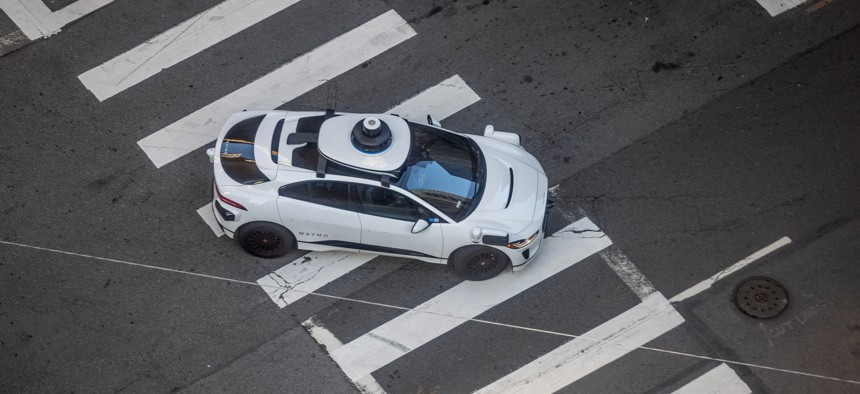
Adams and Rodriguez signed off in August on the city’s first-ever permit for testing autonomous vehicles. It cleared Waymo for all-hours testing of eight of its Jaguar I-PACE vehicles through the end of this month, but requires a “trained safety specialist” behind the wheel at all times.
The tech company would need to reapply to the permit program in order to extend or expand its testing, which New Yorkers have been chronicling online through sightings of the Jaguars equipped with the technology already in use elsewhere.
“We know this testing is only the first step in moving our city further into the 21st century,” Adams said in August. “As we continue to implement responsible innovation, we will always prioritize street safety.”
Riding Out
The Aug. 22 approval of Waymo’s permit application by a mayor who is running for re-election and struggling to survive politically caught some elected officials off guard.
“It kind of felt like, with the mayor sort of on his way out, sort of pulling random stuff out of a junk drawer and saying, ‘Hey, we never did this,’” said Councilmember Justin Brannan (D-Brooklyn), who co-sponsored a 2021 bill that would have required the TLC to establish rules regulating the use of autonomous vehicles as taxis.
The proposal — which also would have regulated licensing, safety, vehicle standards, insurance and trip and fare reporting — went nowhere.
City Comptroller Brad Lander, who co-sponsored that bill while serving in the City Council, said the legislation was designed, in part, to avoid a repeat of what happened more than a decade ago, when Uber’s arrival in New York upended the city’s yellow taxi industry and sunk the value of the taxi medallion.
“It's unfortunate that a law did not get passed in advance of Waymo’s pilot that would have provided a framework for the considerations that the city needs to make about the arrival of autonomous for-hire vehicles or taxis,” Lander told THE CITY. “Having gone through the Uber process, we have the ability to foresee this and work to set the public policy considerations and rules on the city’s terms, rather than a private company’s terms.”
Desai said the early days of self-driving vehicles in New York bear more than a passing resemblance to Uber’s arrival in the city.
“Waymo is using the same tech-finance playbook of trying to dominate politically so they can monopolize financially,” she said.
But the city’s densely packed streets would offer a new type of challenge for self-driving vehicles.
“Autonomous vehicles right now might work in more suburban cities,” Brannan said. “But here, you’ve got pedestrians, and cyclists, and delivery workers and emergency vehicles and people just running in the street.
“The margin for error is less than razor thin.”
Waymo, which began as the Google Self-Driving Car Project in 2009, says it’s taking the steps necessary to safely offer fully autonomous vehicle service on streets where the competition for space can be tough.
“While New York City would certainly be the most densely populated city Waymo has tackled in the U.S., the Waymo Driver already confronts and capably navigates many challenges associated with density — including different types of road users, jaywalking pedestrians, traffic and emergency vehicles — in five major U.S. cities,” Teicher said.
The fate of autonomous cars in New York City may fall to the next mayoral administration. Frontrunners Zohran Mamdani — a Queens Assemblymember and the Democratic nominee — and former Gov. Andrew Cuomo, who is running as an independent, may come at self-driving cars from different angles.
Mamdani has previously aligned himself with taxi workers, participating in their 2021 hunger strike over crushing medallion debt. Mamdani’s campaign did not respond to a request for comment.
Cuomo, as governor, pushed to bring autonomous vehicles to New York, announcing in 2017 that they would be tested in Manhattan (then-Mayor Bill de Blasio was not on board). Cuomo’s successor, Gov. Kathy Hochul, took a 2017 test ride in Albany while she was lieutenant governor. Cuomo’s campaign declined to comment.
The outcome of the mayoral election sets the stage for advancing a technology that’s likely to further upend how many New Yorkers move.
“That’s the big question,” Desai said. “Just because Adams gives this a final hour, desperate, green light does not mean the next administration cannot stop it and wait to formulate a thoughtful policy on how to address such a massive economic change.”