
Phoenix plans digital twin to solve regional challenges
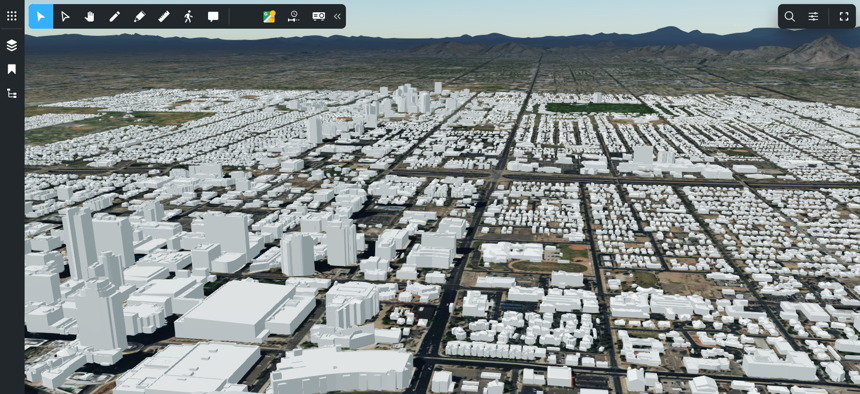
Courtesy image via CyberCity 3D





 By
Chris Teale
By
Chris Teale
The Arizona region’s smart city consortium wants to bring together several towns and cities to explore how to potentially work on issues around traffic, development, climate and others.
With almost 5 million residents and several towns and cities, greater Phoenix is looking to solve several of its challenges on a regional basis, given how closely connected many of those places are.
Traffic congestion, housing affordability, heat mitigation and urban planning are just some of the challenges that could benefit from a more collaborative approach. And the area of Arizona, led by The Connective, its smart region consortium, is looking to technology to help with that. In partnership with CyberCity 3D, a leading producer of 3D city models, the region will roll out a multi-jurisdictional digital twin to visualize, test and optimize urban development virtually before committing resources to physical implementation.
The twin will expand across Phoenix, Tempe, Mesa, Gilbert and Avondale and will integrate information from Google Maps as well as the cities’ governments and artificial intelligence. It also will standardize data from across multiple jurisdictions.
“If you're the city of Tempe and next-door Scottsdale and you don't have cross insight into the traffic or crime or public safety, whatever variable you want, even the weather, you really don't have a complete twin of your system,” said Jake Taylor, design and technology manager for The Connective. “When we started looking at that through this regional lens, if anyone really wanted to model anything for real, you would have to understand what's coming in from outside your borders and around you.”
Digital twins, a virtual replica of a physical space, object, system or process, mirror their real-world counterparts and so allow for monitoring, simulations and analysis of various scenarios. They have become more popular in urban planning, especially as cities look to understand their buildings and other public spaces, infrastructure, energy use, public safety and more.
The Connective and the Phoenix region more broadly has yet to decide on use cases for their digital twin, Taylor said, but the possibilities are endless in a region that has grown hugely in population and seen jurisdictional boundaries blur between its various cities and towns. But there are plenty of challenges, even in how siloed those cities and towns can be. For example, the cities of Tempe and Mesa may have different transit systems that only operate within their borders but do not allow for easy connectivity between the two. Having a digital twin could help plan for a world where those transit systems are better connected.
“Mesa is not going to pay for a transit line that takes me to Tempe,” Taylor said. “That's outside of their jurisdictional mandate, if you will. But you have these weird little things where those dotted [jurisdictional] lines start to control actual people's lives. When we talk about citizen-centered smart cities, that's about as far removed as you can get.”
A twin could also help contractors and developers looking to build in the region, Taylor said. Right now, it is a “real pain point” to deal with various cities and their differing rules and regulations around construction. Having them all contained in one digital twin with the ability to experiment virtually with a new development could take a lot of the guesswork out of construction, and reduce compliance costs.
“If you had an open data platform like this, where I could go in and code a building based on this web application of a digital twin, that would cut weeks of development time off my plate,” he said. “That is a real, tangible benefit that I think we're trying to work towards.”
Public safety and community engagement are two other areas that could benefit from a digital twin, Taylor said.
Interest in digital twins appears to be growing, especially as they integrate artificial intelligence to allow planners to game out scenarios years in advance. Kevin DeVito, CyberCity 3D’s founder, executive director and CEO, said in an era of tight budgets and a need to do more with less, digital twins will serve a valuable function in municipal government.
“Most cities want to improve operational efficiency,” DeVito said. “They want to make their mayor look good and their executive staff, so they want to use these tools to show economic development scenarios, events, location information and growth patterns within the city, maybe provide tools for third-party developers and architects and planners. But I think they also want a public-facing site that's ultimately like, wouldn't it be great if you had a Google Maps that was customized for every city so they could get their information?”