
Questions about self-driving cars amplify after one blocked an ambulance responding to Austin shooting
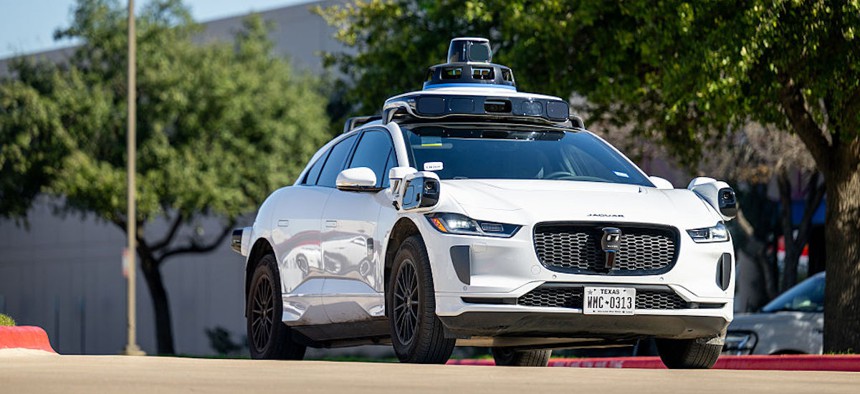
A Waymo vehicle exits a charging lot on Jan. 15, 2026, in Austin, Texas. Brandon Bell/Getty Images




While the encounter didn’t significantly hinder response to the shooting, it has raised concerns about the vehicles as they expand to more Texas cities and before new state regulations kick in.
This article first appeared on The Texas Tribune.
A viral image from the March 1 shooting in downtown Austin — an autonomous vehicle blocking an ambulance from reaching the scene where a gunman fatally wounded three people and injured 15 others — has put a spotlight on driverless cars as they hit the streets in more major Texas cities.
A video widely circulated on social media shows a Waymo vehicle blocking the street as paramedics try to reach the scene of the shooting at Buford’s, in the city’s nightlife district on West 6th Street, forcing the ambulance driver to seek another route.
“This is why we should not have self-driving cars,” an onlooker says in the video.
The encounter didn’t significantly hinder the city’s ability to respond to the shooting, local emergency officials have said, and an Austin police officer was able to move the vehicle within two minutes of arriving at the scene, the video shows.
Nonetheless, the encounter tapped into anxieties about autonomous vehicles as their presence grows on Texas roads — despite evidence that autonomous vehicles tend to be much safer than human drivers.
“Their fatality rate is already much lower,” said Adie Tomer, a senior fellow who studies transportation issues at the Brookings Institute. “The promise is, as the technology improves, that it will get better.”
That doesn’t mean those vehicles are ready to operate on roadways, said Tray Gober, an Austin personal injury lawyer who specializes in vehicle crash cases and has been critical of Waymo.
“Self-driving vehicles are the future,” Gober said. “There will be less crashes because of self-driving vehicles. But the future isn’t today because these vehicles are not ready.”
Sunday’s incident was the latest documented glitch involving autonomous vehicles in Austin — where they have blocked traffic, ignored police officers and illegally passed school buses as they pick up or drop off students.
“If we're dealing with an incident at one of our schools, the last thing that I would want is any autonomous vehicle blocking emergency first responders from being able to quickly access to triage patients or get to the scene,” said Travis Pickford, assistant chief of the Austin ISD Police Department.
In a statement, a Waymo spokesperson said, “Safety is at the core of everything we do. We appreciate the dedication of first responders and remain committed to continuous learning to better serve our riders and the community.”
Austin Trains First Responders on AV Troubleshooting
Texas banned cities from regulating autonomous vehicles in 2017, a move policymakers and transportation experts said was necessary to allow the industry to grow. Texas lawmakers last year directed the state’s Department of Motor Vehicles to draw up more regulations to oversee autonomous vehicle companies operating in the state. Those regulations won’t take effect until May.
In the meantime, self-driving cars have hit the road in more parts of the state. The week before the Austin shooting, Waymo, the autonomous vehicle company, deployed its vehicles in San Antonio, Dallas and Houston. Other companies like Tesla, Volkswagen and Zoox are testing self-driving cars in Austin, according to the Texas Department of Transportation.
Austin has been a testing ground for self-driving cars since the middle of the last decade. While city officials are forbidden from regulating autonomous vehicles, they’ve kept an eye on them and tried to work with operators to work out kinks. According to the city’s website, Austin officials have worked to “collaborate with TxDMV and companies as they enter the market to offer staff's knowledge on the local transportation network to help AVs operate more safely.”
Within a minute and a half of arriving on scene, an Austin police officer commandeered the vehicle and drove it into a nearby parking garage, clearing the roadway.
“We already had a system where a police officer could get in that vehicle and move it. That didn't exist four years ago,” said Jay Blazek Crossley, executive director of the nonprofit Farm & City, a group that advocates for transportation safety measures
Austin officials said emergency responders followed established protocol for interacting with autonomous vehicles. Waymo also has its own guide for law enforcement officers in dealing with its cars, and the company says on its website that it “proactively offers training to first responders where we operate.”
“Our first responders are trained on how to manage driverless vehicles that become stopped or unresponsive,” Captain Christa Stedman, a spokesperson for Austin-Travis County Emergency Medical Services, said in an email. “This type of scenario is something we prepare for, and it was resolved quickly without a significant impact to patient care or overall response operations.”
Other cities are figuring out how to handle encounters with autonomous vehicles.
In Dallas, emergency officials are still working out protocols for dealing with autonomous vehicles, city spokespeople said.
In San Antonio, the police and fire departments “have received training and quick-reference guidance for safely managing autonomous vehicles, including steps to take if a vehicle becomes unresponsive, how to contact the vendor for immediate support, and how to redirect vehicles away from active incident scenes,” city spokesperson Brian Chasnoff said.
Waymo met with each department late last year “to familiarize our first responders with its vehicles,” Chasnoff said.
Representatives for the city of Houston did not return a request for comment.
Glitches Are Common With AVs but Accidents Are Rare
Austin has documented 230 issues with self-driving cars since the city began tracking them in 2023, a city dashboard shows, including collisions and near misses along with instances where the vehicles ignored police officers’ direction, blocked traffic or posed some other kind of safety concern.
But collisions are rare: Travis County saw 15,872 vehicle crashes in 2024, according to state figures. That year, the city recorded two involving a self-driving car.
That doesn’t mean those incidents don’t pose real danger.
Austin ISD officials found last year that Waymo vehicles had illegally passed school buses on a number of occasions while their stop signs were deployed. No child has been struck, but Pickford worries it could be a matter of time — noting that in California, a Waymo vehicle in January struck a child who suffered minor injuries.
In all, the Austin school district has issued 25 tickets to Waymo since August, Pickford said. The company had knowledge of its vehicles’ activity, he said, because each ticket issued by the district’s police department was paid on time.
When district officials brought the matter to the company’s attention at a meeting with Waymo representatives in November, company officials initially rejected the district’s assessment that the cars posed a threat to students and refused a request for the company to pause operations during pick-up and drop-off hours, Pickford said.
In the meantime, Waymo cars continued to rack up violations, he said. Human drivers, Pickford said, tend not to reoffend once they’re ticketed.
“The Waymos were not learning, and that was concerning to us,” Pickford said.
Waymo issued a software update in November after meeting with district officials, Pickford said. In December, the company collected data on the district’s school buses with the apparent goal of improving their vehicles’ ability to recognize and respond to school bus signals.
That month, Waymo issued a software recall after its buses also failed to yield to school buses in Atlanta — two months after the National Highway Traffic Safety Administration launched an investigation into the company. The NHTSA and the National Transportation Safety Board have each begun probes into the company for its vehicles’ failures to stop for school buses.
A preliminary NTSB report released this week found that one Waymo vehicle illegally passed an Austin ISD school bus in January because one of the company’s remote assistance agents, employees who help the cars' system navigate unclear driving circumstances, incorrectly told the car it could do so.
Meanwhile, Texas is standing up its own regulatory framework.
At the end of May, Texas will require autonomous vehicle operators to gain authorization from the state Department of Motor Vehicles before their cars can carry passengers on Texas roads.
Companies must certify in writing that their vehicles are “capable of operating in compliance with applicable traffic and motor vehicle laws,” among other requirements, in order to gain that authorization. Operators must also provide a copy of a plan specifying how emergency responders “should interact with the automated motor vehicle” should they encounter one.
