
Autonomous cars in Iowa would need human drivers under proposed bills
gremlin via Getty Images



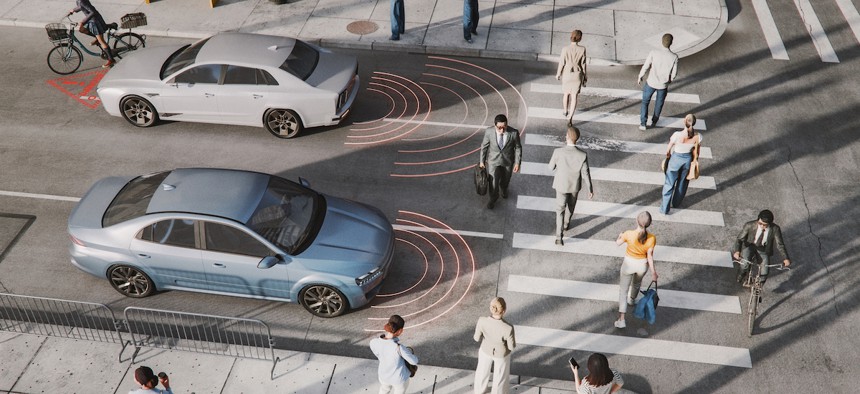
Iowa lawmakers advanced two bills from House subcommittees that would restrict the commercial operation of driverless cars.
This story was originally published by the Iowa Capital Dispatch.
Iowa lawmakers advanced two bills from House subcommittees Monday that would restrict the commercial operation of self-driving vehicles and assign liability to the owners of autonomous vehicles.
The bills were opposed by automotive industry representatives who argued the legislation would prohibit situations like an automated car transporting passengers in places like an airport. Labor unions and trial lawyers supported the bills, arguing the language would protect Iowans from the new technology.
House Study Bill 598 would hold the owner of a self-driving vehicle liable in the event of a crash or traffic law violation. It would also prohibit a “driverless-capable vehicle” from transporting hazardous material without a conventional human driver.
Michael Triplett, speaking on behalf of the Alliance For Automotive Innovation, said the bill would hold the owner of the car liable for “everything” when they put the car into autonomous mode.
“If you’re in autonomous mode and you’re driving your car through an intersection on a green light, and a drunk driver runs a red light and T-bones you, under this language, the driver of the autonomous vehicle is liable,” Triplett argued.
Triplett also called the language around hazardous material “extremely vague.”
The bill summary explains hazardous material is a “substance or material which has been determined by the U.S. secretary of transportation to be capable of posing an unreasonable risk to health, safety, and property when transported in commerce.”
General Motors also registered against the bill.
Lawmakers said the language of the bill still needed work, but the subcommittee ultimately decided to advance the bill.
Rep. Craig Williams, R-Manning, said the bill “lays that groundwork” for responsibility.
“Even though you’re not driving, you are in control, and there’s some liability to be had there, so we need to figure that out before it becomes a problem,” Williams said.
A version of the bill in the Senate, Senate Study Bill 3052 advanced from a subcommittee in early February.
The other bill considered on Monday, House File 2375, would require a licensed, “conventional human driver” to be present in vehicles equipped with self-driving capabilities if the car is operating in a commercial capacity.
Public comment on the bill featured many of the same speakers from the earlier subcommittee, including Triplett, who called the bill a “prohibition” against operating a car in autonomous mode without a human present.
“We think the future, in some certain circumstances, will involve places you go without a human driver involved,” Triplett said. “Uber and Tesla and a bunch of different companies are already testing this out in certain places.”
Driverless cars from companies like Waymo are now common rideshare operators in large cities like San Francisco, Austin and Los Angeles.
Uber Technologies, Inc. the popular rideshare and delivery company, registered as undecided on both bills, and did not have a representative speak at either subcommittee.
Commercial autonomous vehicles are popping up elsewhere. Triplett said some airports are now using autonomous vehicles to transport passengers from terminals to the parking garage or rental lots. Triplett argued that under the bill, those services couldn’t be operated in Iowa without a present, human driver.
“We don’t believe that this is the proper role of the state,” Triplett said. “The feds will regulate this, and they will set the standard that encompasses drivers from Iowa to Illinois and Illinois to Iowa and back.”
Peter Hird, representing the Iowa Federation of Labor, spoke in favor of the bill and said “some human component” should be available in a driverless vehicle, especially when transporting humans.
Tamara Marcus, speaking on behalf of Teamsters Local 238, said the union was supportive of the bill primarily because of public safety concerns.
“Our position is that the technology just isn’t there yet to safely have these commercial vehicles on the roads,” Marcus said.
The Iowa Association for Justice, a group of trial lawyers in Iowa, also supported the bill. Lisa Davis-Cook, speaking on behalf of the association, said it is not “unheard of” for the Legislature to “take a position” and regulate an industry or issue that is still developing.
“There’s nothing to say you can’t go back when the technology is there and repeal this and say it doesn’t have to have a person in it,” Davis-Cook said. “But I think especially when you’re talking about commercial vehicles on our highways, on our city streets, this is something where we could really use some eyes and ears in the cab.”
All three lawmakers agreed to move HF 2375 forward Monday. Rep. Brent Siegrist, R-Council Bluffs, said some exceptions, like airports, might be warranted in the bill, but said generally the bill was an “appropriate response” to the “burgeoning industry.”
The bills are scheduled for consideration Tuesday in the House Transportation Committee. They must advance from the committee by Friday to remain eligible beyond Legislature’s self-imposed funnel deadline.
Iowa Capital Dispatch is part of States Newsroom, a nonprofit news network supported by grants and a coalition of donors as a 501c(3) public charity. Iowa Capital Dispatch maintains editorial independence. Contact Editor Kathie Obradovich for questions: info@iowacapitaldispatch.com.