
Utah protesters want more sunlight on data center plan and its effects on water and air
Daniel Ingelhart via Getty Images





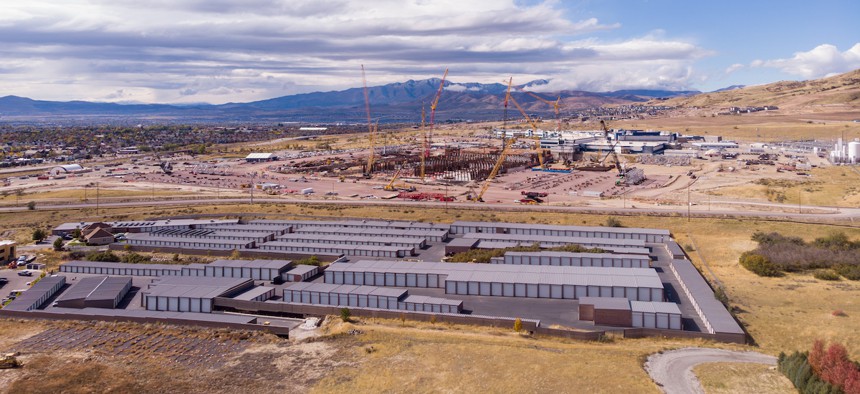
Utah protesters demanded independent reviews of the planned Stratos project in Box Elder County and a “genuine public comment period.”
This story was originally published by Utah News Dispatch.
Chants of “no data center!” echoed in the Utah Capitol Thursday as protesters carried a letter to the office of Gov. Spencer Cox demanding independent reviews of the planned 40,000-acre Stratos project in Box Elder County and a “genuine public comment period.”
A few hundred demonstrators rallied on the Capitol steps Thursday morning before delivering the petition signed by more than 7,000 to the governor’s office. With signs saying “Keep sharks out of the Great Salt Lake” and “You can’t drink data,” they sang, chanted and called for state officials to press pause on the fast-moving Stratos proposal.
The data center — set to become one the world’s largest if fully built — is backed by celebrity investor Kevin O’Leary of TV’s “Shark Tank,” known on the show as “Mr. Wonderful.” One big banner at the Capitol Thursday featured a picture of O’Leary’s face and the title, “Mr. Terrible.”
The pushback in Utah comes in a wave of wider opposition to new data centers, with communities in states from Virginia to Montana fighting the projects. Several states are considering limiting tax breaks for them. Some, including Washington and Minnesota, already have.
At the Utah rally on Thursday, speakers condemned the speed of government approval in Utah, saying it happened too fast for the scale of the operation and without enough time for the public to learn about it and weigh in.
On April 24, the appointed, seven-member board of Utah’s Military Installation Development Authority, or MIDA, gave its approval for the proposal. Ten days later, Box Elder County commissioners voted to keep it moving forward during a tense meeting where protesters shouted in opposition. The commission did not take public comment before voting on May 4.
“Utahns do not feel heard,” Jayden Weekes of Cache County said from a podium at the rally Thursday, balancing one of her young children on her hip. “We do not feel like wanting transparency is extremism. We do not feel like it is the ‘dumbest thing ever’ to slow down and ask questions about water infrastructure and long term.”
Weekes’ “dumbest thing ever” quip referenced comments Gov. Spencer Cox made about the data center at a news conference last month, saying “I’m so tired of our country taking years to get stuff done. It’s the dumbest thing ever. We think that taking time makes things better or safer, it absolutely does not.”
A week later, in response to the public outcry about the data center proposal, Cox softened his tone, saying his remarks that day “did not meet the expectations I have for myself. I seek to do better.” He laid out a plan for the data center’s completion in phases and said he’s directed the state’s Department of Natural Resources “to ensure that the most environmentally-sensitive cooling technology is used to ensure that our water and the Great Salt Lake are protected.”
Cox said the developers are committing to pursue other types of energy apart from natural gas that could include low- or no-emissions solutions, and he’s asked them to publish a water plan showing how they’ll avoid any degradation to the lake. Because of the project’s approval process under MIDA, an environmental impact study has not been conducted at this point.
Conservationists and protesters said they welcomed the update from Cox but want more assurance that the costs to the environment, the dwindling Great Salt Lake and neighboring communities will be studied by an outside reviewer long before the data center could come online.
Spokespeople for the governor’s office did not immediately respond Thursday to messages from Utah News Dispatch seeking comment. When demonstrators brought their letter to the office, the door remained closed for a few moments before Mike Mower, an adviser to Cox, stepped out and accepted the manila envelope.
Powered by its own natural gas plant, the project is expected to produce 9 gigawatts of energy, which is double the state’s consumption. Its backers say it would use a closed-loop cooling system, recirculating the same water instead of continually drawing more.
Opponents say the Great Salt Lake Basin doesn’t have an extra drop to give. At the rally, Rhonda Lauritzen said her family owns land on the north end of the lake adjacent to the area Stratos would draw water from. She noted Locomotive Springs, named more than a century ago for the sound of its once rushing water, is producing just a fraction of those flows because of drought and groundwater that’s been pumped for agriculture.
Now she’s working with the Box Elder Accountability Referendum, or BEAR, to put the data center’s fate in the hands of voters in the county. The group is waiting to see if their effort meets initial requirements for a referendum and plans to gather signatures in an effort to put the project on the ballot.
“Today, there is hope,” Lauritzen said.
Utah News Dispatch is part of States Newsroom, a nonprofit news network supported by grants and a coalition of donors as a 501c(3) public charity. Utah News Dispatch maintains editorial independence. Contact Editor McKenzie Romero for questions: info@utahnewsdispatch.com.