
School systems are remaking the old yellow bus into a high-tech machine
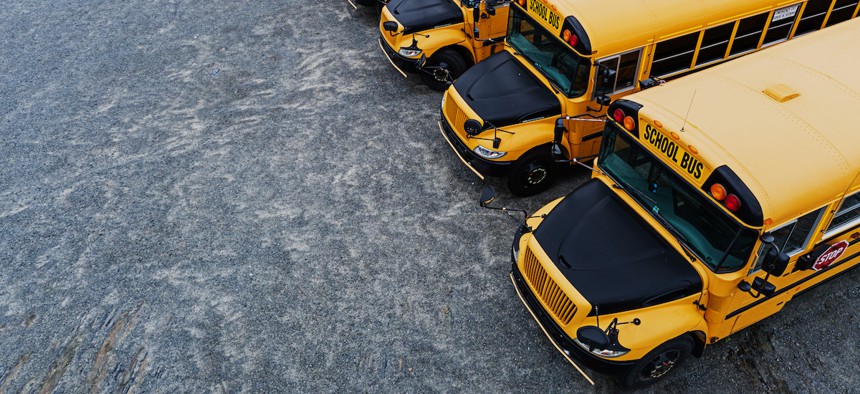
shaunl via Getty Images




Live cameras, GPS tracking and navigation have reshaped the school bus experience for students and drivers.
This story was originally published by Stateline.
KANSAS CITY, Mo. — A transplant from Miami, Anallive Calle learned her way around Kansas City from behind the wheel of a big yellow school bus.
The tablet near the dash provides turn-by-turn directions to every stop and checks each kid on and off the bus throughout her route. It’s helped her navigate the narrow roads and one-ways that stretch through one of the city’s oldest neighborhoods.
And from her phone, she can check on the status of her own son and whether he made the bus each morning and afternoon.
“So it’s transparent all the way,” she said. “You know when your child is picked up and where they’re at every moment.”
Last school year, Kansas City Public Schools started a new transportation contract with Zum, a company that provides busing services for districts across the country.
With the new vendor, drivers welcomed updates like air conditioning and tinted windows that keep the new fleet comfortable. But they also were given a suite of new technology — a main driver of the 15,000-student urban school district’s decision to ink a $100 million, 5-year contract with Zum.
Aside from navigation, the buses are loaded with live cameras inside and out. Checking in at the tablet allows parents to track their kids and schools to get a headcount on that day’s breakfast and lunch. From the bus barn’s dispatch office, a large screen shows the location of each bus, its exact speed, whether it’s running on time — and even the driver’s rating from parents.
Derrick Gines, a Zum driver and safety trainer with 10 years of experience, said the technology built into today’s buses make drivers and students safer.
“Versus yesteryear, they were designed for freight — human freight,” he said. “But now, there’s so much safety wrapped around this thing.”
While the iconic yellow buses might look like those of yore, school systems big and small are increasingly investing in a new wave of on-board technology.
New software programs monitor engine components, alerting transportation departments to maintenance needs. Other tools create the most optimal routes, saving on fuel, staff and bus costs. Turn-by-turn navigation and student manifests help ensure that no driver is lost and no kid is left behind. And live video feeds can help with student behavior issues — even allowing a school principal to speak to students on the bus in real time, in some cases.
This newfangled technology is a stark contrast to the machinery and aesthetics of the yellow bus, which have remained largely unchanged for decades, said Ryan Gray, editor-in-chief of School Transportation News, which covers the industry.
“Even when you walk onto a school bus, it still looks the same,” he said. “But the inner workings have just completely changed. All of the advanced electronics in it — the wiring to make all of this technology work, whether it be the hardware or the software — it’s grown by leaps and bounds.”
Schools see some of these technologies as intuitive progress: Technology has reshaped many other facets of public education, while many bus drivers were stuck with paper maps and CB radios. But with the rise of new technology comes new risks, and some advocates are cautious about the security of all the data flowing through yellow buses.
A booming market of vendors and limited regulations on bus tech has given more responsibility to school IT and transportation departments. But Gray said most school districts are embracing these new tools — if they can afford them.
“It always comes down to money,” he said. “I think that if they think they have the money, they’re going to want to buy this stuff.
School systems and tech companies say these tools can improve student safety, create efficiencies and help alleviate the chronic shortage of bus drivers.
“It’s a huge recruiting tool,” said Jason Salmons, transportation director for Bentonville Schools in northwest Arkansas.
Bentonville contracts with Transportant, a Kansas-based company, to equip its buses with new camera and tracking technology. Salmons said the navigation and student tracking provide peace of mind to drivers, who can easily traverse new neighborhoods. The seven live cameras on each bus also provide security if an incident arises.
About 13,000 of the district’s 20,000 students ride buses across 135 daily routes. In addition to an upfront cost, he said the school system pays a subscription of about $90,000 per year.
The software tracks not only every bus, but also every student’s boarding and disembarkment, even taking photos of the kids. If something happens, law enforcement can see where a child was and what they were wearing at dropoff — providing a “priceless” service, Salmons said.
With real-time tracking — much like a rideshare customer would see on their screen — parents and students view buses as more reliable, he said. With more precise pickup times, students don’t wait outside in the cold as long and older kids can even get a few more minutes of sleep, Salmons said.
“High schoolers use the app as their bible,” he said.
Data Privacy
Given the national driver shortage and parents’ focus on reliability, Cassie Creswell understands the appeal of the new bus technology. But she has concerns about the growing loads of data being collected.
“It’s a mixed bag on this stuff,” said Creswell, the co-chair of the national Parent Coalition for Student Privacy, which advocates to protect student data.
That group has pushed to keep cameras out of classrooms, but hasn’t taken a formal position on school buses, she said. Creswell, a parent of a Chicago Public Schools student, said the more data that is collected — such as GPS locations and video footage — the more opportunities for that data to be sold or illicitly breached.
“Are we actually clearing away stuff that you really shouldn’t hold on to forever?” she asked. “We’re so careless with student data — even very sensitive data — and we’re very careless about the long-term protection of that data.”
School systems interviewed by Stateline said their bus data is being securely stored separately from other student records and that data such as videos are routinely deleted.
Alan Fairless, a founder and chief technology officer of the tech provider Transportant, previously worked in building encrypted tech products.
He said the company doesn’t sell any student data and encrypts the memory of each device — so, someone stealing a tablet off a bus would have no access to its memory. The company was created in 2018 to tackle parent and school concerns about bus reliability and delays.
Fairless said he quickly learned many districts struggle with high driver turnover because of student behavior issues on board.
By providing multiple cameras that can be accessed live, he said, the company’s product provides a new layer of support to drivers.
“Now, when something happens, they push a button and a dispatcher or principal is going to watch that bus in real time,” he said.
Fairless said one school district has what it calls a seven-minute rule: When a driver alerts of an incident, a dispatcher aims to watch the video, figure out what happened and notify parents over text or phone call within seven minutes.
“The effect is, that video arrives to the parents, and now they know the real problem, and they know that before the student comes home and creates some other version of the story,” he said. “So now, it’s like the parents and the school district are working together to solve the problem.”
Since launching, the company has contracted with 88 school systems in 19 states to provide its all-inclusive tech suite that includes the app for families, on-board Wi-Fi, camera systems and routing services.
While prices can vary, school districts typically pay about $3,600 per bus up front and an annual subscription cost of about $69 per bus, said Jeff Shackelford, vice president of sales.
Changing Parent Demands
The addition of Transportant has helped keep parents informed in Oregon’s Estacada School District, which sprawls across 750 square miles southeast of Portland.
“It’s been great customer service for our families to just see, just like when someone orders an Uber, they can keep track of where their kid is at,” said Maggie Kelly, a spokesperson for the school system of about 2,000 students.
Kelly said the district expects to make up some of its initial investment in the technology as it realizes savings from more efficient bus routes.
Parents are demanding more real-time information on bus times and locations, said Rick D’Errico, a spokesperson for Transfinder, whose products build more efficient bus routes and provide tracking apps for parents.
“If I can track a burrito order, why can’t I track a bus?” D’Errico said. “Parents these days expect their districts to have ways to notify them on individualized ETAs and alerts for when their kid is on their routes, and not rely on schoolwide email blasts.”
Recently, school districts in Alaska, Texas and Wyoming have launched the company’s apps, which are free for parents.
Such services can provide savings by cutting back on the number of drivers and buses in operation. But they also relieve pressure on dispatchers, who can be besieged with parent phone calls during disruptions or delays.
Since rolling out a new bus tracking app this year, the St. Johns County School District in northeast Florida has fielded far fewer parent calls.
That app is just the latest addition to a portfolio of advanced onboard technology, said Jonah Paxton, transportation fleet technology foreman at the district, which serves about 27,000 bus riders.
The 52,000-student school system intentionally purchased separate products for bus cameras, parent tracking and driver navigation. Paxton said that allows the school system to avoid getting stuck with a single provider that could demand higher prices in the future.
“We’re not locked into a single sort of a walled-garden of products, which gives us a lot more freedom to pick and choose which products we like, which ones we don’t like, and gives us a little more negotiating power,” he said.
To ensure security, the school system stores video files on its own servers rather than those of outside vendors, he said. The district has a specific video retention policy and it blurs out student faces if videos are ever requested under the state’s public records law.
Paxton said student and driver safety drives many of the tech decisions for the school’s fleet of more than 300 buses.
“Buses are vastly different than they were even five,10 years ago,” he said. “I think many people who haven’t ridden a bus in a while can think of the bus as sort of an unpleasant place, or kind of the Wild West of schooling, but they’ve really come a long way.”
Stateline reporter Robbie Sequeira contributed to this story. Stateline reporter Kevin Hardy can be reached at khardy@stateline.org.
Stateline is part of States Newsroom, a nonprofit news network supported by grants and a coalition of donors as a 501c(3) public charity. Stateline maintains editorial independence. Contact Editor Scott S. Greenberger for questions: info@stateline.org.