
NJ bill targets social media companies promoting diet products to children
Chris McGrath via Getty Images





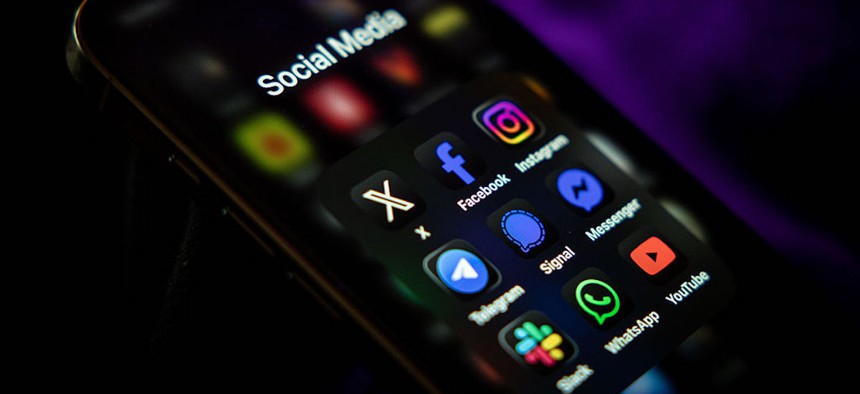
A bill sponsor said social media companies must have safeguards in place to protect young users from content that promotes eating disorders.
This story was originally published by the New Jersey Monitor.
A bill set for final approval by the Legislature on Monday would bar social media companies from promoting certain content that could cause children to develop eating disorders, including diet product ads.
Bill sponsor Assemblywoman Andrea Katz (D-Burlington), a mom of three teenagers, said she has witnessed the impact social media has had on body-image issues.
“We have to have those safeguards in place, especially for our kids. Our social media companies make a whole lot of money off of all of our information, and so it seems to me the least they can do is protect our kids,” she said.
Social media companies that violate the bill would face penalties of up to $250,000 per violation. The bill would require companies to audit themselves regularly or hire third parties to review their algorithms, designs, and features to ensure none contribute to young users developing an eating disorder. Companies wouldn’t be held accountable for photos and content uploaded by users who aren’t paid or promoted by the platform.
Darian Eletto is the chief clinical officer of behavioral health at Bergen New Bridge Medical Center in Paramus. Eletto agreed that social media platforms need restrictions to avoid exploiting children and furthering disordered eating, negative body image, or unhealthy eating behaviors.
Young people don’t always know how to differentiate between healthy and unhealthy content online, Eletto said.
“We’re seeing that shift towards that thin, thin body image being very in vogue again, which is very harmful for many of our kids and our teenagers,” she said. “We see that teenagers and adolescents are learning about these behaviors online, and no one is really talking about, ‘Hey, this is not a healthy relationship with food. This is not realistic.’”
A study from the National Institute of Health found that the constant use of social media platforms can promote addictive behavior, including disordered eating patterns. Other research has found that social media users typically report a higher dissatisfaction with their appearance.
A Harvard study found that roughly 9% of New Jerseyans, or more than 784,000 people, will have an eating disorder in their lifetime, and found that women are twice as likely to struggle with an eating disorder.
The state Senate is scheduled to vote on the bill Monday. The legislation passed out of the Assembly in December 46-24, largely along party lines.
The Senate will also consider a measure that would require the state Department of Health to study disordered eating.
“Kids today are not just exposed to unhealthy and often unrealistic body standards, they’re immersed in them nearly every day,” said bill sponsor Sen. Kristin Corrado (R-Passaic). “As students form their sense of self, constant comparisons to unrealistic expectations quietly distort how many see their own bodies, laying the groundwork for unhealthy habits.”
New Jersey Monitor is part of States Newsroom, a nonprofit news network supported by grants and a coalition of donors as a 501c(3) public charity. New Jersey Monitor maintains editorial independence. Contact Editor Terrence T. McDonald for questions: info@newjerseymonitor.com.